Why making employees faster doesn’t necessarily make the business faster—and how enterprise AI workflow redesign turns individual productivity into measurable business outcomes.
Organizations are investing billions of dollars in artificial intelligence.
Employees are using AI assistants to write documents, analyze information, generate software, prepare presentations, summarize meetings, and automate routine tasks.
Productivity is improving.
Yet many organizations are struggling to demonstrate corresponding improvements in profitability, operating efficiency, customer experience, or enterprise performance.
How can employees become substantially more productive without the organization becoming substantially more productive?
The answer is not necessarily a failure of artificial intelligence.
It may be a failure to redesign the business processes in which that intelligence operates.
Recent research from McKinsey reinforces this distinction.
In its October 2026 analysis of AI and organizational transformation, McKinsey reported that 80% of respondents in its State of AI survey experienced individual productivity improvements.
However, only 37% reported a positive impact on earnings before interest and taxes (EBIT), and just 6% qualified as AI high performers.
These figures represent different measures of organizational performance, not a controlled calculation of AI’s financial return. Nevertheless, the contrast illustrates a significant challenge.
Individual productivity is not the same as enterprise productivity. And enterprise productivity is not automatically enterprise value.
To realize AI’s economic potential, organizations must move beyond giving employees better tools.
They must redesign how work gets done.
The AI Productivity Paradox
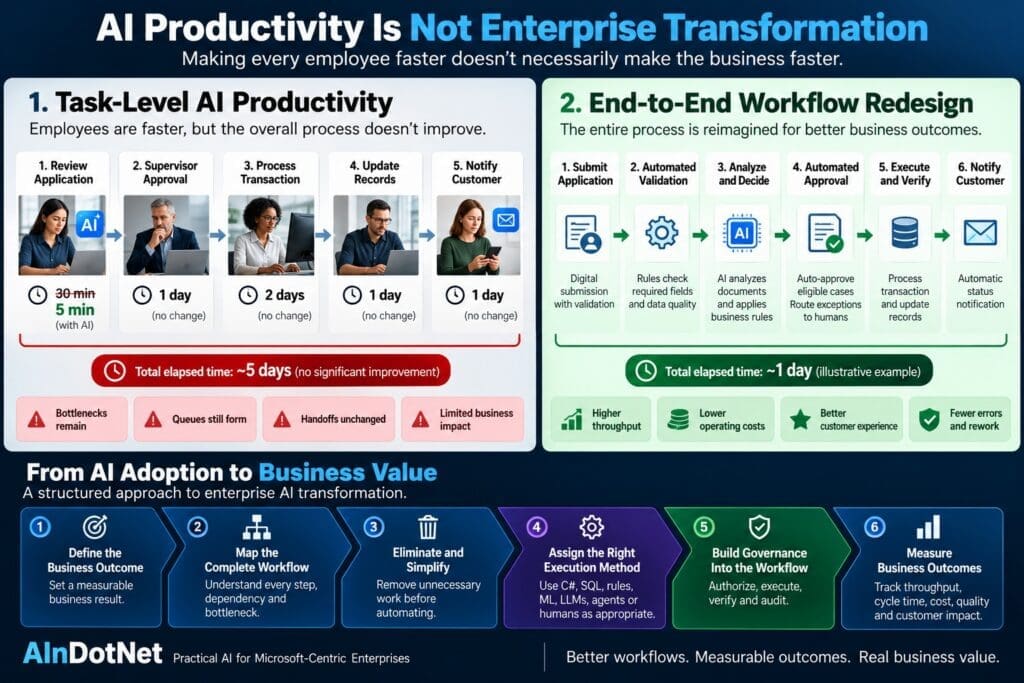
Consider a familiar business process.
A customer submits an application.
An employee reviews the application and prepares a recommendation.
A supervisor approves the recommendation.
Another department processes the transaction.
A third department updates the records.
Finally, someone notifies the customer.
Now imagine introducing an AI assistant that reduces the initial review from 30 minutes to five minutes.
That is an impressive productivity improvement.
The employee can theoretically process six times as many applications during the same period.
But what happens to the rest of the workflow?
The supervisor still approves applications once per day.
The processing department still works from a queue.
The records team still performs manual updates.
The customer still waits for the final notification.
The initial employee is substantially more productive.
The business process may not be meaningfully faster.
In fact, the organization may simply accumulate a larger backlog at the next stage.
This is the fundamental difference between task optimization and workflow optimization.
AI can dramatically accelerate individual tasks without improving the throughput of the complete business process.
The constraint simply moves somewhere else.
For enterprise leaders, that distinction matters more than how many employees are using AI.
A Business Process Is a System, Not a Collection of Independent Tasks
Traditional business process engineering has recognized this problem for decades.
A business process consists of interconnected activities, dependencies, queues, decisions, resources, and constraints.
Improving one component does not guarantee an improvement in the overall system.
Consider a simplified workflow:
| Process stage | Before AI | After task-level AI |
|---|---|---|
| Application review | 30 minutes | 5 minutes |
| Supervisor approval | 1 day | 1 day |
| Transaction processing | 2 days | 2 days |
| Record updates | 1 day | 1 day |
| Customer notification | 1 day | 1 day |
The application review becomes six times faster.
Yet the end-to-end process still takes approximately five days, assuming these are sequential stages and the durations represent typical elapsed times.
The organization may report a significant improvement in employee productivity while customers experience almost no difference.
The economic benefits depend on what happens to the capacity that AI releases.
Can the organization process more applications?
Can it reduce operating costs?
Can it improve service quality?
Can it eliminate unnecessary work?
Can it increase revenue?
Or has it simply made one step faster while leaving the rest of the process unchanged?
A faster task is valuable only to the extent that it contributes to a valuable outcome.
This is why enterprise AI initiatives should begin with the business process—not the AI tool.
Why AI Adoption Metrics Can Be Misleading
Many organizations measure AI success through adoption metrics.
Examples include:
- Number of AI licenses assigned.
- Percentage of employees using AI.
- Number of prompts submitted.
- Number of AI agents deployed.
- Documents generated.
- Lines of code written.
- Hours reportedly saved.
These metrics can help organizations understand adoption and usage.
They do not independently establish business value.
An employee may save five hours per week using AI.
But what happens to those five hours?
If the employee uses that capacity to perform additional valuable work, the organization may benefit.
If the saved time eliminates a business bottleneck, the organization may benefit substantially.
If the employee simply produces more material that someone else must review, the net benefit may be small—or even negative.
The same problem applies to AI coding assistants.
Generating more code is not necessarily equivalent to delivering more software.
The resulting code must still be reviewed, tested, integrated, deployed, maintained, and supported.
If AI increases code generation while also increasing review effort, rework, or defects, the economic benefit may be much smaller than the activity metrics suggest.
This distinction is particularly relevant because GitHub disclosed in October 2026 that some Copilot agent-usage metrics had been undercounted or incorrectly attributed due to changes in IDE and SDK instrumentation.
The disclosure illustrates a separate but related problem: even the activity metrics themselves can have measurement limitations.
Enterprises should validate telemetry before relying on vendor dashboards for adoption or ROI decisions.
More importantly, they should connect activity measurements to accepted business outcomes.
The objective is not to maximize AI usage. The objective is to improve business performance.
The Missing Step: Redesign the Entire Workflow
McKinsey’s October 2026 analysis argues that organizations achieving greater AI value are more likely to organize work around complete products, customer journeys, and business processes.
The research also highlights a readiness gap.
While 70% of respondents considered themselves personally ready for AI, only 27% of leaders considered their organizations ready for agentic change.
These findings are based substantially on survey responses and should not be interpreted as proof that any single operating model causes superior financial performance.
Nevertheless, they support an important architectural principle.
AI transformation requires organizational and process redesign—not simply technology deployment.
At AInDotNet, we believe enterprise AI initiatives should follow a structured sequence:
Business Outcome → Workflow Analysis → Eliminate and Simplify → Execution Allocation → Governance → Measurement
The sequence matters.
Starting with an AI agent often leads organizations to automate whatever process already exists.
Starting with the business outcome creates an opportunity to question whether that process should exist in its current form.
Step 1: Define the Business Outcome
Before selecting a model, agent framework, or automation platform, identify the business result the organization wants to improve.
For example:
- Reduce customer onboarding from five days to one day.
- Reduce invoice-processing cost by 40%.
- Improve first-contact customer service resolution.
- Reduce insurance claim-processing delays.
- Improve manufacturing quality while reducing inspection costs.
- Reduce software delivery cycle time without increasing defects.
These are measurable business objectives.
They provide a basis for evaluating whether an AI initiative is successful.
Contrast this with a technology-centered objective:
“Deploy 500 AI agents across the organization.”
That may be an implementation milestone.
It is not a business outcome.
A successful enterprise AI initiative should be evaluated by the value it produces, not the number of AI components it deploys.
Step 2: Map the Complete Workflow
Once the business objective is established, map the existing end-to-end process.
Identify:
- Every activity performed.
- The people and systems involved.
- Inputs and outputs.
- Decision points.
- Approvals and handoffs.
- Waiting periods and queues.
- Rework and exception paths.
- Regulatory and security requirements.
- Dependencies on external organizations.
The goal is to understand the complete system.
For each step, distinguish between processing time and elapsed time.
An activity may require only ten minutes of actual work but remain in a queue for two days.
Automating the ten-minute activity will not eliminate the two-day delay.
This distinction is frequently overlooked in technology-led automation projects.
It is also important to identify the actual constraint limiting system throughput.
Improving a non-constrained activity may release local capacity without increasing the output of the overall process.
That is not necessarily worthless, but it should not be confused with end-to-end transformation.
Step 3: Eliminate and Simplify Before Automating
This is arguably the most overlooked step in enterprise AI implementation.
Organizations often assume existing workflows are fundamentally correct.
They then use technology to perform the same activities faster.
But many business processes contain unnecessary steps that accumulated over years of organizational change.
For example:
- Duplicate data entry.
- Redundant approvals.
- Reports nobody uses.
- Manual reconciliation between systems.
- Repeated document formatting.
- Unnecessary transfers between departments.
- Legacy validation procedures.
- Multiple applications maintaining the same information.
Before automating these activities, ask a more fundamental question:
Why are we doing this at all?
Some steps can be eliminated.
Others can be consolidated.
Still others can be redesigned so that the underlying problem no longer occurs.
Consider an employee who manually copies information from one application into another.
An AI agent could perform that activity.
But if the applications can exchange structured data through an API, why introduce an AI agent?
A conventional integration may be faster, cheaper, more reliable, and easier to audit.
Automating unnecessary work does not transform a business process.
It makes unnecessary work happen faster.
Step 4: Assign Each Activity to the Appropriate Execution Method
One of the most important decisions in enterprise AI architecture is determining which technology should perform each activity.
Not every problem requires a large language model.
Not every workflow requires an autonomous agent.
Many enterprise activities are better handled by conventional software.
At AInDotNet, we advocate an execution architecture that considers multiple approaches:
C# / SQL → Business Rules → Algorithms and Statistics → Specialized ML → Small Language Models → Frontier Models → Autonomous Agents → Human Judgment
This is a decision hierarchy, not a mandatory runtime pipeline. The appropriate technology depends on the characteristics of each task.
For example:
| Business activity | Potential execution approach |
|---|---|
| Validate required fields | C# business rules |
| Retrieve customer records | SQL Server |
| Calculate an insurance premium | Deterministic algorithms |
| Predict equipment failure | ML.NET or specialized ML |
| Classify incoming support tickets | Specialized ML or a small language model |
| Summarize complex documents | Language model |
| Interpret ambiguous customer correspondence | Language model with validation |
| Coordinate an unfamiliar multistep investigation | Bounded AI agent |
| Approve a high-value financial transaction | Authorized human or policy-controlled decision service |
The purpose is not to minimize AI usage arbitrarily.
It is to use the most appropriate execution method for each requirement.
A SQL query should not become an agent merely because agents are fashionable.
A deterministic calculation should not become a probabilistic language-model operation without a compelling reason.
And an autonomous agent should not receive broad execution privileges simply because it can reason through a workflow.
The goal is not AI everywhere. The goal is the right intelligence and automation at the right point in the process.
This approach can improve reliability, reduce operating costs, simplify governance, and preserve existing enterprise investments.
Step 5: Redesign the Future-State Workflow
After eliminating unnecessary work and selecting appropriate execution methods, design the new end-to-end process.
Return to the customer application example.
The original workflow required multiple manual reviews, approvals, processing steps, and notifications.
A redesigned workflow might operate differently.
- The customer submits an application through a digital interface.
- Deterministic rules validate required fields and formats.
- Existing enterprise services retrieve relevant customer information.
- Specialized models analyze supporting documents when necessary.
- Business rules automatically approve cases meeting established criteria.
- Complex or exceptional cases are routed to authorized employees.
- Approved transactions execute through existing application services.
- The system verifies completion and updates records.
- The customer receives an automated status notification.
Notice that this workflow does not require an autonomous AI agent to control every activity.
Some steps use conventional application logic.
Others use specialized AI capabilities.
Human judgment remains where it provides value or is required by policy.
The result is not merely a faster version of the original process.
It is a different process.
That is the distinction between task-level automation and enterprise transformation.
Step 6: Build Governance Into the Workflow
Workflow redesign must preserve enterprise accountability.
AI-generated recommendations should not automatically become authorized business actions.
For consequential operations, the architecture should distinguish between:
Observe → Analyze → Recommend → Authorize → Execute → Verify → Audit
AI models may assist with observation, analysis, and recommendations.
But authorization should be independently enforced.
Execution should occur through controlled business capabilities.
Results should be verified against authoritative systems.
Actions should be auditable.
For Microsoft-centric organizations, this can be implemented using familiar technologies:
- Microsoft Entra ID for identity.
- ASP.NET Core for application services and authorization.
- SQL Server for transactional business data.
- Azure Service Bus for asynchronous workflows.
- ML.NET for specialized predictive models.
- Azure AI Foundry or other model providers for AI reasoning.
- OpenTelemetry and Azure Monitor for observability.
- Existing enterprise applications for controlled business execution.
These technologies do not automatically provide complete governance. The necessary security boundaries, policies, approvals, and verification mechanisms must be explicitly designed.
The important principle is that the organization’s business rules and security controls remain authoritative.
AI assists the workflow.
It does not automatically acquire ownership of the workflow.
Step 7: Measure Business Outcomes, Not Just AI Activity
Once the redesigned workflow is operational, measure whether it actually improves business performance.
A useful evaluation framework includes several categories.
| Measurement category | Example metrics |
|---|---|
| Throughput | Applications completed per day |
| Cycle time | Submission-to-completion elapsed time |
| Cost | Cost per accepted transaction |
| Quality | Error rate, rework, defect rate |
| Customer experience | Resolution time, satisfaction |
| Human effort | Labor minutes per completed case |
| Risk | Unauthorized actions, policy violations |
| AI economics | Model and infrastructure cost per accepted outcome |
These measures should be established before implementation so the organization has a meaningful baseline.
Where practical, compare the redesigned process with an appropriate control group or phased rollout.
Account for changes in workload, staffing, demand, and process complexity.
Otherwise, organizations may incorrectly attribute improvements—or deterioration—to AI.
One particularly important metric is:
Cost per Accepted Business Outcome
An AI workflow may use fewer employee hours but consume more infrastructure resources.
It may generate more outputs but require additional review.
It may process more transactions while introducing higher error rates.
Measuring the cost of a successfully completed, accepted business outcome helps expose these tradeoffs.
The financial analysis should also account for implementation costs, ongoing maintenance, licensing, governance, and organizational change.
A Hypothetical Example: Transforming Invoice Processing
Consider a company processing 100,000 invoices annually.
Its existing process requires an average of 20 minutes of manual effort per invoice.
That represents approximately 33,333 labor hours annually.
At an illustrative fully burdened labor cost of $50 per hour, the manual effort costs approximately $1.67 million annually.
Now consider two approaches.
Approach A: Improve Individual Productivity
The organization gives employees AI assistants that reduce invoice review effort by 50%.
Average manual effort falls from 20 minutes to ten minutes.
The theoretical labor-capacity benefit is approximately $833,000 annually.
However, that amount is not automatically a realized financial saving.
The organization must determine whether released capacity can be redeployed, staffing costs can be reduced, or additional business volume can be processed without additional labor.
Approval queues, payment scheduling, exception handling, and reconciliation may remain unchanged.
Approach B: Redesign the Complete Workflow
Instead, the organization redesigns invoice processing.
It introduces:
- Automated structured-data extraction.
- Deterministic invoice validation.
- Purchase-order matching.
- Duplicate detection.
- Policy-based approval for qualifying invoices.
- Exception routing for unusual cases.
- Automated posting to the financial system.
- Independent transaction verification.
Suppose this reduces average manual effort from 20 minutes to four minutes per invoice.
That represents approximately 26,667 hours of annual labor capacity released.
At the same illustrative labor rate, the theoretical labor-capacity benefit is approximately $1.33 million annually.
The redesigned workflow may also reduce cycle time, improve accuracy, and allow employees to concentrate on exceptions.
Those additional benefits must be measured rather than assumed.
The example is hypothetical, and the calculation excludes implementation costs, ongoing operating expenses, and any quality-related financial effects.
Its purpose is to illustrate a structural difference.
Task automation makes an existing activity faster. Workflow redesign changes how much work is necessary in the first place.
Why This Matters for Microsoft-Centric Enterprises
Many medium-to-large organizations have spent decades building business applications around Microsoft technologies.
Their environments may include:
- Custom C# and .NET applications.
- SQL Server databases.
- Microsoft 365 and SharePoint.
- Dynamics 365.
- Azure services.
- Power Platform applications.
- Existing workflow and integration systems.
These investments contain established business logic, security policies, transaction processing, and operational knowledge.
An enterprise AI strategy should not assume that these systems must be replaced.
In many cases, the greatest opportunity is to connect existing capabilities into redesigned workflows.
For example, a custom .NET application may already contain reliable business rules for eligibility, pricing, approvals, or financial transactions.
Those capabilities can be exposed through controlled application services.
AI can then assist with unstructured information, ambiguous requests, document interpretation, or complex analysis.
The deterministic application services remain responsible for authorized execution.
This approach preserves valuable enterprise investments while introducing AI where it creates measurable benefits.
It also avoids unnecessary dependence on any single model or agent platform.
Models will evolve.
Enterprise workflows, business rules, security requirements, and systems of record will continue to require careful engineering.
AI Transformation Is an Operating-Model Problem
Technology is only one component of enterprise transformation.
Organizations must also address:
- Who owns the end-to-end process?
- Who has authority to redesign it?
- How are responsibilities divided between employees and automation?
- What happens when AI produces an incorrect recommendation?
- Who manages exceptions?
- How are downstream departments affected?
- How are financial benefits measured?
- Who is accountable for the final business outcome?
These questions cannot be answered by selecting a better language model.
They require business leadership, process ownership, enterprise architecture, and organizational change.
This is consistent with McKinsey’s emphasis on cross-functional teams organized around business outcomes rather than isolated departmental activities.
An organization can deploy hundreds of AI agents without changing how it operates.
Conversely, it can achieve meaningful transformation with a relatively small number of well-designed AI capabilities integrated into redesigned business processes.
The number of agents is not the measure of transformation.
The improvement in business performance is.
Conclusion: Stop Counting AI Agents. Start Measuring Business Outcomes.
Artificial intelligence is making individual employees more capable.
That is valuable.
But the economic opportunity is much larger than helping employees perform existing tasks faster.
The real opportunity is to reconsider how enterprises operate.
Which activities should disappear?
Which decisions can be automated?
Which processes should be simplified?
Which tasks require human judgment?
Which operations belong in deterministic software?
Where can AI provide capabilities that were previously impractical?
And how should all of these components work together to produce a measurable business result?
These are enterprise architecture and business transformation questions.
They cannot be solved through AI adoption alone.
The organizations that benefit most from AI will not necessarily be those that deploy the most agents or purchase the most AI licenses.
They will be those that redesign complete workflows, eliminate unnecessary work, apply the appropriate technology to each activity, and measure the resulting business outcomes.
Because making every employee faster does not necessarily make the business faster.
Enterprise transformation begins when we stop optimizing isolated tasks and start redesigning the system.
About AInDotNet
AInDotNet helps Microsoft-centric enterprises move beyond AI experimentation toward practical, measurable business transformation.
We specialize in enterprise AI architecture, workflow redesign, custom .NET development, AI integration, and implementation using Microsoft technologies.
Our approach begins with business outcomes, evaluates existing enterprise capabilities, and introduces AI where it delivers measurable value—without unnecessary technology replacement or architectural complexity.
Explore our services:
- Enterprise AI Opportunity Assessment
- Enterprise AI Consulting & Advisory
- Enterprise AI Development & Implementation
Better AI adoption is useful. Better business performance is the objective.
References and Further Reading
- McKinsey — AI Is Changing Work. Now It Has to Change the Organization, October 5, 2026.
- GitHub — Update Your IDE to Restore Agent Activity in Copilot Usage Metrics, October 6, 2026.
The numerical invoice-processing example is illustrative and does not represent an actual client implementation.
Frequently Asked Questions
What is AI workflow redesign?
AI workflow redesign is the process of reengineering an end-to-end business workflow to improve measurable outcomes using an appropriate combination of conventional software, business rules, machine learning, language models, autonomous agents, and human judgment. It goes beyond automating existing tasks by questioning which activities are necessary and how the overall process should operate.
Why doesn’t AI productivity automatically improve business performance?
Improving individual tasks does not necessarily eliminate bottlenecks, approvals, queues, or dependencies elsewhere in a workflow. Employees may complete work faster while the overall process experiences little improvement. Business value depends on how productivity gains affect throughput, cost, quality, revenue, and customer outcomes.
What is the difference between AI automation and AI transformation?
AI automation uses technology to perform specific tasks with less human effort. AI transformation redesigns business processes, responsibilities, decision-making, and operating models to produce better organizational outcomes. Automation can contribute to transformation, but deploying automation alone does not guarantee it.
Should every enterprise business process use AI agents?
No. Many business activities are better handled by deterministic software, SQL queries, business rules, algorithms, or specialized machine learning. Autonomous agents are most useful when tasks require flexible reasoning, dynamic planning, or coordination across uncertain multistep activities. The execution method should be selected based on the task’s requirements.
How should enterprises measure AI ROI?
Enterprises should measure business outcomes such as cost per accepted transaction, process cycle time, throughput, error rates, customer satisfaction, and realized financial benefits. AI license adoption, prompt volume, and estimated hours saved are useful supporting metrics but do not independently establish return on investment.
Can existing .NET and SQL Server applications support enterprise AI transformation?
Yes. Existing .NET and SQL Server applications can provide business rules, transactional processing, data access, authorization, and integration capabilities. AI models and agents can be incorporated where they add value, while existing enterprise systems retain responsibility for controlled business execution.
What is the first step in an enterprise AI transformation initiative?
Start by identifying a measurable business outcome and mapping the complete workflow responsible for producing it. Analyze processing time, waiting time, bottlenecks, unnecessary activities, decision points, and exceptions before selecting AI technologies or automation tools.
