Enterprise AI Books for Business and Technical Teams
Practical guidance for applying AI inside medium and large organizations using the team, systems, and Microsoft technology stack you already have.
AI is no longer just a research topic or executive buzzword. Organizations are now trying to answer harder questions:
- Which AI projects should we build first?
- How do we move from prototypes to production systems?
- How should business leaders, project managers, architects, developers, analysts, and IT teams work together?
- How do we apply AI without rebuilding the entire organization around hype?
The AI n Dot Net book series is written for professionals who need practical answers. These books focus on applied enterprise AI, Microsoft technologies, AI architecture, AI project selection, intelligent document processing, AI assistants, LLM usage, and production-oriented implementation patterns.
These books are not sold directly on this website. Each book page includes the current availability, including Amazon links where applicable.
Learn in the Format That Works Best for You
Enterprise AI is a large subject. Some professionals want a quick article. Others prefer a short video, deeper whitepaper, shareable infographic, or complete book they can read, highlight, and return to later.
AI n Dot Net presents enterprise AI content in multiple formats so readers can choose the format that fits the moment:
- Articles for focused explanations of one idea
- Whitepapers for deeper business and technical analysis
- Infographics for visual summaries and team discussion
- Short videos for quick concepts and practical reminders
- Long-form videos for deeper walkthroughs
- Ebooks for reading on Kindle, tablets, phones, and ebook readers
- Paperbacks and hardcovers for readers who prefer physical books
- Audiobooks, where available, for listening while commuting, traveling, exercising, or working on hobbies
The goal is not to force every reader into one format. The goal is to make practical enterprise AI knowledge easier to access, revisit, and share across business and technical teams.
Start Here
If you are new to enterprise AI, start with the introductory books. They are designed to help business and technical teams build a shared vocabulary, ask better questions, and identify realistic AI opportunities.
If you are already working on AI strategy, architecture, or implementation, move into the architecture and core application books.
Available Books
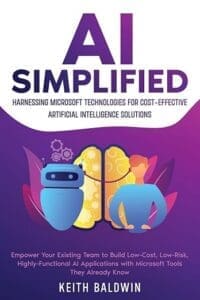
AI Simplified
Harnessing Microsoft Technologies for Cost-Effective Artificial Intelligence Without AI Specialists
Status: Available Now
Important: This book has been retitled. The updated edition is Enterprise AI Strategy and Implementation (see below).
Formats: eBook, Paperback, Hardcover, Audiobook
AI Simplified introduces a practical way for medium and large organizations to begin applying AI without assuming they already have a large team of AI specialists.
The book focuses on how organizations can start identifying useful AI opportunities, build internal alignment, and think about AI projects through the lens of business value, implementation risk, and available technology.
This book is especially useful for executives, business leaders, project managers, technical managers, and software teams who need a realistic starting point for enterprise AI.
This book is a good fit for readers who want to understand:
- How organizations should begin thinking about AI projects
- Why AI adoption is a business and engineering problem, not just a model-selection problem
- How Microsoft-oriented organizations can approach AI without abandoning their existing stack
- How to start building an internal AI innovation team
- How to think about AI opportunities before spending heavily on implementation
More Information:
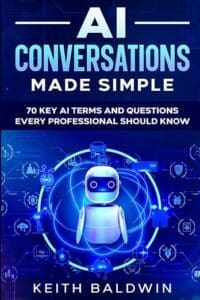
AI Conversations Made Simple
70 Key AI Terms and Questions Every Professional Should Know
Status: Available Now
Formats: eBook, Paperback, Hardcover, Audiobook
Once an organization starts discussing AI, a different problem appears: people are invited into AI strategy meetings, planning sessions, vendor calls, and innovation discussions — but they do not always know what to ask.
AI Conversations Made Simple is designed to solve that problem.
This book gives professionals a structured way to participate in AI conversations by focusing on practical questions. The goal is not to turn every reader into an AI engineer. The goal is to help professionals ask sharper questions, identify weak assumptions, and contribute meaningfully to AI planning and implementation discussions.
This book is useful for executives, project managers, analysts, department leaders, developers, architects, operations teams, and anyone who is now expected to participate in AI-related decisions.
This book is a good fit for readers who want to understand:
- What questions to ask in AI meetings
- How to evaluate AI ideas before they become expensive projects
- How to participate in technical conversations without pretending to be a data scientist
- How to challenge vague AI claims professionally
- How to improve communication between business and technical teams
More Information:
Enterprise AI Strategy and Implementation
A Practical Roadmap for Building AI Applications with the Team and Technology You Already Have
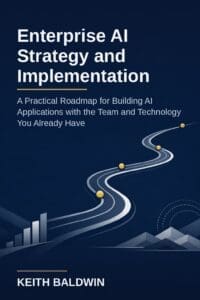
Important: This is the retitled edition of AI Simplified.
Status: Available Now
Formats: eBook, Paperback, Hardcover, Audiobook
Enterprise AI Strategy and Implementation is the retitled and updated version of AI Simplified.
This book provides a practical roadmap for organizations that want to move beyond AI curiosity and begin selecting, planning, and implementing realistic AI projects.
The central idea is simple: most organizations do not need to start by hiring an army of AI specialists. They need a disciplined method for identifying AI opportunities, ranking them, prototyping carefully, and building production systems around existing business knowledge, existing data, existing applications, and existing technical teams.
This book is intended for organizations that want to apply AI without losing control of architecture, cost, security, governance, and business value.
This book is a good fit for readers who want to understand:
- How to build an enterprise AI roadmap
- How to select the right AI projects
- How to use existing teams and Microsoft technologies
- How to avoid random AI experimentation
- How to move from AI idea to prototype to production system
More Information:
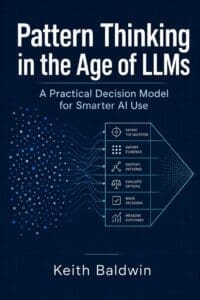
Pattern Thinking in the Age of LLMs
A Practical Decision Model for Smarter AI Use
Status: Coming Soon / At Publisher
Formats: eBook
Large language models are powerful, but weak usage produces weak results. Asking vague questions usually leads to generic output. Better results come from better thinking before the prompt is written.
Pattern Thinking in the Age of LLMs explains how to use patterns, frameworks, constraints, cycles, and decision models to get more useful results from LLMs.
The book is not about prompt tricks. It is about improving human judgment when using AI. The LLM can generate, summarize, compare, draft, and explore. The human still defines values, evaluates risk, owns tradeoffs, and approves action.
This book is especially useful for professionals who use AI tools for strategy, writing, analysis, planning, architecture, product thinking, management, or decision support.
This book is a good fit for readers who want to understand:
- Why vague prompts produce weak AI output
- How pattern-first thinking improves LLM results
- How to use AI as a thinking partner without outsourcing judgment
- How to structure context, constraints, frameworks, and validation
- How professionals can make better decisions with AI assistance
More Information:
- View Book Page
- Amazon link coming soon
In Development
The following books are in development. Much of the underlying content already exists as whitepapers, articles, videos, infographics, and framework pages. These books will package that material into more complete and organized formats.
Enterprise AI Engineering Methodology
A Practical Methodology for Designing and Delivering Enterprise AI Systems
Status: In Development
Enterprise AI Engineering Methodology, or EAEM, is a structured approach for moving enterprise AI from isolated experiments into engineered business systems.
This book will explain how organizations can think about AI delivery across strategy, architecture, capabilities, workflows, governance, and implementation.
EAEM is intended for leaders and technical teams who need more than prompt examples. It is for organizations that need a repeatable methodology for designing, building, evaluating, and improving AI-enabled systems.
This book is a good fit for readers who want to understand:
- How to organize enterprise AI work
- How to connect AI strategy to implementation
- How to structure AI capabilities
- How to avoid disconnected AI experiments
- How to think about AI as an engineering discipline
More Information:
How AI Changes Enterprise Application Architecture in .NET
Status: In Development
AI does not simply add another feature to enterprise applications. It changes how applications are designed, integrated, governed, tested, monitored, and maintained.
This book will focus on how AI changes enterprise application architecture, especially in organizations that build and maintain .NET applications.
Topics will include AI-enabled workflows, LLM integration, RAG, APIs, security boundaries, observability, validation, human approval, data access, and production reliability.
This book is a good fit for readers who want to understand:
- How AI changes application architecture
- Where LLMs fit inside enterprise systems
- How .NET teams should think about AI integration
- Why prompts are not architecture
- How to design AI features that can survive production use
More Information:
Intelligent Document Processing
One of the Core Enterprise AI Application Patterns
Status: In Development
Many organizations are still buried under documents: PDFs, forms, scanned files, contracts, claims, reports, emails, invoices, applications, case files, and supporting records.
Intelligent Document Processing, or IDP, is one of the most practical AI application categories for medium and large organizations. It can help extract, classify, validate, route, summarize, and operationalize information that is currently trapped in documents.
This book will explain IDP from a practical enterprise implementation perspective, including business use cases, architecture, data flow, human review, validation, exception handling, and integration with existing systems.
This book is a good fit for readers who want to understand:
- What Intelligent Document Processing is
- Which document-heavy processes are good AI candidates
- How IDP fits into enterprise workflows
- Why extraction alone is not enough
- How to think about validation, auditability, and downstream integration
More Information:
AI Assistants and Chatbots
Capability-First Architecture for Enterprise AI Assistants
Status: In Development
AI assistants and chatbots are often treated as simple conversational interfaces. In enterprise environments, that is not enough.
A useful AI assistant needs capabilities, boundaries, context, tools, workflows, permissions, validation, logging, and escalation paths. The conversation is only the visible layer. The real system is the architecture underneath it.
This book will focus on capability-first architecture for enterprise AI assistants, especially for organizations that want assistants connected to real business processes, systems, documents, and data.
This book is a good fit for readers who want to understand:
- Why chatbots fail when they are treated as prompt-only systems
- How to define assistant capabilities
- How to connect assistants to workflows and enterprise systems
- How to design assistant boundaries, validation, and escalation
- How to move from prototype assistant to production assistant
More Information:
Enterprise AI Operating Model
How to Select, Prioritize, and Govern AI Projects
Status: In Development
Most organizations do not have a shortage of AI ideas. They have a shortage of disciplined selection.
The Enterprise AI Operating Model book will explain how organizations can evaluate AI opportunities, compare candidate projects, prioritize investments, and manage AI work across business and technical teams.
The goal is to help organizations avoid random AI experimentation and build a practical operating model for AI adoption.
Enterprise AI Strategy and Implementation starts the AI conversation by explaining how organizations can begin applying AI. Enterprise AI Operating Model goes deeper into how organizations select, prioritize, and govern AI projects.
This book is a good fit for readers who want to understand:
- How to select AI projects
- How to compare business value, technical difficulty, risk, and readiness
- How to manage an AI opportunity pipeline
- How to align executives, business units, and technical teams
- How to move from AI enthusiasm to AI portfolio management
More Information:
Enterprise AI Architecture
A Practical Architecture Model for Enterprise AI Systems
Status: In Development
Enterprise AI Architecture, or EAA, provides a structured way to think about AI systems inside real organizations.
AI systems are not just models. They involve data, applications, workflows, user interfaces, APIs, security, observability, governance, deployment, evaluation, and ongoing operations.
This book will package the Enterprise AI Architecture framework into a practical guide for leaders, architects, developers, and implementation teams.
This book is a good fit for readers who want to understand:
- What architecture is required for enterprise AI
- Why AI systems need more than prompts and model calls
- How to think about AI capabilities, workflows, and governance
- How to design systems that fit into existing enterprise environments
- How to move AI from isolated demos into maintainable business systems
More Information:
Which Book Should You Read First?
If you are new to enterprise AI, start with Enterprise AI Strategy and Implementation.
If you are already in AI meetings and want to contribute more effectively, read AI Conversations Made Simple.
If you use ChatGPT, Copilot, Claude, Gemini, or other LLM tools for professional work, read Pattern Thinking in the Age of LLMs.
If you are responsible for AI architecture, implementation, or technical strategy, watch for the upcoming books on EAEM, Enterprise AI Architecture, AI Assistants, Intelligent Document Processing, and How AI Changes Enterprise Application Architecture in .NET.
About the Series
The AI n Dot Net book series is written for organizations that need practical AI adoption, not abstract theory.
The focus is applied enterprise AI: how to identify useful AI opportunities, design AI-enabled systems, select projects, communicate across teams, and implement AI using familiar business systems and Microsoft-oriented technology stacks.
These books are written for professionals who need to make AI useful inside real organizations.