Why business logic, boundaries, and governance matter more in the age of AI-assisted development
Artificial intelligence is changing enterprise application development in .NET, but not in the simplistic way many discussions suggest.
The most important shift is not that AI can generate code. It is that AI can now automate a growing share of the repetitive, mechanical work that has traditionally consumed large portions of enterprise software delivery.
Controllers, DTOs, repository patterns, test scaffolding, mappings, documentation drafts, configuration code, and other predictable implementation tasks can increasingly be generated or accelerated by tools such as GitHub Copilot, ChatGPT, and Microsoft’s broader AI ecosystem.
That shift changes the center of gravity in software architecture.
As AI reduces the cost of routine implementation, the parts of the system that matter most become more visible:
- business logic
- architectural boundaries
- governance
- validation
- data meaning
- long-term maintainability
- human accountability
That is why AI does not reduce the need for architecture.
It increases the need for disciplined architecture.
What This Whitepaper Covers
This whitepaper explains how AI-assisted development changes the way enterprise .NET teams should think about application architecture.
It focuses on a practical point:
AI makes repetitive implementation faster, but it does not define business meaning, architectural boundaries, governance rules, or production accountability.
The paper covers:
- what AI actually changes in enterprise development
- what does not change about good architecture
- why the business layer matters more in the AI era
- how the architect’s role is changing
- where AI should be used aggressively
- where AI should be used carefully
- why governance is now a first-class architectural concern
- common failure patterns in AI-assisted development
- what enterprise .NET teams should do next
The Core Argument
For years, many enterprise teams have spent too much time and energy on plumbing, scaffolding, and framework-specific construction.
That work still matters, but it is no longer where the highest-value human judgment should live.
AI can help teams move faster through repetitive implementation work. But speed alone does not create better systems.
In enterprise applications, the durable asset has never been the boilerplate. It is the logic that reflects how the business actually operates:
- policies
- rules
- workflows
- constraints
- approvals
- exceptions
- calculations
- accountability
Those elements do not disappear because code generation gets faster.
If anything, they become more important.
Poorly defined business logic combined with AI simply produces bad software faster.
Speed without structure is not transformation.
It is accelerated disorder.
Why This Matters for .NET Teams
The .NET ecosystem is especially well positioned for AI-assisted delivery because it already supports disciplined enterprise architecture.
Modern .NET teams have mature tools for:
- layered application design
- modular solution structures
- ASP.NET Core APIs
- Entity Framework Core
- Blazor applications
- Azure deployment
- testing frameworks
- DevOps pipelines
- observability
- security integration
- AI-assisted development through GitHub Copilot and related tools
That makes .NET a strong environment for using AI productively.
But the tools do not answer the architectural question.
They raise it.
Enterprise teams still have to decide:
- what should be automated aggressively
- what should be AI-assisted but tightly reviewed
- what should remain primarily human-led
- where business rules belong
- how generated code should be validated
- how architectural drift should be prevented
- how governance should work in an AI-assisted delivery model
The winning model is not:
Let AI build everything.
The winning model is:
Automate the repeatable. Protect the meaningful. Validate everything.
Why the Business Layer Matters More
One of the strongest conclusions in the whitepaper is that AI shifts enterprise architecture toward business-layer-first design.
The business layer is where enterprise applications express meaning.
It captures how the organization thinks, decides, validates, approves, calculates, constrains, and responds.
That layer should contain the rules that determine:
- how orders move
- how exceptions are handled
- how pricing is calculated
- how eligibility is evaluated
- how workflows are enforced
- how approvals are escalated
- how operational truth is maintained
AI is strongest at the edges of the architecture: controllers, DTOs, mappings, documentation drafts, repetitive scaffolding, standard wrappers, and predictable implementation patterns.
But the core business layer requires judgment, context, and accountability.
That is where architects, senior developers, business analysts, and subject matter experts remain essential.
The Architect’s Role Is Becoming More Strategic
AI does not eliminate the architect.
It changes where the architect creates value.
The architect is no longer primarily the person who manually shapes every technical artifact. The architect increasingly becomes the person who defines the structure that allows humans, automation, and AI to contribute without damaging the integrity of the application.
That means architects must spend more time on:
- system intent
- business translation
- domain boundaries
- automation boundaries
- governance rules
- validation strategy
- production readiness
- long-term maintainability
The architect becomes less of a carpenter and more of a conductor.
AI can generate pieces of the system. The architect ensures those pieces fit inside a coherent, durable, governable design.
A Practical AI-Assisted .NET Delivery Model
The whitepaper proposes a practical seven-phase model for AI-assisted enterprise .NET delivery:
- Business Requirements and Domain Modeling
- Structural Architecture and Solution Design
- Automated Scaffolding and Baseline Setup
- AI-Assisted Assembly
- Human Validation and Architectural Review
- Governance, Hardening, and Production Readiness
- Continuous Evolution and Pattern Refinement
The core principle is straightforward:
Humans define meaning and structure. Automation accelerates construction. Humans validate what matters.
This model avoids two common mistakes.
It does not reject AI as a productivity tool.
It also does not treat AI as a substitute for architecture, judgment, or governance.
Where AI Should Be Used Aggressively
AI should be used aggressively where the work is repetitive, pattern-based, bounded, and easy to validate.
Strong candidates include:
- DTOs
- controllers
- mapping classes
- service scaffolding
- repository wrappers
- test scaffolding
- documentation drafts
- standard logging patterns
- configuration setup
- repeated implementation structures
These are areas where AI can save real time without taking ownership of business meaning.
The practical test is simple:
If expert review is fast and cheap, AI should usually be used aggressively.
Where AI Should Be Used Carefully
AI should be used carefully where business nuance, risk, ambiguity, or accountability are high.
That includes:
- core business rules
- security-sensitive code
- authorization logic
- financial calculations
- regulatory workflows
- compliance rules
- cross-system transaction boundaries
- architectural tradeoff decisions
- workflows where validation is expensive
AI can still assist in these areas, but its role changes.
It becomes a drafting assistant, scenario generator, requirements organizer, refactoring assistant, or challenger of assumptions.
It should not become the owner of business meaning.
Governance Is the Missing Layer
Most AI discussions focus on productivity.
That is incomplete.
In enterprise development, governance is what determines whether speed is safe.
AI can generate code quickly, but teams still need clear rules for:
- where business logic belongs
- which patterns are approved
- what AI may generate freely
- what requires deeper review
- how generated code is validated
- how security and compliance checks are handled
- how architectural drift is detected
- how production readiness is confirmed
Governance is not bureaucracy.
Governance is the control system that prevents fast output from becoming fast technical debt.
Common Failure Patterns
The whitepaper also covers common ways enterprise teams can misuse AI-assisted development.
These failure patterns include:
- using AI before defining the architecture
- confusing scaffolding speed with production readiness
- letting business logic leak into the wrong layers
- trusting AI output because it looks professional
- generating tests that validate only the obvious path
- allowing inconsistent standards across the codebase
- treating AI as an authority instead of an assistant
- focusing on tools before requirements
- ignoring governance until drift has already happened
- mistaking local productivity for enterprise progress
Most AI-related failures in enterprise development are not caused by AI itself.
They are caused by weak architecture, weak process, weak judgment, or weak expectations surrounding the AI.
What Enterprise .NET Teams Should Do Next
The right next step is not a wholesale rebuild.
It is a disciplined change in how software is designed, assembled, reviewed, and governed.
Enterprise .NET teams should:
- separate repeatable work from meaningful work
- strengthen the business layer
- define architectural standards before scaling AI output
- establish AI review rules early
- create a practical AI-assisted delivery workflow
- build a library of approved patterns
- strengthen validation, not just generation
- train architects and senior developers for higher-leverage work
- measure success at the system level
- move in phases instead of trying to transform everything at once
The real question is not whether AI will matter.
That question is already settled.
The real question is whether organizations will use AI as an unstructured convenience tool or as part of a disciplined architectural model.
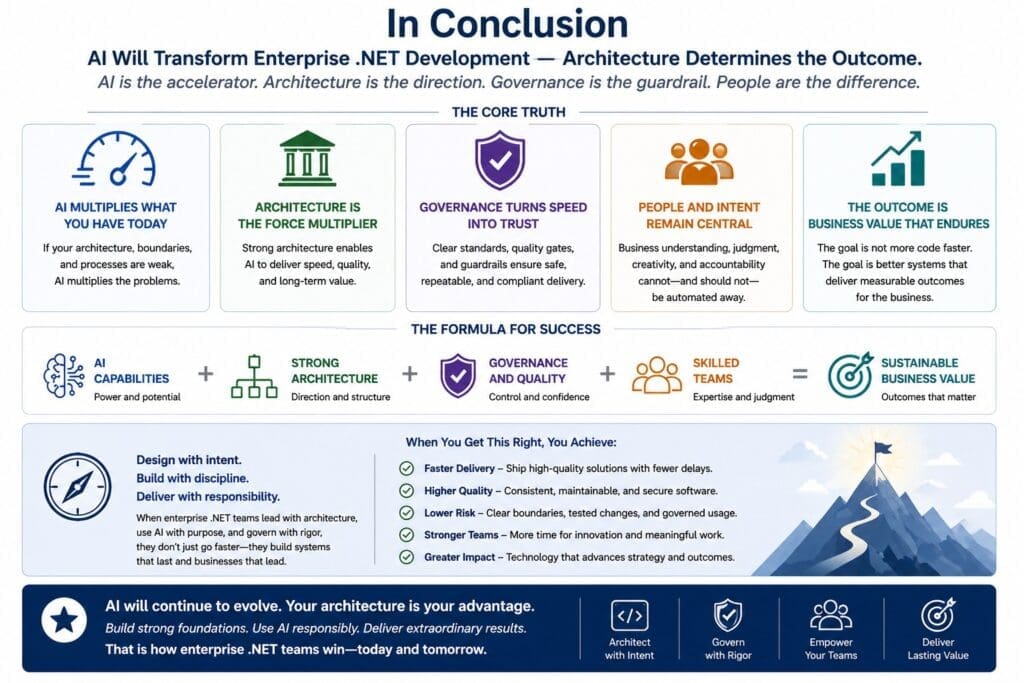
Conclusion
AI is changing enterprise application development in .NET, but its most important effect is not that it can generate code.
Its most important effect is that it changes where architecture creates value.
As repetitive implementation becomes cheaper, the deeper responsibilities of architecture become easier to see.
Business rules matter more.
Layering matters more.
Boundaries matter more.
Governance matters more.
Validation matters more.
Human judgment matters more.
The organizations that benefit most from AI will not be the ones that generate the most code the fastest.
They will be the ones that best separate the repeatable from the meaningful, automate the outer layers without corrupting the core, and build delivery models in which AI accelerates implementation while humans retain ownership of structure, judgment, and accountability.
Not AI instead of architecture.
AI inside architecture.
Not less human responsibility.
More leverage for the parts of human responsibility that matter most.
Download the Whitepaper
Download the full whitepaper: How AI Changes Enterprise Application Architecture in .NET
This whitepaper is intended for enterprise software leaders, .NET architects, senior developers, technical managers, and organizations evaluating how AI-assisted development should fit into serious application delivery.