
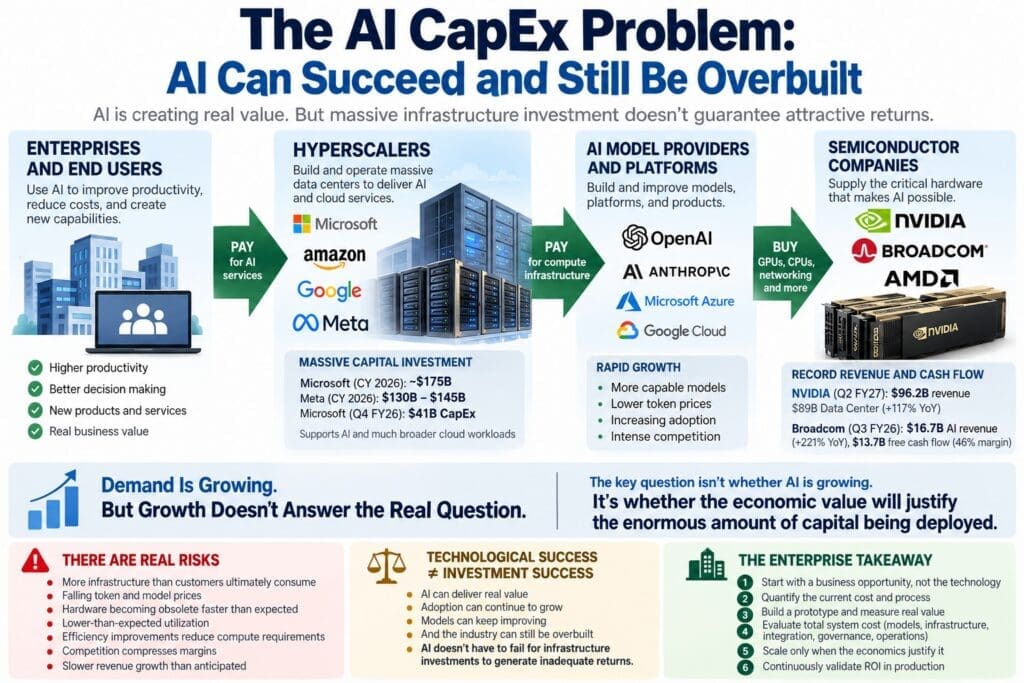
This analysis was inspired by a LinkedIn post from Dr. Jeffrey Funk (https://www.linkedin.com/in/dr-jeffrey-funk-a979435/) who raised an important question about the growing imbalance between semiconductor cash flow and the enormous capital investments being made by hyperscalers and AI companies.
I don’t agree with every conclusion in the original post, but I think the underlying question deserves serious examination: Can AI succeed technologically while the industry still over invests in the infrastructure required to deliver it?
That’s the question I explore here. Here is Dr Funk’s original article:
Semiconductor Companies are getting all the cash
https://www.linkedin.com/feed/update/urn:li:activity:7511398516875812864
Dr Funk and I do not agree on everything. Which I think is a plus for our readers. Our readers get to read both sides of the argument, think about it, and decide for their self what they believe, As usual – the truth is often in the middle.
The AI infrastructure boom has created an unusual economic picture.
Semiconductor companies are generating extraordinary revenue and cash flow. Hyperscalers are spending enormous sums on GPUs, CPUs, networking, power, and data centers. AI model providers are racing to increase usage while model and token prices continue to fall.
This has led to an increasingly common conclusion:
The AI boom is unsustainable.
There is a legitimate concern buried inside that argument. But the conclusion is too simplistic.
AI does not have to fail for the current infrastructure buildout to have been excessive.
AI adoption can continue growing. AI models can continue improving. Enterprises can deploy valuable AI systems. Hyperscalers can generate billions of dollars in additional AI revenue.
And the industry can still discover that it built too much infrastructure, too quickly, at too high a cost.
That is the AI CapEx problem.
The AI Boom Is Also a Capital Investment Boom
The scale of today’s infrastructure investment is difficult to overstate.
Microsoft reported $41 billion in capital expenditures in its fiscal 2026 fourth quarter, with roughly two-thirds associated with shorter-lived assets, primarily CPUs and GPUs. Microsoft said its calendar-year 2026 CapEx expectations are approximately $175 billion after accounting for a change in datacenter lease classification. Microsoft
Meta reported $31.1 billion in capital expenditures during the second quarter of 2026 and expects full-year CapEx of $130 billion to $145 billion. Meta
At the other end of those transactions are companies selling the infrastructure.
NVIDIA reported $96.2 billion in quarterly revenue for its fiscal 2027 second quarter, up 106% year over year. Data Center alone accounted for $89 billion, up 117%. NVIDIA Investor Relations
Broadcom provides another striking example. Its fiscal 2026 third-quarter AI semiconductor revenue reached $16.7 billion, up 221% year over year. The company generated $13.7 billion in free cash flow on $29.6 billion in revenue—a 46% free-cash-flow margin. Broadcom Investor Center
The semiconductor suppliers are clearly benefiting from the infrastructure race.
The harder question is what happens farther up the economic chain.
The Hyperscalers Are Not Simply “Cash-Flow Negative”
One criticism circulating around the AI investment boom is that semiconductor companies are generating all the cash while hyperscalers have become cash-flow negative.
That characterization is too broad.
Microsoft, for example, generated $55.4 billion in operating cash flow and $19.6 billion in free cash flow in its most recent reported quarter—even after enormous infrastructure spending. Microsoft
Meta presents a more dramatic example of the pressure CapEx can place on cash generation. It generated $31.9 billion in operating cash flow during Q2 2026, but approximately $31.1 billion of capital expenditures and finance-lease principal payments reduced reported free cash flow to just $784 million. Meta
That’s a significant compression.
But it isn’t the same thing as saying the major hyperscalers are collectively cash-flow negative.
It also illustrates why terminology matters.
Profit, Operating Cash Flow, and Free Cash Flow Are Different Things
Discussions about AI economics frequently mix several financial concepts together.
Accounting profit measures revenue and expenses according to accounting rules. Capital investments generally become assets and are depreciated over time.
Operating cash flow measures cash generated from business operations.
Free cash flow is commonly calculated approximately as:
Operating Cash Flow − Capital Expenditures = Free Cash Flow
That distinction matters enormously during an infrastructure boom.
A company can remain highly profitable while simultaneously spending so much on data centers and computing infrastructure that its free cash flow falls substantially.
That doesn’t automatically mean the investment is bad.
It means the company is making a large bet on future economic returns.
And that is exactly what is happening with AI.
The Wrong Question: “Is AI Growing?”
There is abundant evidence that AI infrastructure demand is growing.
NVIDIA’s Data Center revenue increased 117% year over year in its latest reported quarter. Broadcom’s AI semiconductor revenue increased 221%. Microsoft Cloud revenue reached $59.3 billion in its fiscal fourth quarter, up 27%, while Microsoft’s commercial remaining performance obligation reached $678 billion. NVIDIA Investor Relations
Those numbers don’t look like an industry in which demand has disappeared.
But growth doesn’t answer the important economic question.
Suppose a company invests $100 billion in additional infrastructure and ultimately generates $50 billion of additional revenue.
Was that successful?
You cannot answer without knowing the margins, useful life of the assets, operating costs, financing costs, utilization rates, replacement requirements and duration of the resulting revenue.
Revenue growth is not the same thing as return on investment.
That is the distinction much of the AI bubble debate misses.
AI Can Succeed and Still Be Overbuilt
Imagine AI adoption continues rapidly for the next five years.
Enterprises deploy copilots.
Software companies embed AI throughout their products.
Developers increasingly use AI-assisted development.
Customer service, document processing, analytics, search, cybersecurity and other workloads consume increasing amounts of inference.
Agents begin executing more complex workflows.
None of that guarantees that today’s infrastructure investments will earn attractive returns.
There are several ways AI could succeed technologically while the infrastructure investment cycle disappoints financially.
Companies could build more capacity than customers ultimately consume.
Competition could push inference prices down faster than infrastructure costs decline.
Hardware could become obsolete faster than expected.
Utilization rates could remain lower than financial models assumed.
Efficiency improvements could reduce the compute required for a given workload.
New models could accomplish the same work using substantially less compute.
Or AI could create enormous economic value—but customers rather than infrastructure providers could capture much of that value.
This is not unusual.
Technological success and investment success are two different things.
The Internet succeeded beyond almost anyone’s expectations.
That didn’t mean every telecommunications network, fiber buildout, hosting company or dot-com investment made during the Internet boom was economically justified.
Infrastructure can be strategically important and simultaneously overbuilt.
Falling AI Costs Complicate the Economics
AI has another unusual characteristic: its unit economics are changing extremely quickly.
Models are becoming more efficient.
Hardware is becoming faster.
Inference optimization is improving.
Competition among model providers is intense.
Enterprises increasingly have multiple model choices.
That is excellent news for AI customers.
But it creates a complicated problem for infrastructure investors.
Suppose a workload requires $1 million of compute today but improvements in hardware, models and software allow the same workload to run for $200,000 several years from now.
Demand could increase fivefold while the amount customers spend remains roughly unchanged.
This is why counting tokens, users, queries or AI applications does not tell us whether the infrastructure economics work.
Usage can explode while the cost per unit collapses.
Whether total revenue grows faster than unit costs fall becomes critical.
But Hyperscaler CapEx Is Not Purely “AI Spending”
There is another important qualification.
It is misleading to compare all hyperscaler capital expenditures directly with AI revenue.
Microsoft’s infrastructure, for example, supports far more than standalone generative AI services.
Azure hosts databases, applications, storage, analytics, networking, cybersecurity, traditional compute and thousands of other enterprise workloads.
Microsoft specifically noted that its CPU and GPU investments support customers building solutions using both AI and non-AI infrastructure. Microsoft
The physical infrastructure also has different economic lives.
Datacenter buildings, electrical infrastructure and land can remain productive far longer than an individual generation of GPU.
Microsoft reported that roughly one-third of its Q4 CapEx went toward longer-lived assets, while approximately two-thirds went toward shorter-lived assets, primarily CPUs and GPUs. Microsoft
So a simple comparison such as:
AI revenue ÷ total datacenter CapEx
doesn’t tell us very much.
The real economics require allocating infrastructure costs across workloads and measuring the incremental return generated by the investment.
The Semiconductor Companies Are Capturing the Economics—For Now
During an infrastructure buildout, suppliers frequently benefit first.
That is exactly what we’re seeing.
NVIDIA and Broadcom sell critical components into a market where companies are competing aggressively for compute capacity.
Broadcom’s 46% free-cash-flow margin illustrates just how attractive the supplier side of this investment cycle can currently be. Broadcom Investor Center
But supplier economics depend ultimately on downstream economics.
A hyperscaler can justify purchasing another generation of accelerators if customers consume enough profitable compute.
If returns on incremental infrastructure eventually disappoint, hyperscalers can slow the rate of expansion.
That would eventually flow backward through the supply chain.
This doesn’t require AI demand to collapse.
It only requires the expected return from the next dollar of AI infrastructure investment to fall below alternative uses of capital.
That distinction is important.
The Metric That Matters: Return on Invested Capital
The AI infrastructure debate therefore needs to move beyond revenue.
A better question is:
What incremental operating cash flow is being generated by the incremental capital invested in AI infrastructure?
Ultimately, investors will care about some variation of return on invested capital.
Enterprises should care about essentially the same thing.
If an organization spends $20 million implementing AI and saves $2 million per year, that’s very different from spending $2 million and saving $20 million.
Both organizations can truthfully announce:
“We successfully deployed AI.”
Only one necessarily made a good investment.
Enterprises Have Their Own AI CapEx Problem
The hyperscaler numbers involve hundreds of billions of dollars, but the underlying economic problem exists at every level.
Enterprise AI projects accumulate costs from:
- Models and inference
- Cloud infrastructure
- Data pipelines
- Vector databases and retrieval systems
- Integration
- Security
- Governance
- Observability
- Software development
- Testing and evaluation
- Human review
- Maintenance
- Model and platform migration
A successful proof of concept proves that something can work.
It does not prove that the system creates enough value to justify production deployment.
Likewise, high user adoption does not automatically establish ROI.
An AI assistant used by 10,000 employees might be enormously valuable.
Or it might save each employee three minutes per month while consuming millions of dollars in licenses, infrastructure, integration and operational support.
Usage is not value.
Enterprises Should Measure Economics Before Scaling
This is one reason enterprise AI should begin with opportunity assessment rather than technology selection.
Before asking:
Which model should we use?
Should we build an agent?
Should we deploy Copilot?
Do we need a vector database?
Organizations should first ask:
What business problem are we solving?
Then quantify the current process.
How much does it cost?
How much time does it consume?
What is the error rate?
What is the economic cost of those errors?
What portion of the workflow can realistically be improved?
What will the AI system cost to build and operate?
What measurable improvement would justify that investment?
Only then does architecture become meaningful.
The progression should look something like:
Business Opportunity → Economic Baseline → Prototype → Measurement → Architecture → Production → Continuous ROI Validation
Not:
New AI Technology → Find Something to Do With It
That distinction becomes increasingly important as AI experimentation turns into enterprise-scale deployment.
Cheap Tokens Do Not Mean Cheap AI
One of the most dangerous assumptions in enterprise AI is that falling model prices automatically make AI systems inexpensive.
Inference may represent only one portion of total system cost.
A production AI application may require identity management, APIs, data integration, retrieval, security controls, deterministic business logic, human authorization, monitoring, logging, evaluation and auditability.
The model might become cheaper while the surrounding enterprise system remains expensive.
This is especially true as organizations move from simple assistants toward systems capable of taking actions.
The more authority an AI system receives, the more engineering is required around it.
That means enterprises should evaluate total system economics, not simply token prices.
AI Doesn’t Need Infinite Infrastructure
There is also a conceptual problem with extrapolating today’s infrastructure growth indefinitely.
Technology adoption typically moves through periods of shortage, rapid investment, increasing capacity, improving efficiency and eventual normalization.
AI may require vastly more computing infrastructure than existed before generative AI.
That doesn’t mean the optimal amount of infrastructure increases at today’s rate forever.
Eventually supply catches demand.
Efficiency improves.
Markets mature.
Customers become more selective.
Infrastructure becomes commoditized.
The important question isn’t whether AI infrastructure will continue to exist.
Of course it will.
The question is whether the marginal return on additional infrastructure continues to justify the marginal investment.
That is where the economics eventually impose discipline.
AI Can Win While Some AI Investments Lose
The AI debate is too often framed as two opposing predictions.
One side says AI will transform everything.
The other says AI is a bubble.
Those outcomes aren’t mutually exclusive.
AI could become one of the most important computing platforms ever created while simultaneously producing one of the largest periods of infrastructure overinvestment in technology history.
Both can be true.
The Internet demonstrated that.
Cloud computing demonstrated a milder version of it.
AI may demonstrate it again.
The question isn’t whether AI is real.
It is.
The question isn’t whether AI creates value.
It already does.
The question is:
How much capital should rationally be invested to capture that value?
That answer will ultimately determine whether today’s AI infrastructure boom looks like extraordinary foresight—or substantial overbuilding.
And enterprises should ask exactly the same question about their own AI investments.
Frequently Asked Questions
What is AI CapEx?
AI CapEx refers to capital expenditures associated with building infrastructure used for artificial intelligence workloads. This can include data centers, GPUs, CPUs, networking equipment, power infrastructure, cooling systems and other long-lived or computing assets.
Are hyperscalers losing money because of AI?
Not generally. Large hyperscalers can remain highly profitable and generate positive free cash flow while dramatically increasing AI-related infrastructure investment. Microsoft, for example, reported $19.6 billion in quarterly free cash flow despite $41 billion of CapEx in its fiscal 2026 fourth quarter.
Why are AI semiconductor companies generating so much cash?
AI infrastructure demand has created exceptionally strong demand for accelerators, networking and related semiconductor products. NVIDIA reported $89 billion of quarterly Data Center revenue in its latest quarter, while Broadcom reported $16.7 billion of quarterly AI semiconductor revenue.
Can AI be successful while the AI infrastructure market is overbuilt?
Yes. Technology adoption and investment returns are different questions. AI usage and business value can grow substantially while companies simultaneously build more infrastructure than is economically justified.
What should enterprises measure when evaluating AI ROI?
Enterprises should evaluate total cost against measurable business outcomes. That includes model costs, infrastructure, software development, integration, security, governance, operations and human oversight—not simply token prices or user adoption.
Does falling AI inference cost solve the CapEx problem?
Not necessarily. Lower inference costs benefit customers and can increase demand, but they can also reduce revenue per unit of compute. The economic result depends on whether growth in total demand and productivity exceeds declines in unit pricing and the cost of infrastructure.
What is the biggest financial risk from AI infrastructure spending?
The key risk is not necessarily that AI fails. It is that AI succeeds while generating insufficient incremental cash flow and return on invested capital to justify the amount of infrastructure built.
