
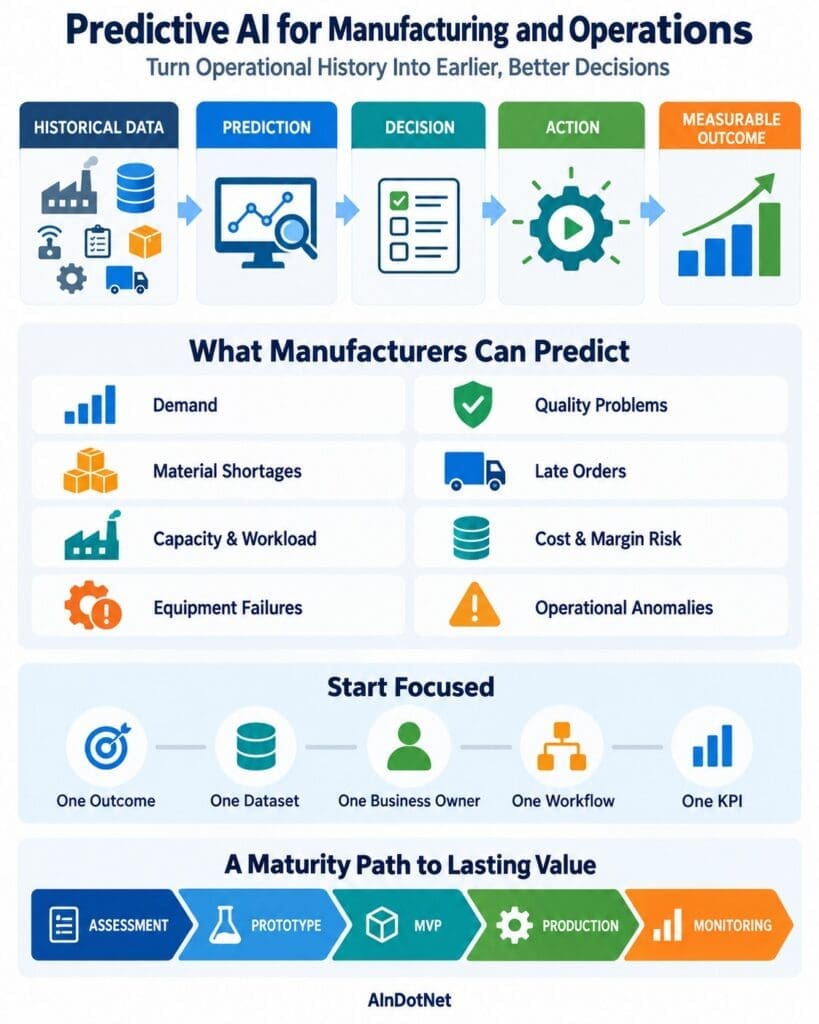
Manufacturers already collect much of the data needed for forecasting and predictive AI. Sales orders, production history, inventory movements, supplier performance, machine telemetry, quality inspections, maintenance records, labor hours, schedules, and shipment history often contain patterns that can help estimate what is likely to happen next.
The business opportunity is not prediction for its own sake. A useful prediction arrives early enough to change a decision. It may give purchasing time to order material before a shortage, help production revise a schedule before a bottleneck develops, allow maintenance to inspect equipment before a failure, or warn customer service that an order is likely to ship late.
That is the practical value of predictive AI for manufacturing: turning historical business and operational data into earlier decisions, targeted actions, and measurable outcomes.
What Predictive AI Means in Manufacturing
Predictive AI is the broader category of machine learning applications that estimate an unknown or future outcome from existing data. Forecasting is one important form of predictive AI, especially when the outcome changes over time.
A manufacturer might forecast how many units customers will order next month. It might use regression to estimate the final cost of an order. It might use classification to estimate whether a machine will fail during the next 30 days, whether a production run is likely to produce a defect, or whether a shipment will arrive late.
These are related problems, but they are not identical. The business question should determine the machine learning task. The team should not begin with a preferred algorithm and search for somewhere to use it.
A well-defined predictive manufacturing question includes the outcome, prediction horizon, decision, action, and measure of success. For example: Can we predict which raw materials will fall below their required inventory level during the next 21 days, early enough for purchasing to prevent production delays without materially increasing excess inventory?
High Value Forecasting and Predictive AI Use Cases
Manufacturing contains many potential predictive applications. The following categories are commercially attractive because they combine repeated decisions, historical observations, measurable outcomes, and direct economic consequences.
Demand Forecasting
Demand forecasting estimates future product, product-family, customer, channel, or location demand. Useful inputs can include prior orders, seasonality, price, promotions, customer type, region, holidays, weather, contracts, economic conditions, and known market events.
The forecast becomes valuable when it changes planning. Purchasing can adjust replenishment, production can revise schedules, distribution can reposition inventory, and finance can update revenue and cash projections. Forecast accuracy matters, but fewer stockouts, less excess inventory, improved service levels, and better use of working capital are the real objectives.
Inventory and Material Shortage Prediction
Inventory applications can estimate consumption, reorder timing, stockout risk, excess inventory, obsolete inventory, and the effect of supplier delays. A strong first project usually focuses on a narrow result such as predicting which critical materials are likely to fall below required levels during a defined period.
This approach is more actionable than a general goal to improve inventory. It identifies the items, time horizon, employee, and decision involved. It also makes the result easier to compare with an existing reorder report or planning method.
Production Planning and Capacity Forecasting
Operations teams can forecast workload, throughput, cycle time, queue length, labor requirements, equipment utilization, and capacity constraints. Predictions can help planners identify when expected orders may exceed the capacity of a production line, work center, warehouse, or shift.
The most useful horizon depends on the action. A short-term forecast may support shift scheduling or job sequencing. A longer forecast may support hiring, capital planning, supplier commitments, or changes to production capacity. A technically accurate forecast delivered after those decisions are locked has little operational value.
Predictive Maintenance
Predictive maintenance uses operational and maintenance data to estimate equipment condition or failure risk. Relevant data may include sensor readings, alarms, run time, load, temperature, vibration, environmental conditions, service history, part replacements, and prior failures.
The phrase predictive maintenance is too broad for a first implementation. A focused target might be identifying pumps with an elevated risk of seal failure during the next 30 days, early enough to schedule an inspection and obtain replacement parts.
The goal is not to eliminate preventive maintenance or human judgment. The goal is to use evidence to prioritize inspections, schedule maintenance more intelligently, reduce unplanned downtime, and avoid unnecessary work.
Quality and Defect Prediction
Quality prediction can identify production runs, batches, or units with elevated defect risk. Inputs may include supplier, material lot, machine, tooling, operator, process settings, temperature, humidity, line speed, inspection results, and measurements taken during production.
An elevated risk score might trigger additional inspection, a process adjustment, temporary isolation of a batch, or review by a quality engineer. Because quality decisions can affect customers, compliance, and product safety, the application should preserve the supporting data, model version, recommendation, employee decision, and final outcome.
Late Order and Delivery Prediction
Manufacturers can estimate whether an order, production step, supplier delivery, or customer shipment is likely to be late. The prediction may combine current order status, routing steps, production progress, supplier performance, backlog, carrier history, distance, and known disruptions.
Early warning gives employees options. They may expedite a component, move work to another line, change the schedule, select a different carrier, or communicate proactively with the customer. Predicting a late shipment after it has already missed its required date adds little value.
Cost Duration and Margin Prediction
Historical orders and projects can help estimate final cost, labor hours, duration, material usage, change orders, or margin risk. This can be especially useful in engineer-to-order, configure-to-order, job-shop, construction, fabrication, and project-based manufacturing environments.
The application should compare estimates with the organization’s current process. A machine learning estimate may complement rather than replace estimating rules and experienced judgment. Large disagreements between the model and the employee can become useful cases for review.
Anomaly and Risk Detection
Predictive systems can identify unusual operating behavior, unexpected consumption, abnormal transactions, warranty risk, supplier risk, and other events that deserve attention. An anomaly does not automatically mean something is wrong. It means the observation differs from the pattern the system learned.
For many risk applications, the best design is human in the loop. The system prioritizes cases; a qualified employee reviews the evidence and decides what to do. This reduces the danger of treating a probability or anomaly score as proof.
Manufacturing Data Is Usually the Starting Point
Many manufacturing organizations do not need to begin by installing an entirely new data platform. They may already have years of useful information across ERP, MRP, MES, quality, maintenance, warehouse, CRM, financial, historian, telemetry, and custom SQL Server applications.
The first challenge is determining whether that data can answer the intended business question. Useful historical data needs more than volume. Dates and timestamps must be reliable. Outcomes must be recorded. Identifiers must connect records across systems. Definitions must be consistent enough to compare one period with another.
Teams should also determine when each field became available. A model cannot legitimately use information that would not have existed when the prediction was made. Accidentally training on later information creates data leakage and can make a weak model appear excellent during testing.
Domain knowledge is equally important. Shutdown weeks, preventive maintenance, promotions, contract changes, new products, supplier transitions, inventory policies, production constraints, and fiscal calendars may explain patterns that are invisible in raw data. Strong predictive applications combine data, algorithms, and manufacturing knowledge.
A Predictive Model Is Not a Manufacturing Application
A prototype might read a file, run a model, and produce a prediction. A production manufacturing application must do much more.
The system needs dependable data extraction, validation, feature preparation, model execution, business rules, workflow integration, security, logging, exception handling, monitoring, audit history, and feedback. It must deliver the result to the right employee at the right time and allow the employee or system to act.
A useful architecture follows this path: operational data becomes prepared features; the model produces a prediction or risk score; business rules interpret the result; the application presents or executes an action; and later outcomes feed performance monitoring.
Prediction frequency should match the decision. A nightly batch process may be appropriate for purchasing recommendations or next-day scheduling. A per-transaction API may suit order-risk scoring. Streaming may be justified for high-frequency equipment signals. Companies should not pay the complexity cost of real-time architecture when a daily prediction is sufficient.
Building Predictive Manufacturing Applications with Microsoft Technologies
Microsoft-centric manufacturers can add predictive capabilities to existing business applications without rebuilding every system or automatically moving the entire solution to a separate AI platform.
C# and .NET can provide business logic, integrations, APIs, background services, user interfaces, security, and operational workflows. SQL Server or Azure SQL can store source data, prepared features, predictions, model versions, employee actions, and actual outcomes.
ML.NET is Microsoft’s open-source, cross-platform machine learning framework for integrating custom models into .NET applications. Its supported workflows include APIs, a command-line interface, and Model Builder for Visual Studio. Model Builder uses automated machine learning to evaluate algorithms and settings for supported scenarios, then generates training and model-consumption code.
When a model is trained in another environment, ONNX can provide a practical interoperability path for supported models. Azure Machine Learning and other Azure services may add managed training, deployment, monitoring, or scale where those capabilities justify their cost and complexity.
The correct architecture depends on the business requirement. The important point is that prediction can become a capability inside an existing manufacturing application rather than an isolated experiment that employees must visit separately.
How to Evaluate a Predictive Manufacturing Opportunity
A structured assessment prevents organizations from choosing projects based on novelty or executive enthusiasm alone. For each candidate, ask:
What outcome are we trying to predict?
What decision would change if we had the prediction?
How far in advance must the prediction arrive?
Who owns the decision and who will act?
What historical data exists and how reliable is it?
How frequently does the event occur?
Is the actual outcome eventually recorded?
What method does the business use today?
What does a missed event cost?
What does a false alarm cost?
What measurable improvement would justify implementation?
Candidates can then be rated as poor, possible, good, or excellent. Excellent candidates usually have repeated measurable outcomes, relevant historical data, enough lead time to act, a committed business owner, an existing workflow that can change, and meaningful economic value.
Start with One Focused Prototype
The safest first step is not enterprise-wide predictive infrastructure. It is one outcome, one dataset, one business owner, one workflow, and one measurable KPI.
For example, a manufacturer might select 50 high-value materials in one plant and predict which will fall below their required level during the next 14 days. Purchasing owns the workflow. The current reorder report is the baseline. Success means fewer material shortages without an unacceptable increase in excess inventory.
The prototype should establish a simple baseline, use temporal validation or backtesting, and simulate the business decision. If the prediction had existed six months ago, what alerts would it have produced? What would employees have done? How many expensive events might have been prevented? How many false alarms would they have reviewed?
A simple rule or moving average may perform nearly as well as a complex model. If it does, the simple method may be the better business solution. Complexity adds development, deployment, monitoring, explanation, and maintenance costs. The objective is operational improvement, not algorithmic prestige.
Move from Assessment to Prototype to MVP to Production
A disciplined predictive manufacturing initiative progresses through stages, with each stage reducing a different form of uncertainty.
The opportunity assessment determines whether the business problem, data, action, owner, and economics justify further work. The focused prototype tests technical feasibility against historical data. The business MVP places predictions into a limited real workflow and measures adoption, timing, false alarms, and operational value.
The production application adds automated pipelines, access controls, testing, deployment, monitoring, auditability, rollback, model lineage, actual-versus-predicted analysis, drift detection, and a defined retraining process.
Models can degrade as suppliers, products, equipment, processes, customer behavior, and economic conditions change. Production monitoring must evaluate both model performance and business performance. A model can remain technically respectable while no longer improving the decision that justified it.
The Best Manufacturing Prediction Is the One That Changes a Decision
Manufacturers have no shortage of things they could predict. The stronger question is which recurring decision would create measurable value if employees knew what was likely to happen next.
Look for repeated outcomes, useful historical data, a clear owner, enough lead time to act, an operational workflow that can change, and an economic consequence worth improving. Then prove the idea with a focused prototype before investing in production infrastructure.
Your organization may already have the raw material for its first predictive AI application stored in SQL Server, ERP, MES, maintenance, quality, and operational systems. The opportunity is to convert that history into an earlier warning, a better decision, and a measurable manufacturing result.
Next Step
A Forecasting and Predictive AI Opportunity Assessment can help your organization identify, compare, and rank candidate applications before committing to a large implementation. The assessment connects business value, available data, decision timing, workflow ownership, technical feasibility, and production requirements.
The objective is straightforward: select one focused predictive application where existing manufacturing data can improve a real decision, prove it with a prototype, and expand only when the evidence supports the investment.
Sources and Further Reading
Microsoft Learn Overview of ML.NET
Microsoft Learn What is Model Builder and how does it work
Microsoft Learn Model monitoring in production
Predictive AI & Forecasting for Business
Frequently Asked Questions
How is predictive AI used in manufacturing
Manufacturers use predictive AI to forecast demand, anticipate inventory shortages, estimate capacity and labor requirements, predict equipment failures, identify defect risk, estimate costs and durations, and warn that orders or shipments may be late.
What data is needed for predictive AI in manufacturing
The required data depends on the outcome. Common sources include orders, production history, inventory movements, supplier performance, machine telemetry, maintenance, inspections, quality results, schedules, labor, and shipments. Reliable timestamps and recorded outcomes are especially important.
Does predictive manufacturing require real time data
No. Prediction frequency should match the decision. Nightly or weekly batch predictions are often sufficient for purchasing, planning, and scheduling. Real-time or streaming data is justified only when the operational response requires it.
Can manufacturers build predictive AI with C sharp and dot NET
Yes. C# and .NET can support the application, integrations, APIs, background processing, security, and workflow. ML.NET can train and consume supported models, ONNX can support compatible externally trained models, and Azure services can be added when managed scale or deployment capabilities are needed.
What is the best first predictive AI project for a manufacturer
The best first project has a measurable repeated outcome, usable historical data, enough lead time to act, a committed business owner, and clear economic value. It should be narrow enough to test with one dataset, one workflow, and one KPI.
