Most organizations do not have a shortage of potential artificial intelligence projects.
They have a prioritization problem.
Sales wants better forecasts. Operations wants fewer delays. Finance wants earlier warnings about cash flow and payment risk. Customer service wants to identify accounts likely to leave. Maintenance teams want to know which equipment is likely to fail.
Each idea may sound promising. But not every business problem is a good predictive AI opportunity—and even technically feasible predictions may produce little business value.
The goal should not be to find somewhere to “use AI.” The goal should be to identify recurring business decisions that could be improved by knowing what is likely to happen next.
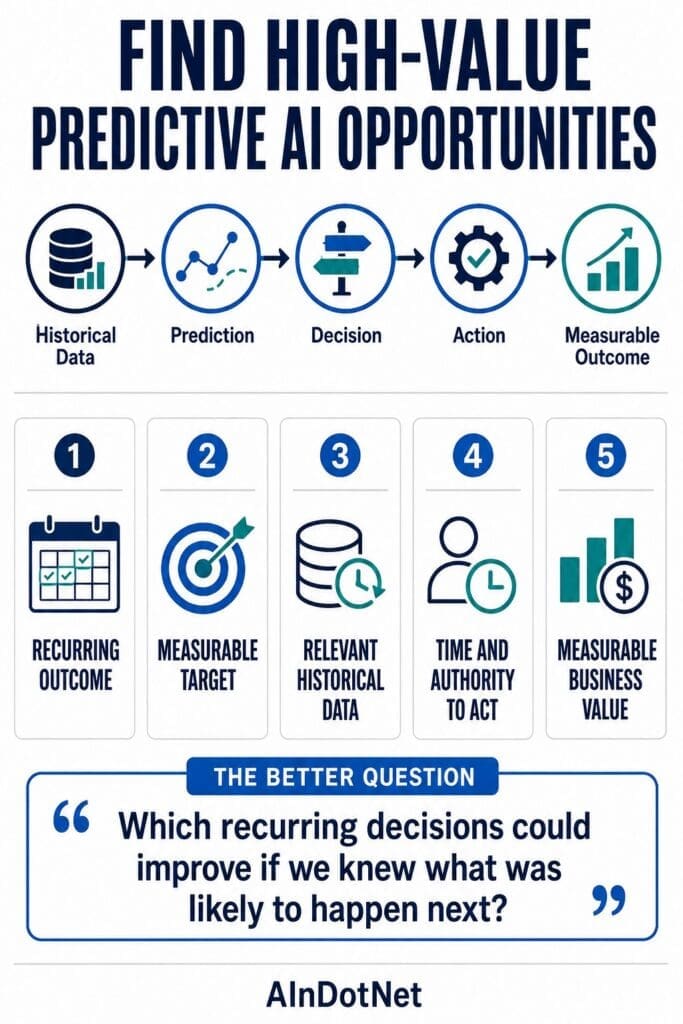
A strong predictive AI opportunity usually follows this pattern:
Historical observations → Predictable outcome → Business decision → Timely action → Measurable value
This article explains how to recognize that pattern, evaluate potential use cases, and select a predictive AI project worth prototyping.
What Is a Predictive AI Opportunity?
Predictive AI uses historical data to estimate an unknown or future outcome.
Depending on the business question, the system might:
- Forecast next month’s sales
- Estimate the final cost of a project
- Predict whether a customer will leave
- Calculate the probability that a payment will be late
- Identify equipment at risk of failure
- Estimate staffing requirements
- Predict delivery times
- Flag transactions that may be fraudulent
- Estimate the likelihood of a quality problem
The prediction is not the final objective. Its value comes from the decision or action it enables.
For example, predicting that a customer has an 82% probability of leaving is useful only if the organization can respond. An account manager might contact the customer, offer assistance, resolve a service problem, or recommend a better contract.
The complete business capability is therefore not merely:
Data → Prediction
It is:
Data → Prediction → Decision → Action → Business Outcome
Organizations that evaluate only the model—and ignore the decision and workflow surrounding it—frequently produce interesting demonstrations that never become useful business applications.
Start With Business Decisions, Not Algorithms
A common mistake is to begin predictive AI discovery by discussing algorithms, platforms, or products.
Should we use ML.NET, Azure Machine Learning, AutoML, Python, LightGBM, a neural network, or a large language model?
Those may eventually become important technical decisions, but they are usually the wrong starting point.
Begin with a business question:
What recurring decision would we make differently if we had a reasonably accurate estimate of what is likely to happen?
That question changes the discussion.
Instead of saying:
We want to build a machine learning model.
The organization can say:
We want to predict inventory shortages at least 14 days in advance so purchasing managers have enough time to adjust orders.
That statement begins to define:
- The outcome being predicted
- The required prediction horizon
- The person responsible for acting
- The available intervention
- The expected business benefit
- The standard against which the prediction will be evaluated
The technology now has a specific business purpose.
The Five Characteristics of a High-Value Predictive AI Opportunity
The strongest predictive AI candidates generally share five characteristics.
1. A Recurring Event or Outcome
Machine learning identifies patterns across repeated historical observations. It usually performs best when the organization has seen the same general type of event many times.
Examples include:
- Thousands of customer renewals and cancellations
- Years of daily product sales
- Millions of financial transactions
- Thousands of equipment service records
- Hundreds of completed projects
- Repeated insurance claims
- Years of inventory movements
- Thousands of deliveries
- Repeated manufacturing quality inspections
An event that occurred only three or four times is unlikely to provide enough information for a dependable predictive model.
Prediction becomes more practical when the business process repeatedly produces comparable observations and outcomes.
2. A Clearly Measurable Target
The system needs a specific outcome to learn and predict.
Good targets include:
- Customer renewed or canceled
- Invoice paid on time or late
- Equipment failed or remained operational
- Actual sales quantity
- Final project cost
- Actual delivery date
- Product passed or failed inspection
- Employee remained or left
- Transaction was legitimate or fraudulent
Vague goals such as “improve operations” or “understand customers better” are not sufficient.
They may describe a business objective, but they do not define a prediction.
A useful discovery question is:
What fact will eventually become known and recorded?
If the actual outcome is never recorded, the organization may be unable to train the initial model or determine whether future predictions were correct.
3. Relevant Historical Data
Predictive AI learns from historical examples. The organization therefore needs data that describes what was known before each outcome occurred.
Potential sources include:
- SQL Server databases
- ERP systems
- CRM applications
- Manufacturing execution systems
- Financial applications
- Inventory and order systems
- Maintenance platforms
- Customer service systems
- Project management applications
- Claims systems
- Equipment telemetry
- Application logs
- Data warehouses and data lakes
The data does not need to be perfect before an opportunity can be evaluated. Most enterprise datasets contain missing values, inconsistent codes, outdated fields, or records collected for operational rather than analytical purposes.
However, relevant historical information must exist—or be practical to begin collecting.
The most important question is not simply, “Do we have data?”
It is:
Did we record the conditions that existed before the outcome occurred?
For customer churn, useful information might include contract type, tenure, service usage, support incidents, payment history, and prior complaints.
For equipment failure, it might include operating hours, temperature, vibration, load, error codes, previous maintenance, and equipment age.
Data that was created after the outcome cannot legitimately be used to predict it. Doing so introduces data leakage and can make a model appear far more accurate during testing than it will be in production.
4. Enough Time and Authority to Act
A prediction delivered too late has little value.
Suppose a model accurately predicts a shipment delay five minutes before the scheduled delivery. The prediction may be correct, but the business has almost no opportunity to respond.
The same prediction delivered five days earlier could allow the organization to:
- Change carriers
- Expedite materials
- Adjust production
- Notify the customer
- Reschedule dependent work
- Prevent contractual penalties
Every candidate should therefore define a useful prediction horizon.
Ask:
- How far in advance must the prediction be available?
- Who receives it?
- What authority does that person have?
- What actions are available?
- How quickly can the organization respond?
- Are those actions operationally and economically realistic?
A technically strong model is not valuable if nobody owns the response or the organization cannot act in time.
5. A Measurable Economic or Operational Benefit
A predictive AI project should connect to a measurable result.
Potential benefits include:
- Fewer stockouts
- Less excess inventory
- Reduced downtime
- Lower overtime
- Improved customer retention
- Faster collections
- Fewer fraudulent transactions
- More accurate budgets
- Better staffing decisions
- Fewer late deliveries
- Reduced warranty expense
- Higher production yield
- Improved margins
Model metrics remain important. Depending on the problem, the technical team may measure accuracy, precision, recall, F1 score, mean absolute error, root mean squared error, or other statistical measures.
But model performance is not the same as business performance.
A churn model can have impressive technical metrics and still fail to improve retention. A less sophisticated model may create substantial value if it reaches the right employee early enough to support an effective intervention.
The real question is:
Does using the prediction produce a better business result than the organization’s current process?
A Practical Predictive AI Opportunity Test
A candidate becomes stronger each time the organization can answer “yes” to one of these questions:
- Does the event or outcome happen repeatedly?
- Is the actual outcome clearly defined and recorded?
- Do we have enough historical examples?
- Was potentially relevant information recorded before the outcome?
- Can the prediction be generated early enough to matter?
- Can someone take a specific action based on it?
- Does that person have the authority and resources to act?
- Can the financial or operational impact be measured?
- Is there a current baseline against which the model can be compared?
- Can the prediction become part of an existing business workflow?
A candidate does not need a perfect answer to every question before discovery begins. Weak answers, however, identify risks that should be investigated before the organization invests heavily.
Good and Poor Predictive AI Candidates
A promising predictive AI candidate might look like this:
A distributor has five years of order and inventory history. Stockouts occur hundreds of times each year and lead to measurable lost sales. Purchasing managers can modify orders when given at least two weeks of warning.
This opportunity has repeated outcomes, historical data, economic consequences, a useful prediction horizon, and an employee who can act.
A weaker candidate might look like this:
Executives want AI to predict whether the company will experience another once-in-a-generation disruption.
The event is rare, historical examples are limited, the target may be poorly defined, and the factors driving the outcome may change dramatically. The cost of building the system could exceed any practical value.
Another poor candidate is:
We want to predict a problem, but even if we know it will happen, our process cannot change.
That may be an interesting analytical exercise. It is not yet a strong operational AI opportunity.
Where to Look for Predictive AI Opportunities
Organizations can find opportunities by examining recurring decisions across major business functions.
Sales and Customer Management
Potential questions include:
- Which customers are most likely to leave?
- Which prospects are most likely to buy?
- Which accounts are likely to expand?
- What will each customer purchase next?
- Which contracts are unlikely to renew?
- What will sales be next month or next quarter?
Finance
Finance teams might predict:
- Cash flow
- Revenue
- Late payments
- Customer default risk
- Project cost overruns
- Budget variance
- Claims expense
- Transaction fraud
Operations and Supply Chain
Operations teams may benefit from predicting:
- Product demand
- Inventory consumption
- Stockouts
- Supplier delays
- Delivery dates
- Staffing requirements
- Workload
- Capacity constraints
Manufacturing and Maintenance
Potential applications include:
- Equipment failure
- Remaining useful life
- Maintenance requirements
- Quality defects
- Scrap and rework
- Production throughput
- Warranty claims
- Process anomalies
Projects and Professional Services
Historical project data may help predict:
- Final project cost
- Completion date
- Resource requirements
- Schedule slippage
- Change-order risk
- Customer escalation
- Profitability
These lists should be treated as prompts, not as a catalog from which executives arbitrarily select an AI project.
The best candidates emerge from specific business processes, real historical data, and decisions that employees already make repeatedly.
Look for Decisions Hidden Inside Existing Workflows
Many valuable predictive opportunities are not described as “prediction” problems.
A purchasing manager decides how much inventory to order. A maintenance supervisor chooses which machines to inspect. A project manager decides whether a schedule needs intervention. A customer-success team determines which accounts require attention.
Each decision contains an implicit estimate of what will happen next.
Employees may currently make that estimate using:
- Spreadsheets
- Fixed thresholds
- Personal experience
- Simple averages
- Reports
- Business rules
- Informal judgment
- Last year’s numbers
- “The way we have always done it”
Those methods are not automatically wrong. In fact, they provide an essential baseline.
Predictive AI should be tested against the existing approach. If a simple average, business rule, or experienced employee performs just as well, a more complicated machine learning system may not be justified.
The objective is improvement—not technical novelty.
Evaluate Data Before Promising a Solution
A high-level business idea can look excellent until the underlying data is examined.
Before committing to a project, profile the available data:
- How many historical records exist?
- How far back does the data go?
- How frequently is it captured?
- Are the outcomes reliable?
- Are important fields frequently missing?
- Have definitions changed over time?
- Did a system migration alter the data?
- Are dates and categories consistent?
- Are there enough examples of the outcome being predicted?
- Does the data represent current operating conditions?
- Are there legal, contractual, security, or privacy restrictions?
This is one reason an opportunity assessment should occur before a major implementation commitment.
The assessment may confirm that the opportunity is ready for a prototype. It may also reveal that the organization must improve data collection, redefine the target, or redesign the business process first.
That is not a failed assessment. Identifying those limitations early prevents a much more expensive failure later.
Rank Opportunities Using Business and Technical Criteria
When several candidates exist, score them consistently rather than selecting the idea with the most executive enthusiasm.
A practical scoring framework should consider:
Business value
- What does the problem currently cost?
- How frequently does it occur?
- How much could earlier or better decisions improve the outcome?
- Is the benefit large enough to justify development and operation?
Data readiness
- Does relevant historical data exist?
- Is the target recorded reliably?
- Are there enough observations?
- Can the data be accessed and joined?
- Is the information sufficiently representative of current conditions?
Actionability
- Who will use the prediction?
- What decision will change?
- What action will be taken?
- Is there enough lead time?
- Can the result be incorporated into an existing workflow?
Technical feasibility
- Is the outcome sufficiently predictable?
- Can the system operate at the required frequency?
- Are batch predictions adequate, or is real-time scoring necessary?
- Can the model integrate with existing applications?
- Can predictions and outcomes be monitored?
Implementation risk
- Are sensitive or regulated data involved?
- Will the system affect consequential decisions?
- Is human review required?
- Could false positives or false negatives cause harm?
- Will organizational adoption be difficult?
The highest-value candidate is not necessarily the one with the largest theoretical benefit. A moderately valuable opportunity with strong data, clear ownership, and a simple workflow may be a much better first project than an ambitious use case surrounded by uncertainty.
Select a Focused First Prototype
The first prototype should be deliberately narrow.
Choose:
- One business outcome
- One historical dataset
- One business owner
- One prediction horizon
- One decision or workflow
- One measurable success criterion
For example:
Use three years of customer, billing, service, and contract data to determine whether customers likely to cancel within the next 60 days can be identified more effectively than the current rules-based process.
That is specific enough to test.
The prototype should answer several questions:
- Is the available data usable?
- Does it contain meaningful predictive patterns?
- Can a model outperform the current baseline?
- Which factors contribute to the prediction?
- Are the results stable across appropriate test periods?
- Would the prediction arrive early enough to support action?
- Is the likely business value sufficient to justify an MVP?
The prototype is not the production system.
It does not need every integration, dashboard, security control, monitoring process, or automated workflow. Its purpose is to reduce uncertainty before the organization makes a larger investment.
Move From Opportunity to Production in Stages
A disciplined predictive AI initiative normally progresses through four stages.
1. Opportunity Assessment
Define the business question, target, prediction horizon, decision, available action, data sources, baseline, risks, and potential value.
2. Focused Prototype
Use representative historical data to determine whether the outcome is predictably useful and whether the model can outperform the existing baseline.
3. Business MVP
Place the prediction in front of real users through a limited workflow. Measure whether people use it, whether they act, and whether the action improves results.
4. Production Predictive Application
Add the engineering capabilities required for dependable operation:
- Automated data pipelines
- Data validation
- Application integration
- Security and identity
- Prediction logging
- Model versioning
- Performance monitoring
- Drift detection
- Retraining procedures
- Exception handling
- Auditing
- Deployment and rollback
- Human review when appropriate
This staged approach prevents the organization from building expensive infrastructure before proving that the prediction is technically useful, operationally actionable, and economically worthwhile.
Predictive AI Is an Application Capability
A predictive model should rarely be treated as an isolated science project.
The prediction usually needs to become part of an existing business application or process.
For example:
- A CRM displays customer churn risk to an account manager.
- An ERP system uses predicted demand to support purchasing.
- A maintenance application prioritizes high-risk equipment.
- A scheduling system displays predicted workload.
- A finance application highlights invoices likely to be paid late.
- A .NET business application calls a prediction service during an existing workflow.
In a Microsoft-centric enterprise, the complete solution might combine C#, .NET, ML.NET, SQL Server, Azure services, ONNX models, APIs, background workers, scheduled batch processing, and existing business systems.
The model generates a prediction. The surrounding application makes that prediction usable, secure, explainable, monitorable, and actionable.
The Most Important Discovery Question
Organizations frequently begin by asking:
Where can we use AI?
That question is so broad that it often produces a list of fashionable technologies rather than a portfolio of valuable business opportunities.
A better question is:
Which recurring business decisions could we improve if we knew what was likely to happen next?
From there, ask:
- What outcome are we trying to predict?
- What historical data do we already have?
- How early do we need the prediction?
- Who will act on it?
- What will that person do differently?
- What does a correct prediction save or produce?
- What does an incorrect prediction cost?
- How will we determine whether the system improved the business?
Those questions move the conversation from AI experimentation to application strategy.
Conclusion
High-value predictive AI opportunities do not begin with an algorithm.
They begin with a recurring business outcome, relevant historical data, a decision that can change, enough time to take action, and a result that can be measured.
The strongest candidates follow a clear chain:
Historical Data → Prediction → Decision → Action → Measurable Outcome
Organizations should assess opportunities systematically, compare predictions with existing baselines, and begin with a focused prototype rather than a large enterprise platform.
The purpose of the prototype is not to prove that machine learning can generate a prediction. We already know that it can.
The purpose is to determine whether a particular prediction—using your data, inside your workflow—can help your organization make a better decision.
Ready to Identify Your Best Predictive AI Opportunities?
A Predictive AI Opportunity Assessment can help your organization identify, evaluate, and rank potential use cases based on business value, data readiness, actionability, technical feasibility, and implementation risk.
The result should not be another generic list of AI ideas. It should be a prioritized path from promising business problem to focused prototype—and, when the evidence supports it, from MVP to production predictive application.
More Information?
Click for more on Predictive AI & Forecasting
Frequently Asked Questions
What makes a business problem suitable for predictive AI?
A strong predictive AI opportunity involves a recurring event, a clearly measurable outcome, relevant historical data, and a business decision that can be improved. The prediction must also arrive early enough for someone to act. If the organization cannot take a meaningful action based on the result, even an accurate prediction may provide little business value.
How much historical data is needed for predictive AI?
There is no universal minimum. The amount depends on the problem’s complexity, the number of variables, the frequency of the outcome, and how much business conditions have changed. Hundreds of consistent observations may support a focused prototype, while complex or rare-event problems may require thousands or millions. Data quality and relevance frequently matter more than raw record count.
Does our data need to be clean before starting a predictive AI project?
The data does not need to be perfect before an initial assessment or prototype. However, the organization must understand missing values, inconsistent definitions, system migrations, duplicated records, inaccurate outcomes, and other quality problems. Data profiling should occur early because poor data can limit model performance or create misleading results.
How is a predictive AI opportunity different from a generative AI opportunity?
Predictive AI estimates an outcome using historical patterns. It answers questions such as “Will this customer leave?” or “How much will we sell next month?” Generative AI creates or transforms content, such as text, images, summaries, or software code. Some business applications may use both, but they solve fundamentally different types of problems.
How should an organization prioritize predictive AI opportunities?
Candidates should be ranked using business value, data readiness, actionability, technical feasibility, implementation risk, and time to value. The best first project is often not the idea with the largest theoretical benefit. A narrower opportunity with reliable data, clear ownership, and an existing workflow may deliver value faster and with substantially less risk.
What makes a predictive AI result actionable?
A prediction is actionable when it reaches the right person or system early enough to influence a specific decision. The organization should identify who receives the prediction, what action they can take, how much lead time they need, and what authority they have. Without an operational response, a prediction usually remains an interesting analytical result rather than a business capability.
Should we begin with a predictive AI prototype?
Yes. A focused prototype can determine whether the available data contains useful predictive patterns and whether a model can outperform the organization’s current baseline. It allows the organization to test technical feasibility and potential business value before investing in production integrations, monitoring, security, automated workflows, and retraining infrastructure.
Can predictive AI applications be built with C#, .NET, and Microsoft technologies?
Yes. Microsoft-centric organizations can build predictive applications using C#, .NET, ML.NET, SQL Server, Azure services, ONNX models, APIs, scheduled workers, and existing enterprise applications. Python may be useful for certain data-science workloads, but it is not automatically required. The appropriate technology depends on the model, data, integration requirements, and operational environment.
