Introduction
In my previous article, we explored the big idea: why large enterprises lose their innovative edge, and how they can revive it in the age of AI.
We looked at Intel’s missed opportunities, NASA’s bureaucratic slowdown, and the lessons from disruptors like SpaceX and TSMC. The conclusion was clear: innovation requires autonomy, speed, and bold experimentation — qualities that often get crushed inside large organizations.
But philosophy alone won’t change outcomes. Leaders need a practical structure that balances the freedom to innovate with the guardrails that keep large enterprises safe.
That’s what this article delivers: a concrete organizational chart for AI innovation teams inside large companies — especially those built on the Microsoft stack (.NET, Azure AI, ML.NET, Semantic Kernel).
Why an Org Chart Matters for AI
AI isn’t like past technology waves. With cloud or mobile, companies could afford multi-year adoption cycles. But AI evolves monthly. A model you ignore today could be table stakes tomorrow.
The danger:
- If AI teams are buried in bureaucracy, they’ll move too slowly.
- If they’re completely unchecked, they risk compliance failures, security breaches, or wasted resources.
The solution: design an organizational structure where small pods move fast, a core team provides reusable tools, and governance checkpoints ensure safety.
The AI Innovation Org Chart
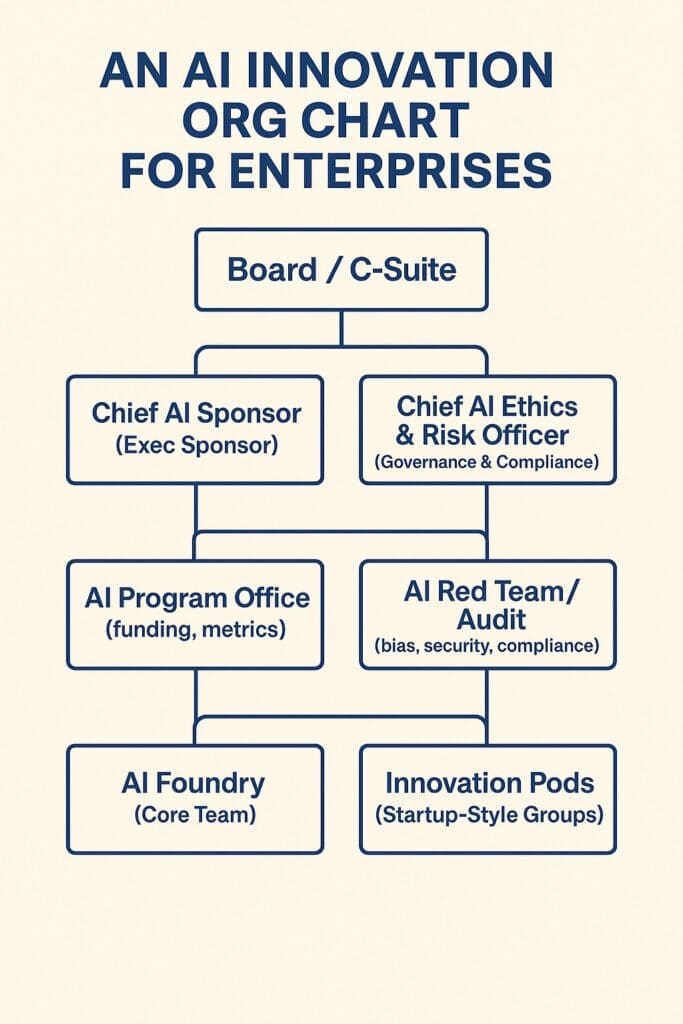
Here’s a simple blueprint for enterprises:
                Board / C-Suite
                     │
         ┌───────────┴───────────┐
         │                       │
 Chief AI Sponsor         Chief AI Ethics & Risk Officer
 (Exec Sponsor)           (Governance & Compliance)

                     │
         ┌───────────┴───────────┐
         │                       │
  AI Program Office        AI Red Team / Audit
  (funding, metrics)       (bias, security, compliance)
         │
   ┌─────┴─────┐
   │           │
AI Foundry   Innovation Pods
(Core Team)  (Startup-Style Groups)
Roles and Responsibilities
🧭 Chief AI Sponsor (Executive Shield)
- A C-level leader (CFO, COO, or CIO) who provides political air cover.
- Protects innovation teams from naysayers and bureaucracy.
- Champions AI successes to shareholders, partners, and regulators.
⚖️ Chief AI Ethics & Risk Officer
- Ensures AI projects align with compliance, regulation, and brand reputation.
- Oversees ethical frameworks, fairness, and security policies.
- Acts as the counterweight to unrestrained experimentation.
📈 AI Program Office (APO)
- Functions like an internal venture capital arm.
- Provides funding to AI innovation pods.
- Tracks ROI, outcomes, and innovation metrics.
- Aligns projects with broader corporate strategy.
Analogy: DARPA for the enterprise — funding multiple bets, expecting some to fail, and celebrating the winners.
🔧 AI Foundry (Core Enablement Team)
- Builds the shared AI infrastructure that all pods use:
- APIs for model access
- Data pipelines and cleansing tools
- Vector databases and orchestration frameworks (Semantic Kernel)
- Monitoring dashboards for usage and performance
- Ensures security and compliance baselines are met.
Analogy: The “air support” for AI pods. Without them, every team reinvents the wheel.
🚀 AI Innovation Pods
- Small, startup-style teams (6–12 people).
- Operate in 90-day cycles to produce MVPs, demos, or pilots.
- Report to the AI Program Office, not middle management.
Roles inside a pod:
- Business lead (domain expert: finance, HR, operations, etc.)
- Product owner (keeps scope aligned)
- 2x .NET developers (integration into existing systems)
- Data scientist / applied ML engineer
- Prompt engineer (LLM + copilot flows)
- UX designer
- QA/test automation
Pods have freedom to experiment with Azure AI, ML.NET, and external APIs. Successes get scaled, failures get documented.
🛡️ AI Red Team
- Stress-tests prototypes before they scale.
- Looks for bias, hallucinations, adversarial prompts, or data leaks.
- Works as a checkpoint, not a choke point.
- Protects the company without stifling innovation.
How It All Works in Practice
- Executive direction: The C-Suite sets the big goals (e.g., “Cut customer support costs 20% with AI”).
- Program Office funds pods: Several AI pods are spun up with seed budgets.
- Pods innovate: Each pod runs rapid experiments, builds MVPs, and tests with users.
- Foundry supports: Provides shared pipelines, APIs, and guardrails so pods move faster.
- Red Team checks: Validates prototypes for bias and security before they reach production.
- Program Office integrates: Scales successful projects into the enterprise.
- Chief AI Sponsor promotes: Showcases wins to keep funding and momentum flowing.
Case Study Example: Microsoft-Heavy Enterprise
A global manufacturer runs thousands of .NET applications. The CEO appoints a Chief AI Sponsor to lead innovation.
- The Program Office launches three pods:
- Pod 1 builds an AI copilot for maintenance technicians.
- Pod 2 prototypes a predictive ML.NET model for supply chain disruptions.
- Pod 3 experiments with Azure AI search to improve customer support knowledge bases.
- The Foundry team creates a shared data lake on Azure and APIs for all pods.
- The Red Team tests Pod 3’s chatbot for hallucinations before rollout.
Result: multiple parallel innovations, all moving fast but within guardrails.
Benefits of This Structure
- Speed: Pods work in parallel, not in line.
- Safety: Red Team and Ethics Officer keep compliance in check.
- Reusability: Foundry prevents duplicated effort.
- Scalability: Program Office integrates wins into enterprise systems.
- Culture: Employees feel empowered to innovate without career risk.
Why It Works
The org chart borrows from proven historical models:
- Military special forces: Commander’s intent → autonomy at the edges.
- DARPA: Fund many experiments, expect failure, celebrate breakthroughs.
- Skunkworks: Isolated, agile teams shielded from bureaucracy.
- Corporate VC arms: Seed funding for internal ideas with real upside.
Applied to AI, this balance of freedom + structure ensures large enterprises can innovate like startups without risking collapse.
Conclusion
AI innovation isn’t just about hiring data scientists or buying shiny tools. It’s about structuring your organization to move fast, experiment boldly, and scale safely.
This org chart gives enterprises a blueprint:
- Leadership air cover (Chief AI Sponsor)
- Ethical guardrails (Ethics Officer + Red Team)
- Enablement layer (Foundry team)
- Startup pods that ship results fast
- Program Office that funds, tracks, and scales
The giants of yesterday fell because they couldn’t adapt. The winners of tomorrow will be those who combine the power of size with the agility of startups.
If you’ve not read Part One of this article, here is the link
Want More?
- Check out all of our free blog articles
- Check out all of our free infographics
- We currently have two books published
- Check out our hub for social media links to stay updated on what we publish
