Introduction
Success can be a trap. The very processes and structures that allow an organization to dominate can eventually suffocate the creativity that made it great.
Intel once set the pace for the entire semiconductor industry, only to stumble as AMD and TSMC overtook it. NASA put humans on the moon, but decades later private firms like SpaceX are outpacing it in launch innovation. History is full of giants that slowed down while smaller, hungrier competitors ran faster.
Now, as artificial intelligence reshapes every industry, the same risk looms over today’s largest enterprises. Bureaucracy, risk aversion, and cultural inertia are the enemies of speed — and speed is the lifeblood of AI adoption.
The question is simple:
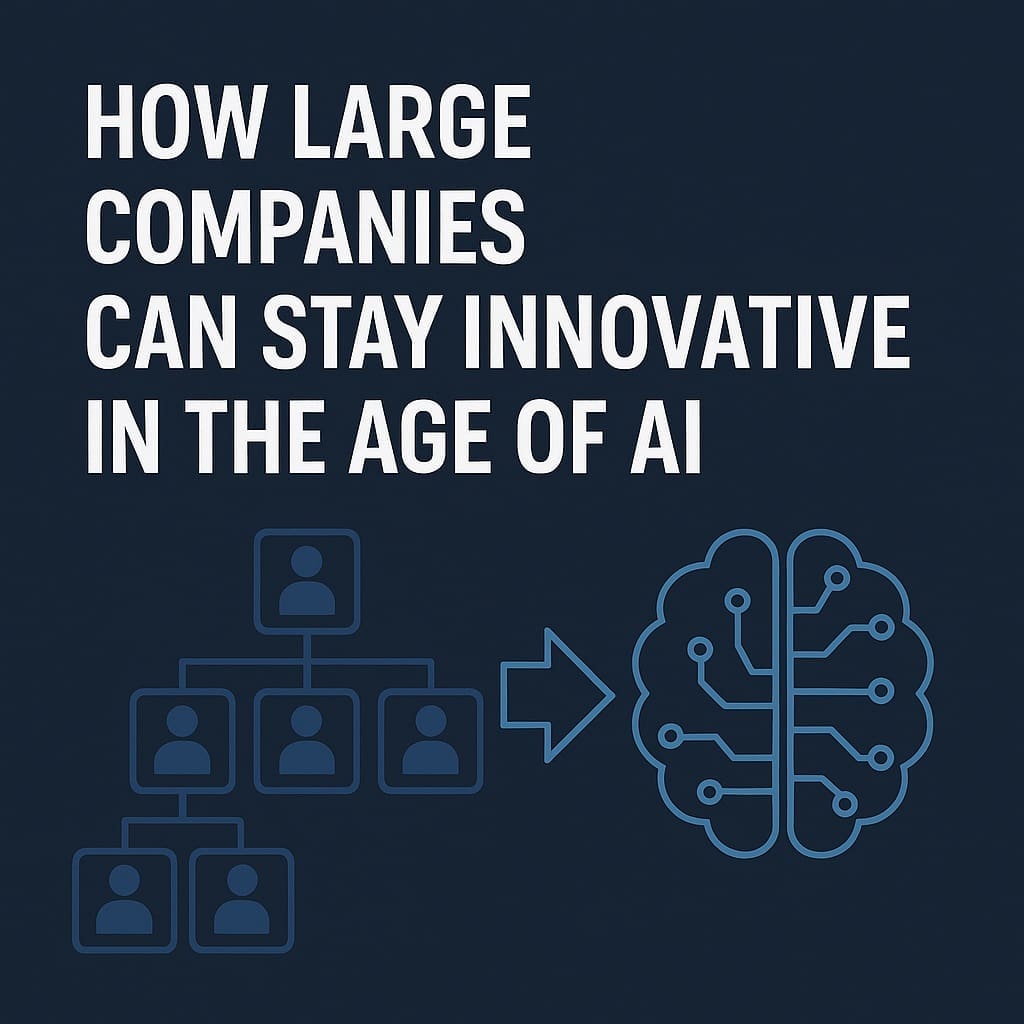
👉 How can large companies stay innovative in the age of AI without being dragged down by their own size?
Why Giants Lose Their Edge
Let’s start with the anatomy of decline. Big companies rarely fall because of a single mistake. They decline because of patterns that set in over time.
1. Bureaucracy Creep
Processes built to manage scale slowly turn into obstacles to experimentation. A new idea needs dozens of approvals. A prototype dies in paperwork before it ever sees a customer.
2. Risk Aversion
When you dominate, you have more to lose than to gain. Leaders stop asking “What if?” and start asking “What could go wrong?” The safest path becomes doing nothing.
3. Protecting the Core
Instead of creating the future, employees are told to defend the past. Intel famously clung to PC chips even as mobile and GPUs took off. NASA doubled down on the Space Shuttle instead of moving to reusability sooner.
4. Disruptors Move Faster
Startups don’t have legacy systems, political baggage, or billion-dollar revenue streams to protect. They take risks because they must. And that urgency lets them move faster than bureaucracies can respond.
Bottom line: Big companies don’t lack talent. They lack the oxygen for talent to experiment, fail, and try again.
Lessons from History
Intel vs. TSMC
Intel dominated chipmaking for decades. But when it stumbled on 14nm and delayed its 10nm rollout, TSMC seized the lead. Fabless companies like AMD and Nvidia thrived by leveraging TSMC’s progress. Intel’s bureaucracy magnified every delay — a two-year slip in manufacturing cascaded across every product.
NASA vs. SpaceX
NASA in the Apollo era was lean, bold, and experimental. By the 1990s, it was risk-averse, over-managed, and politically constrained. SpaceX embraced a different philosophy: rapid prototyping, fast failure, and iteration. Where NASA hesitated, SpaceX launched, exploded, learned, and launched again.
The lesson: Innovation belongs to those who ship — not those who protect.
Principles for Staying Innovative
Large companies can avoid stagnation by deliberately structuring for innovation. Here are the core principles, reframed for the age of AI.
1. Commander’s Intent, Not Micromanagement
In elite military units, leaders set intent — the why and goal — but not the how. This autonomy empowers units to adapt on the fly.
AI twist: Set business objectives like, “Cut customer support costs by 20% with AI in 12 months.” Then let small teams figure out the methods — chatbots, copilots, automation — without executive second-guessing.
2. Skunkworks-Style Teams
Breakthroughs often come from isolated, protected groups:
- Lockheed’s Skunk Works created the SR-71 Blackbird.
- Apple’s Mac team raised a pirate flag.
- Intel’s Israeli engineers built the Pentium M → Core transition.
AI twist: Create small, startup-like pods (6–12 people) where developers, data engineers, and domain experts can experiment without interference. Give them autonomy, a budget, and a separate environment to breathe.
3. Sandbox Funding and Rapid Prototyping
DARPA doesn’t expect every project to succeed. It funds dozens, knowing most will fail and a few will redefine the battlefield.
AI twist:
- Give each innovation pod a small budget they can spend freely.
- Measure them by number of prototypes tested, not just ROI.
- Use tools like ML.NET, Azure AI, and Semantic Kernel for fast prototypes that prove or disprove ideas quickly.
4. Build and Buy
Some innovations are too core to outsource. Others are too fast-moving to build internally.
- Build: Proprietary copilots and AI integrations tied to your IP and workflows.
- Buy: Startups in fast-changing areas like generative media or AI security.
The mistake is choosing one path. The winners do both.
5. Intrapreneurial Incentives
People innovate when they’re rewarded for risk-taking. In too many companies, failed experiments kill careers.
Fix it:
- Reward experimentation, even when it doesn’t pan out.
- Create “internal VC” systems where employees pitch AI ideas and win seed funding.
- Rotate leaders between the core business and innovation teams so AI literacy spreads.
6. Guardrails Without Handcuffs
AI brings real risks: bias, hallucinations, and compliance issues. But burying innovation teams in legal reviews kills speed.
Solution: Run checkpoints instead of choke points. Build AI “red teams” that stress-test models before production, but don’t force every prototype through the full compliance gauntlet upfront.
Why AI Demands This Approach
AI moves faster than previous waves of technology. Cloud adoption took years. Mobile transformation spanned a decade. AI breakthroughs happen monthly.
- Generative AI models double capabilities in under two years.
- Competitors can leapfrog by plugging into the same APIs you could have used yesterday.
- Talent expects freedom to experiment; if they don’t get it, they’ll join the startup across the street.
Large enterprises must recognize that AI innovation is not optional. It’s existential.
Practical First Steps for Enterprises
- Set clear intent. Define AI goals in terms of business outcomes, not technologies.
- Create startup pods. Assemble 6–12 person teams with cross-functional skills.
- Fund experiments. Allocate small, no-approval-needed budgets.
- Balance build and buy. Protect your IP, but be pragmatic about time-to-market.
- Change incentives. Reward employees for learning, not just revenue.
- Add checkpoints. Run ethical and security reviews before scaling, not before testing.
Conclusion
Innovation dies in large companies not because people stop being creative, but because systems stop letting creativity breathe. Bureaucracy, fear, and risk-aversion slowly choke the oxygen out of experimentation.
The age of AI demands a different approach: small autonomous teams, rapid prototyping, balanced build-and-buy strategies, and incentives that reward boldness. Guardrails should guide innovation, not strangle it.
The lesson from Intel, NASA, and every fallen giant is clear: yesterday’s victories don’t guarantee tomorrow’s relevance.
Enterprises that adopt these principles will stay agile, relevant, and competitive. Those that don’t will watch startups — and competitors — run circles around them.
As Andy Grove famously said: “Only the paranoid survive.”
Stay Tuned for our follow on article – an actual organization chart for innovation.
Want More?
- Check out all of our free blog articles
- Check out all of our free infographics
- We currently have two books published
- Check out our hub for social media links to stay updated on what we publish
