
Artificial Intelligence should be engineered like infrastructure — not treated like a novelty.
The Enterprise AI Architecture (EAA) defines a structured, stage-gated construction model for introducing AI into enterprise systems in a governed, repeatable, and defensible way.
In practice, we most often apply it in Microsoft-centric environments.
EAA is designed for enterprise technology leaders who need to integrate AI into production environments without destabilizing existing systems, compliance controls, or operational integrity.
Common Enterprise AI Problems EAA Is Designed to Solve
- Too many AI ideas and no clear prioritization
- Workflows that are still too vague to automate safely
- Disconnected AI solutions across teams
- Pressure to introduce agents before the foundation is stable
- Executive hesitation caused by risk, compliance, and integration concerns
What EAA Is
EAA is a construction-order architecture framework.
It defines:
- How enterprise AI systems should be built
- In what sequence they should be built
- What validation criteria must be satisfied before progressing
- When automation is justified
- When autonomy is safe to introduce
- How governance, oversight, and approval constraints are incorporated
It is not a tooling guide.
It is not a prompt engineering method.
It is not a model comparison catalog.
It is an architectural discipline for controlled enterprise AI adoption.
Why Enterprise AI Requires Architecture
Most AI initiatives fail for structural reasons, not because the underlying models are weak.:
- Work is not clearly defined
- Decision boundaries are ambiguous
- Capabilities are unstable
- Automation is introduced before validation
- Agents are introduced before the foundation is ready
- Governance is retrofitted instead of designed from the beginning
Enterprise AI failure is rarely just a model problem.
It is usually a construction-order, governance, and execution-discipline problem.
EAA is designed to address these failure modes directly.
The Six Pillars of Enterprise AI Construction
EAA is structured around six vertical pillars that define construction order.
Each pillar answers a different architectural question and establishes a different layer of enterprise AI discipline.
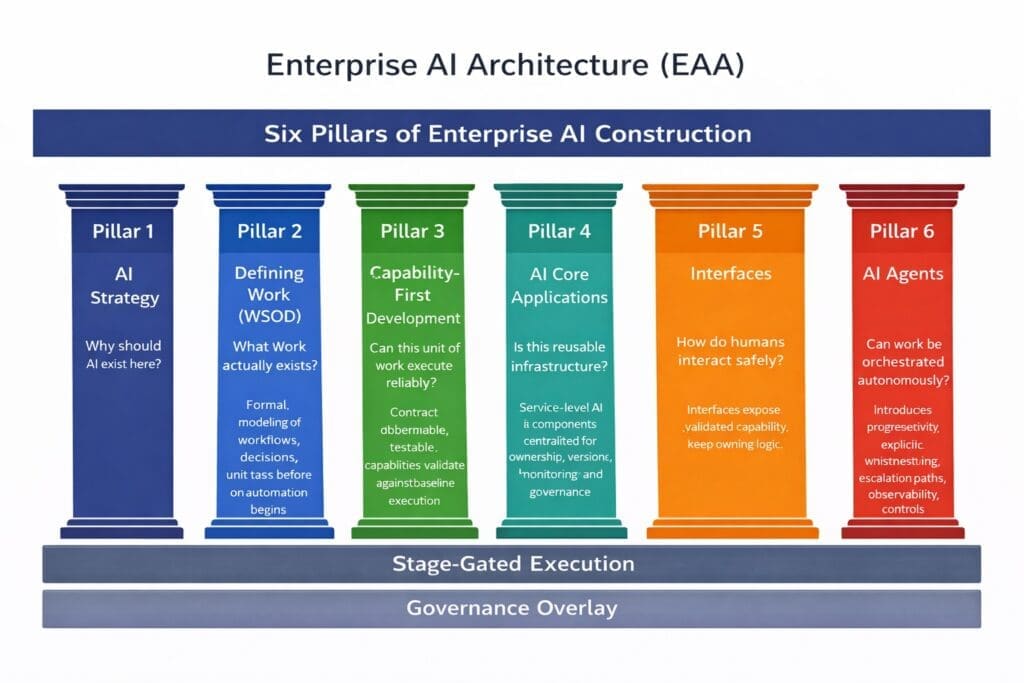
Pillar 1 — AI Strategy
Why should AI exist here at all?
Defines business intent, outcome priorities, explicit non-automation boundaries, and acceptable risk tolerance.
Pillar 2 — Defining Work
What work actually exists here?
Makes workflows, decisions, and unit tasks explicit before automation begins.
Pillar 3 — Capability-First Development
Can this unit of work execute reliably and repeatedly?
Creates contract-defined, observable, testable capabilities validated against baseline execution.
Pillar 4 — AI Core Applications
Is this intelligence reusable enough to become enterprise infrastructure?
Defines service-level AI components that justify centralized ownership, versioning, monitoring, and governance.
Pillar 5 — Interfaces
How do people interact with AI safely and clearly?
Interfaces expose validated capability.
They do not own business logic.
Pillar 6 — Agents
Can work now be orchestrated autonomously within explicit guardrails?
Autonomy is introduced progressively through explicit capability whitelisting, escalation paths, and observability controls.
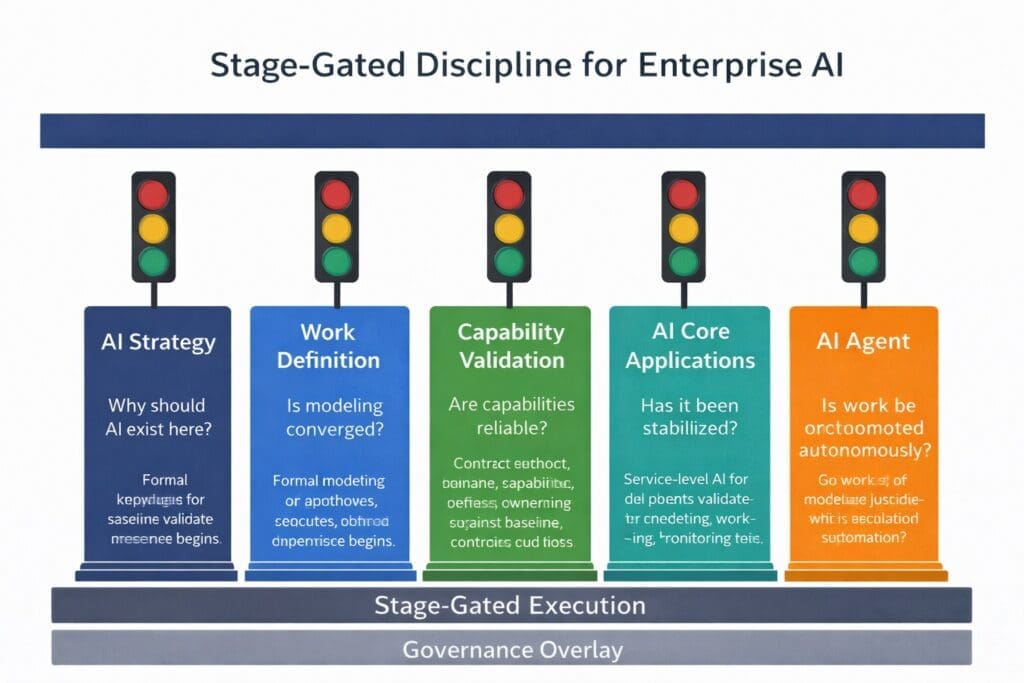
Stage-Gated Execution Discipline
EAA enforces explicit stop conditions between major architectural transitions. Stage gates define the validation criteria required before advancing from modeling to capability, from capability to service, and from service to autonomy.
Advancement is permitted only when those validation criteria are satisfied.
Stage gates determine:
- when workflow modeling has converged
- when a capability is ready for production use
- when centralization is justified
- when orchestration is safe
- when autonomy may be introduced
This prevents premature automation, unstable orchestration, and uncontrolled agent behavior.
Enterprise AI systems should evolve through controlled validation — not experimentation drift.
Governance Overlay Model
Enterprise AI is institutional, not experimental.
EAA incorporates governance overlays that address:
- executive risk tolerance
- security and compliance constraints
- integration anxiety
- organizational change friction
- vendor lock-in concerns
AI adoption is treated as enterprise infrastructure — not as a lab initiative.
Microsoft Alignment
EAA is designed to work in enterprise environments broadly. In practice, we most often apply it in Microsoft-centric organizations.
EAA integrates naturally with:
- .NET application architecture
- Azure AI services
- contract-first APIs
- observability and logging standards
- DevOps and CI/CD pipelines
- enterprise security controls
AI should integrate into existing enterprise systems.
It should not bypass them.
What EAA Is Not
EAA does not:
- replace enterprise architecture
- eliminate human authority
- advocate uncontrolled AI agents
- encourage tool-driven experimentation
- promote model-first design
It enforces construction discipline before automation and guardrails before autonomy.
Who This Framework Is For
EAA is designed for:
- CIOs and CTOs introducing AI into production systems
- VPs of Engineering and architecture leaders
- AI Innovation Teams operating in Microsoft environments
- government and regulated enterprises
- enterprise architects responsible for long-term system stability
It is not designed for hobbyist experimentation or casual AI tinkering.
From Framework to Application
The framework is applied and validated through structured vertical slices across enterprise domains, demonstrating repeatable construction order, controlled execution, and disciplined autonomy introduction.
Explore:
- The Six Pillars
- Stage-Gated Discipline
- Vertical Slice Applications
- Governance & Adoption Model
- Structured Engagement Services
Enterprise AI Requires Discipline
Artificial Intelligence is powerful.
Without structure, validation, and construction order, it becomes operational risk.
EAA exists to bring order, safety, and repeatability to enterprise AI adoption — especially within Microsoft-centric enterprise environments.
AI should strengthen enterprise systems — not destabilize them.
Next Steps
Schedule an EAA Diagnostic
Explore Pillar 1 — AI Strategy
Learn About Stage-Gated Discipline
Frequently Asked Questions
What is Enterprise AI Architecture (EAA)?
Enterprise AI Architecture (EAA) is the structural blueprint for building enterprise AI systems in a disciplined, repeatable, and governable way.
It defines:
- how enterprise AI systems should be structured
- the order in which major AI design decisions should be made
- when automation is justified
- when autonomy is safe
- how governance and validation fit into the process
In simple terms, EAA helps organizations build AI systems with construction order instead of tool chaos.
How is EAA different from EAEM?
EAA is one part of EAEM.
- EAEM is the full enterprise AI methodology
- EAA is the architecture layer inside that methodology
EAEM includes:
- the Enterprise AI Operating Model
- EAA
- stage-gated execution discipline
- governance and validation patterns
So EAA explains how AI solutions are structured, while EAEM explains the larger system for choosing, designing, validating, and governing them.
How is EAA different from the Enterprise AI Operating Model?
The Enterprise AI Operating Model helps the organization decide:
- which AI initiatives to pursue
- how to prioritize them
- how to evaluate prototypes and MVPs
EAA begins after an initiative is serious enough to enter structured design.
Simple version:
EAA = how should that AI solution be architected?
Operating Model = what AI work should we pursue?
Why do enterprises need AI architecture?
Because most enterprise AI problems are not caused by lack of tools. They are caused by lack of structure.
Common failure patterns include:
- unclear workflows
- weak capability design
- disconnected solutions across teams
- premature automation
- premature agents
- governance added too late
EAA exists to reduce those problems by forcing the right construction order.
What are the six pillars of EAA?
The six pillars are:
- AI Strategy
- Defining Work (WSOD)
- Capability Realization & Sourcing
- AI Core Applications
- Interfaces
- AI Agents
These are not just categories. They are a construction sequence.
Why does the order of the six pillars matter?
Because later sophistication cannot fix earlier ambiguity.
If the strategy is unclear, modeling becomes unstable.
If the work is unclear, capability design becomes weak.
If capabilities are unstable, orchestration and agents become risky.
EAA is built on the idea that:
- intent comes before modeling
- modeling comes before execution
- execution comes before orchestration
- orchestration comes before autonomy
That order is one of the main reasons the framework is useful.
Does EAA require AI agents?
No.
EAA does not assume agents are always appropriate. In fact, one of its core ideas is that agents come last, not first.
Agents should only be introduced after:
- guardrails and observability are in place
- strategy is clear
- work is defined
- capabilities are stable
- interfaces and exception paths exist
Does EAA replace enterprise architecture?
No.
EAA does not replace enterprise architecture. It extends and strengthens it for AI-specific problems.
It adds structure around things like:
- workflow clarity
- capability validation
- AI service governance
- bounded autonomy
- stage-gated progression
It should work with existing architecture practices, not against them.