
Pattern Thinking in the Age of LLMs
A Practical Decision Model for Smarter AI Use
Formats: eBook, Audiobook
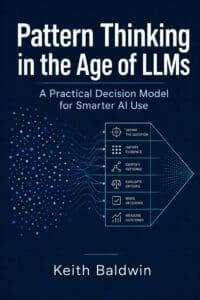
Pattern Thinking in the Age of LLMs is a practical guide for professionals who want better results from large language models by improving how they think before they prompt.
Large language models can generate, summarize, compare, draft, explain, and explore ideas. But they do not replace human judgment. They do not define your values. They do not own your risks. They do not understand your tradeoffs unless you provide the right context, constraints, and decision framework.
Most weak AI results do not begin with weak technology.
They begin with weak thinking.
This book explains how to use patterns, frameworks, constraints, cycles, and decision models to get more useful results from LLMs such as ChatGPT, Microsoft Copilot, Claude, Gemini, and other AI tools.
Availability links will be added when the eBook is published.
Better AI Use Starts Before the Prompt
Many people use LLMs by typing vague questions and hoping for useful answers.
That usually produces generic output.
Generic output may sound polished, but it often lacks the context, structure, constraints, and validation needed for real decisions.
Weak LLM usage often looks like this:
Vague Question → Generic Output → Weak Decision
Pattern-first usage is different.
Context → Constraints → Framework → Targeted Prompt → Validated Output
This book is about that difference.
It is not a collection of prompt tricks. It is a practical thinking model for using AI tools more intelligently.
What This Book Is About
Pattern Thinking in the Age of LLMs explains how to use AI as a thinking assistant without outsourcing judgment to the AI.
The book focuses on a simple but important idea:
LLMs are more useful when humans bring structure to the conversation.
That structure can include:
- Clear context
- Decision constraints
- Business goals
- Risk boundaries
- Evaluation criteria
- Patterns from prior experience
- Frameworks for comparison
- Cycles for refinement
- Human validation before action
The better the thinking model, the better the AI conversation.
Why Pattern Thinking Matters
LLMs are powerful because they can work with language, ideas, examples, alternatives, summaries, and comparisons.
But that power creates a trap.
Because the output sounds confident, people may treat it as a decision.
That is dangerous.
An LLM can help explore options, but it should not own the final tradeoff. It can help draft a plan, but it should not define the organization’s values. It can compare alternatives, but it does not automatically know which risks matter most.
Pattern thinking gives the human a stronger role.
Instead of asking the AI to “figure it out,” the human defines the structure:
- What situation are we in?
- What pattern does this resemble?
- What constraints matter?
- What decision are we trying to make?
- What tradeoffs are acceptable?
- What would make the output useful?
- How should the result be validated?
That is how LLM usage becomes more practical, less random, and more decision-oriented.
The Core Model
The book is built around a practical decision model:
Reality → Patterns → Cycles → Frameworks → Decisions → LLM-Assisted Decisions
The goal is to help readers move from raw situations to better AI-assisted decisions.
Reality is messy.
Patterns help us recognize what kind of situation we are facing.
Cycles help us understand repeated behavior over time.
Frameworks help us organize the problem.
Decisions require tradeoffs, judgment, and accountability.
LLMs can assist the process, but they should not replace the human decision-maker.
This model helps readers use AI with more structure and less guesswork.
LLMs Are Not the Decision-Maker
One of the central ideas of this book is that the LLM and the human have different jobs.
The LLM can help:
- Generate ideas
- Compare options
- Summarize information
- Draft language
- Explore alternatives
- Identify possible risks
- Create examples
- Reframe problems
The human must still:
- Define values
- Judge risk
- Own tradeoffs
- Understand context
- Approve action
- Validate output
- Take responsibility for the final decision
This distinction matters.
When professionals forget it, AI becomes a shortcut for weak judgment. When professionals remember it, AI becomes a powerful thinking partner.
Who This Book Is For
Pattern Thinking in the Age of LLMs is written for professionals who use AI tools for thinking, planning, writing, analysis, strategy, communication, or decision support.
This eBook is especially useful for:
Business Leaders and Managers
Use LLMs to explore options, compare tradeoffs, draft plans, and think through decisions without giving up responsibility for the final judgment.
Entrepreneurs and Consultants
Use pattern-first thinking to analyze opportunities, clarify positioning, evaluate risks, and generate stronger business ideas.
Writers and Content Creators
Use LLMs to move beyond generic content by applying structure, audience context, constraints, and validation.
Analysts and Knowledge Workers
Use AI tools to summarize information, compare alternatives, structure problems, and improve decision support.
Architects and Technical Leaders
Use pattern thinking to evaluate systems, design tradeoffs, technology decisions, risks, workflows, and implementation options.
Developers and Engineers
Use LLMs more effectively for problem analysis, design thinking, debugging, explanation, documentation, and software decision-making.
Professionals New to AI
Learn how to use AI tools more effectively without relying on vague prompts or generic responses.
What Readers Will Learn
Readers will learn how to improve AI-assisted thinking by using patterns before prompts.
Topics include:
- Why vague prompts produce weak results
- Why generic AI output often feels useful but fails under pressure
- How patterns improve LLM conversations
- How to use constraints to guide AI output
- How frameworks improve decision quality
- How to separate AI assistance from human judgment
- How to use cycles to refine thinking over time
- How to validate AI-generated output
- How to avoid treating AI as the decision-maker
- How to use LLMs for smarter planning, analysis, writing, and strategy
The book helps readers use AI tools more deliberately, not just more frequently.
Not a Prompt Trick Book
There are already many resources about prompt engineering.
This book is different.
Prompt wording matters, but the prompt is only the visible part of the thinking process. A good prompt usually comes from better context, better constraints, better framing, and a clearer understanding of the decision being made.
This book focuses on what happens before the prompt:
- How the situation is understood
- How the problem is framed
- How constraints are selected
- How tradeoffs are evaluated
- How patterns are recognized
- How output will be judged
Better prompts are often the result of better thinking.
From Weak AI Usage to Pattern-First AI Usage
Weak AI usage asks the tool to do too much of the thinking.
It sounds like:
- “What should I do?”
- “Write something about this.”
- “Make a strategy.”
- “Tell me the best option.”
- “Analyze this.”
Those requests may produce fluent answers, but they often lack the structure needed for serious use.
Pattern-first AI usage is more deliberate.
It gives the LLM:
- Situation context
- Audience context
- Constraints
- Goals
- Decision criteria
- Known tradeoffs
- Examples
- Output format
- Validation requirements
That shift changes the quality of the output.
The LLM becomes less of a magic answer box and more of a structured thinking assistant.
Why This Matters Now
LLMs are becoming part of daily professional work.
People use them to write emails, create reports, evaluate ideas, summarize documents, compare options, generate code, prepare presentations, plan projects, analyze risks, and make decisions.
That means the quality of AI-assisted work increasingly depends on the quality of the human thinking behind it.
Professionals who learn to combine pattern thinking with AI tools will get better results than professionals who only learn a few prompt templates.
The advantage is not just knowing what to type.
The advantage is knowing how to think.
A Focused eBook for Practical AI Users
Pattern Thinking in the Age of LLMs is being published as a focused eBook.
That format is intentional. This is a practical model readers can move through quickly, revisit often, and apply directly to AI-assisted work.
The book is designed for professionals who want a clearer way to use LLMs for real thinking, not just faster output.
Availability
Pattern Thinking in the Age of LLMs: A Practical Decision Model for Smarter AI Use is currently at publisher and should be available soon.
Formats: eBook, Audiobook