
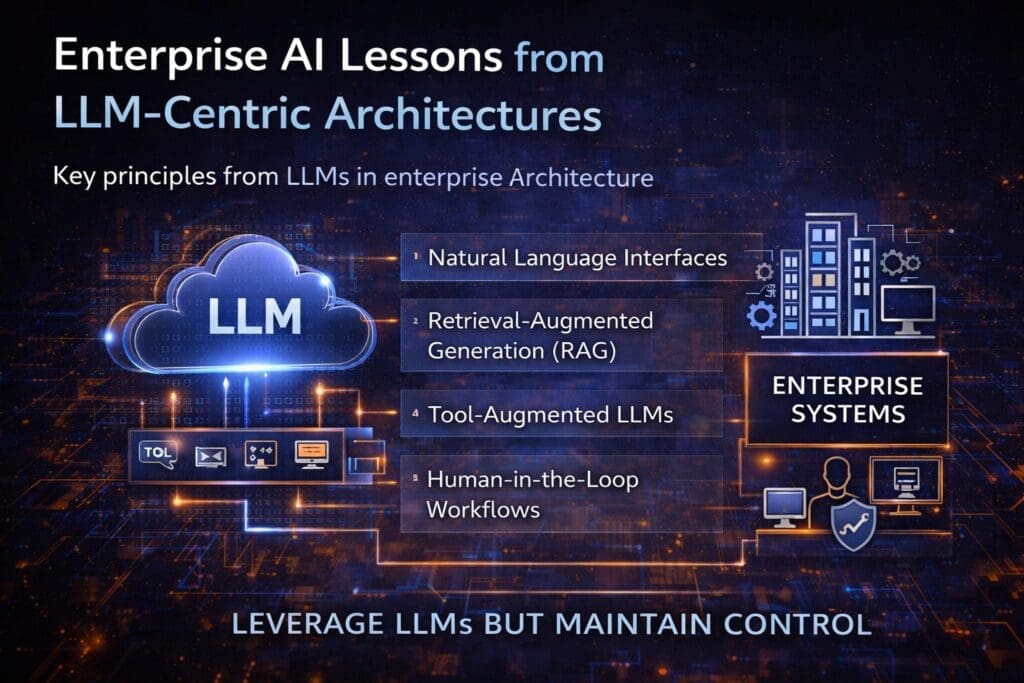
Large Language Models (LLMs) have rapidly become the centerpiece of modern AI discussions.
From copilots and chatbots to document processing and knowledge retrieval systems, LLMs are driving a new generation of applications across industries.
As a result, many architecture patterns have emerged that place LLMs at the center of system design — commonly referred to as LLM-centric architectures.
While these architectures have demonstrated powerful capabilities, enterprises must carefully evaluate how to incorporate them into production systems.
The objective is not to build systems where LLMs control everything.
Instead, enterprises should extract the design patterns that enhance flexibility and usability, while maintaining control, governance, and reliability.
Key Lessons from LLM-Centric Architectures
- Use LLMs as an interface layer, not a control layer
- Ground outputs with retrieval-augmented generation (RAG)
- Integrate LLMs with enterprise tools and APIs
- Keep business logic outside the LLM
- Implement monitoring, logging, and governance
What Is an LLM-Centric Architecture?
An LLM-centric architecture places a large language model at the core of system interaction and decision-making.
In these systems, the LLM often:
- interprets user input
- determines intent
- retrieves or generates content
- orchestrates workflows
- interacts with external tools and APIs
Common patterns in LLM-centric systems include:
- prompt-based workflows
- retrieval-augmented generation (RAG)
- conversational interfaces
- tool-augmented LLMs
- natural language-driven orchestration
These architectures prioritize flexibility and user interaction, allowing systems to adapt to a wide range of inputs and use cases.
Why LLM-Centric Architectures Are Gaining Adoption
LLM-centric architectures are popular because they simplify interaction with complex systems.
Instead of navigating structured interfaces, users can:
- ask questions in natural language
- request data or analysis
- automate workflows through conversation
- generate content dynamically
This dramatically reduces the friction between users and enterprise systems.
Additionally, LLMs provide:
- general-purpose reasoning capabilities
- rapid prototyping of new features
- adaptability across domains
- the ability to unify multiple system interactions behind a single interface
For enterprises, this creates opportunities to improve productivity and user experience.
Architectural Patterns Enterprises Should Adopt
Despite the risks of over-centralizing LLMs, several patterns from LLM-centric architectures translate well to enterprise environments.
1. Natural Language as an Interface Layer
One of the most valuable contributions of LLM-centric architectures is the use of natural language as a user interface.
Instead of building complex UI workflows, enterprises can expose capabilities through:
- chat interfaces
- conversational APIs
- natural language query systems
This allows users to interact with systems more intuitively.
However, natural language should act as a front-end interface, not the core business logic layer.
2. Retrieval-Augmented Generation (RAG)
RAG is a foundational pattern in modern LLM systems.
It combines:
- structured data retrieval
- knowledge base access
- LLM-generated responses
This approach improves accuracy and relevance by grounding LLM outputs in enterprise data.
For enterprises, RAG enables:
- knowledge management systems
- document search and summarization
- customer support automation
- internal research tools
RAG allows organizations to leverage LLMs while maintaining control over information sources.
3. Tool-Augmented LLMs
LLM-centric architectures often enhance models with access to tools such as:
- APIs
- databases
- search systems
- business logic services
This allows LLMs to go beyond text generation and interact with real systems.
Enterprises should adopt tool-based LLM integration, where:
- LLMs call structured services
- business logic remains in deterministic systems
- outputs are validated before execution
This pattern balances flexibility with reliability.
4. Prompt Abstraction and Reusability
LLM-centric systems rely heavily on prompts.
Mature architectures treat prompts as structured assets rather than ad hoc inputs.
This includes:
- version-controlled prompts
- reusable prompt templates
- prompt testing and evaluation
- prompt optimization workflows
For enterprises, managing prompts systematically improves consistency and reduces operational risk.
5. Human-in-the-Loop for Critical Decisions
LLMs are probabilistic systems and can produce incorrect or inconsistent outputs.
For high-impact scenarios, enterprises must implement:
- approval workflows
- validation layers
- human review processes
This ensures that decisions remain accountable and auditable.
LLMs should assist decision-making — not replace it in critical systems.
Where LLM-Centric Architectures Create Enterprise Challenges
While LLM-centric architectures offer significant advantages, they also introduce risks when applied without structure.
1. Over-Centralization of Logic
One of the most common mistakes is placing too much responsibility on the LLM.
When LLMs control:
- business logic
- decision-making
- workflow execution
systems become difficult to test, debug, and audit.
Enterprises should keep core logic in structured backend systems.
2. Lack of Determinism
LLMs do not produce consistent outputs for identical inputs.
This creates challenges for:
- testing
- compliance
- reproducibility
- auditing
Systems that require deterministic behavior should not rely solely on LLM outputs.
3. Security and Data Exposure Risks
LLMs interacting with enterprise data can introduce:
- data leakage risks
- unauthorized access
- improper data handling
Organizations must enforce:
- access controls
- data filtering
- logging and monitoring
- secure API integration
4. Prompt Fragility
Small changes in prompts can produce significantly different outputs.
Without proper management, this can lead to inconsistent system behavior.
Enterprises should treat prompts as part of the system architecture, not informal inputs.
When LLM-Centric Architectures Work Best
LLM-centric architectures are particularly effective in use cases involving:
- knowledge retrieval
- content generation
- conversational interfaces
- research and analysis
- user assistance tools
These scenarios benefit from flexibility and natural language interaction.
Applying LLM Patterns in Enterprise AI Systems
Enterprises should integrate LLMs into existing architectures rather than allowing them to dominate system design.
Best practices include:
- using LLMs as an interface layer
- grounding outputs with RAG
- integrating LLMs with structured tools
- maintaining deterministic backend services
- implementing human oversight
- monitoring outputs and system behavior
This approach allows organizations to leverage LLM capabilities without sacrificing control.
LLMs Are Powerful — But They Are Not the Architecture
LLMs represent a significant advancement in artificial intelligence.
They enable new ways of interacting with systems and automating tasks.
However, they should not be treated as the entire architecture.
Successful enterprise systems:
- separate interface from logic
- maintain governance and control
- integrate AI within structured systems
- balance flexibility with reliability
Organizations that over-rely on LLMs often encounter issues with consistency, security, and maintainability.
Conclusion
LLM-centric architectures have introduced powerful new capabilities for enterprise AI systems.
They simplify user interaction, enable flexible workflows, and allow organizations to rapidly deploy intelligent features.
However, enterprises must adopt these patterns carefully.
The most valuable lessons from LLM-centric architectures include:
- using natural language interfaces
- implementing retrieval-augmented generation
- integrating LLMs with structured tools
- managing prompts systematically
- maintaining human oversight
When applied thoughtfully, these patterns allow enterprises to build AI systems that are both powerful and reliable.
The goal is not to build systems around LLMs.
It is to integrate LLMs into architectures that remain governed, testable, and sustainable over time.
Frequently Asked Questions
What is an LLM-centric architecture?
An LLM-centric architecture is a system design where a large language model (LLM) plays a central role in interpreting user input, generating responses, and orchestrating workflows. These architectures often rely on natural language interfaces, prompt-based logic, and integrations with tools and data sources.
Should enterprises build systems entirely around LLMs?
Enterprises should avoid building systems entirely around LLMs. LLMs are probabilistic and can produce inconsistent outputs. Instead, organizations should integrate LLMs into structured architectures where business logic, governance, and critical workflows remain in deterministic backend systems.
What is Retrieval-Augmented Generation (RAG) in enterprise AI?
Retrieval-Augmented Generation (RAG) is an architecture pattern where an LLM retrieves relevant data from enterprise systems or knowledge bases before generating a response. This approach improves accuracy by grounding outputs in real data rather than relying solely on model training.
Why is RAG important for enterprise AI systems?
RAG is important because it:
- improves response accuracy
- reduces hallucinations
- allows integration with internal data
- ensures outputs are based on controlled information sources
It is one of the most reliable ways to use LLMs in enterprise environments.
What are tool-augmented LLMs?
Tool-augmented LLMs are systems where a language model can call external tools such as APIs, databases, or services. Instead of generating all outputs internally, the LLM interacts with structured systems to retrieve data or execute actions.
What is the biggest risk of LLM-centric architectures?
The biggest risk is over-centralizing system logic within the LLM. When business rules, workflows, and decision-making are handled by prompts instead of structured systems, the architecture becomes difficult to test, audit, and maintain.
Why are LLMs considered non-deterministic?
LLMs are non-deterministic because they generate responses based on probability rather than fixed rules. The same input can produce different outputs depending on context, parameters, or model behavior. This creates challenges for testing, compliance, and repeatability.
How should enterprises safely integrate LLMs?
Enterprises should integrate LLMs by:
- using them as an interface layer
- grounding outputs with RAG
- connecting them to structured tools and APIs
- maintaining backend business logic outside the LLM
- implementing monitoring and logging
- adding human oversight for critical decisions
This approach balances flexibility with control.
What is prompt management in enterprise AI systems?
Prompt management involves treating prompts as structured, version-controlled assets. This includes:
- storing prompts in repositories
- versioning changes
- testing prompt performance
- reusing templates across applications
Proper prompt management improves consistency and reduces risk.
When do LLM-centric architectures work best in enterprises?
LLM-centric architectures work best in scenarios involving:
- knowledge retrieval and search
- document summarization
- conversational interfaces
- internal research tools
- customer support assistants
These use cases benefit from flexibility and natural language interaction.
What is the difference between LLMs and traditional business logic?
LLMs are probabilistic systems that generate responses based on patterns in data, while traditional business logic is deterministic and rule-based. Enterprise systems should rely on deterministic logic for critical operations and use LLMs for interaction, interpretation, and augmentation.
What is the most common mistake enterprises make with LLMs?
The most common mistake is allowing LLMs to control workflows and decision-making without proper governance, validation, and monitoring. Successful implementations keep LLMs in a controlled role within a broader architecture.
Want More?
- Check out our free blog articles
- Check out our free infographics
- Check out our free whitepapers
- We currently have two books published
- Check out our hub for social media links to stay updated on what we publish
