AI is transforming how modern enterprises operate—but without human oversight, the results can become unpredictable, biased, or outright dangerous. As organizations embed AI deeper into workflows, the question is no longer “Can AI automate this?” but “How do we ensure the AI behaves responsibly?”
That’s where Human-in-the-Loop (HITL) design becomes essential.
In enterprise software—especially inside the .NET ecosystem—HITL is the foundation for trustworthy, auditable, and accountable AI systems. It ensures that AI enhances decision-making instead of silently replacing it.
This article breaks down how to design HITL systems for real-world business operations, where accuracy, compliance, and human accountability matter just as much as automation.
1. Why Human-in-the-Loop Matters in Enterprise AI
AI can analyze millions of data points, detect patterns, and generate predictions with incredible speed.
But AI cannot:
- Understand business context
- Interpret political, legal, or reputational risk
- Consider human nuance
- Take responsibility for final decisions
Humans, on the other hand:
- Apply judgment
- Understand exceptions
- Interpret edge cases
- Provide accountability
HITL combines the best of both.
It ensures that:
- AI handles the repetitive, high-volume analysis
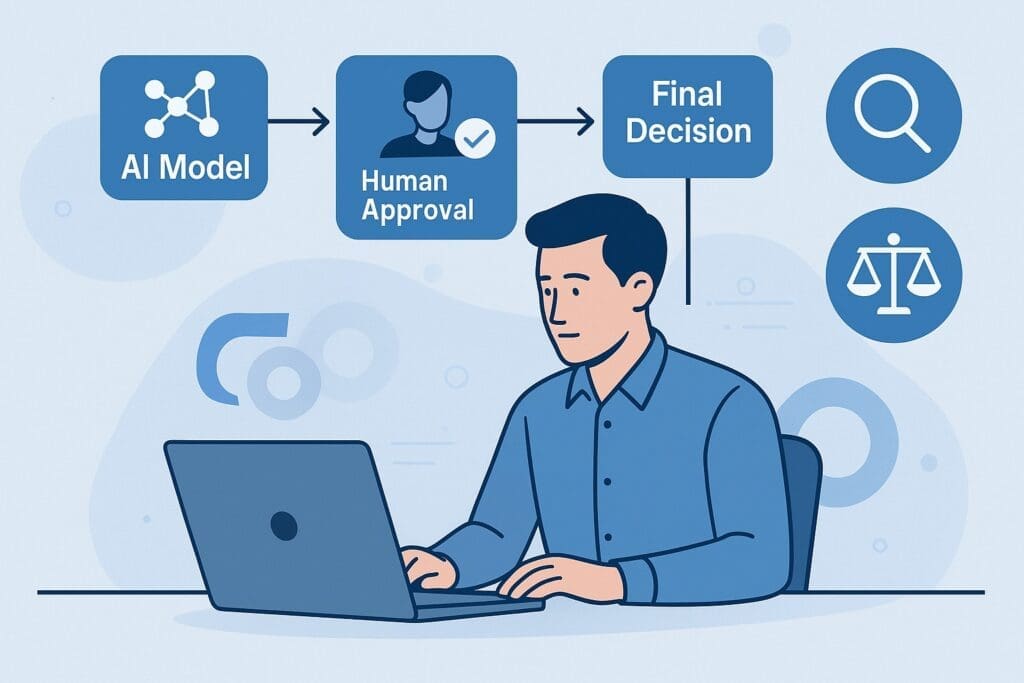
- Humans validate, approve, or override high-impact decisions
This prevents the “black box” problem and aligns AI with organizational ethics and governance.
2. Where Human Oversight Is Mandatory
Every enterprise has areas where AI must never operate autonomously:
✔ Compliance
Regulated industries require human sign-off.
✔ Legal or contractual decisions
AI can assist, but humans remain accountable.
✔ High financial impact
Loan approvals, payouts, settlements, procurement.
✔ Safety and operational risk
Healthcare, utilities, manufacturing, transportation.
✔ HR and personnel decisions
Hiring, firing, performance scoring.
If a decision affects people, money, or risk, HITL should be built in by design.
3. The HITL Architecture for .NET Enterprise Systems
A proper HITL system isn’t a bolt-on—it’s an architectural pattern.
The typical flow looks like this:
Data → AI Model → Preliminary Output → Human Review → Final Decision → Logging & Feedback
In .NET terms:
1. AI Service (ML.NET, Azure AI, or Semantic Kernel)
Provides prediction, classification, or reasoning.
2. Decision Orchestrator (Business Layer)
Determines when human approval is required.
3. Human Review Layer
Blazor app, internal dashboard, workflow inbox, or approval queue.
4. Audit & Logging
Logs AI output, human changes, rationale, timestamps.
5. Feedback Loop
Human corrections become training and tuning data.
This pattern ensures traceability and prevents “AI drift” from silently changing the behavior of mission-critical systems.
4. How .NET Makes HITL Easier
Microsoft’s ecosystem has several strengths:
ML.NET
- On-premise
- Fast
- Fully controllable
- Great for numeric/structured predictions
Azure AI
- GPT-based reasoning
- Long-form audits/explanations
- Summaries for reviewers
- Risk scoring and classification
Semantic Kernel
- Perfect for orchestrating hybrid workflows combining:
- AI steps
- Business rules
- External approvals
Power Platform + .NET
- Can create human approval workflows instantly
- Integrates cleanly with business logic and APIs
Your architecture becomes modular, reviewable, and scalable.
5. Real-World Example: Human-in-the-Loop Risk Decision Engine
Let’s walk through a realistic enterprise workflow.
Scenario
An AI model identifies potentially fraudulent transactions.
AI Output
ML.NET → Risk score: 0.87
Azure AI → Text analysis of notes indicates “uncertain intent”
Semantic Kernel → Combined classification: High-Risk
Business Rule
If risk ≥ 0.75 → send to human reviewer.
HITL Workflow
- AI flags transaction
- .NET Business Service routes to “Risk Review Queue”
- Analyst reviews score + explanation from AI
- Analyst chooses:
- Approve
- Reject
- Request more information
- Decision is logged with the analyst’s name, timestamp, and justification
- AI learning loop logs outcome to improve future accuracy
This creates a transparent, accountable, legally defensible system.
6. Designing Human Interfaces That Work
A HITL system is only as effective as the review experience.
Reviewers need:
✔ Clear explanations
Not just scores—reasons.
✔ Summaries
Azure AI can summarize context so humans review faster.
✔ Highlights
Key risk indicators visually emphasized.
✔ One-click approvals
Frictionless workflow reduces bottlenecks.
✔ An audit trail automatically generated
The system should log:
- AI inputs
- AI outputs
- Human decision
- Rationale
- Timestamps
- Approver identity
Without burdening the human.
7. What HITL Prevents (And Why It Matters)
1. AI hallucinations going unchecked
GPT-based systems sometimes generate confident but wrong conclusions.
2. Business-rule violations
Humans catch exceptions AI can’t understand.
3. Unethical or biased outcomes
Bias must be supervised—not ignored.
4. Legal exposure
Human-reviewed decisions are defensible.
5. Operational failures
Humans catch issues before they become expensive disasters.
HITL protects both the organization and the customer.
8. When to Let AI Act Autonomously
AI can make low-impact decisions autonomously when:
- Consequences are minimal
- Impact is reversible
- Decisions are well-understood
- Model accuracy is consistently high
- Errors won’t create legal or ethical harm
Examples:
- Sorting support tickets
- Categorizing receipts
- Auto-tagging documents
- Suggesting routes in logistics
- Prioritizing tasks
Everything else should remain HITL.
9. Best Practices for Human-in-the-Loop AI
✔ Keep humans in control
AI proposes. Humans decide.
✔ Add risk thresholds
Define what triggers human review.
✔ Use explainable AI (XAI)
AI outputs should include reasons.
✔ Log everything
AI + human actions form the audit trail.
✔ Build feedback loops
Human corrections become training data.
✔ Start simple
Don’t automate the complex before mastering the basic.
✔ Test workflows, not just models
AI isn’t valuable if the human workflow collapses.
10. The Enterprise Advantage: Trust + Accountability
Organizations that implement HITL gain:
- More reliable decisions
- Reduced AI failure risk
- Stronger regulatory compliance
- Better employee adoption
- Improved AI accuracy over time
- Clear ownership and accountability
The result?
AI amplifies human expertise instead of erasing it.
And that’s how the most forward-thinking enterprises build AI systems:
smart, scalable, and always accountable.
Frequently Asked Questions
What is Human-in-the-Loop (HITL) in AI systems?
Human-in-the-Loop (HITL) refers to AI systems where humans review, approve, or override AI outputs—especially when decisions involve risk, compliance, ethics, or financial impact. HITL ensures AI remains aligned with organizational judgment and accountability.
Why do enterprise AI systems need human oversight?
Even the best AI models can misinterpret context, generalize incorrectly, or produce misleading results. HITL prevents:
- Biased or unethical decisions
- Legal or compliance violations
- Unexplainable outcomes
- AI drift and model degradation over time
Humans provide judgment AI cannot.
Which types of decisions should always involve human review?
Any decision involving high risk, legal exposure, or human impact should remain HITL:
Safety-critical workflows
Loan approvals
Hiring or HR decisions
Fraud investigations
Healthcare diagnostics
Insurance claims
Contract approvals
Can AI still automate processes if humans remain in the loop?
Absolutely. AI handles the heavy lifting—classification, prediction, scoring—while humans validate the final decision.
This increases efficiency without sacrificing trust or control.
How does HITL improve AI accuracy over time?
Human corrections become supervised feedback data.
These refinements:
- Reduce false positives/negatives
- Improve model accuracy
- Prevent drift
- Strengthen the AI over time
HITL creates a self-improving feedback loop.
How is HITL implemented in a .NET enterprise system?
A typical .NET HITL architecture includes:
Feedback Loop (data sent back into model tuning)
AI Service (ML.NET, Azure AI, or Semantic Kernel)
Decision Orchestrator (business layer)
Review Interface (Blazor dashboard, workflow inbox, PowerApps, etc.)
Audit Logging (compliance-grade logging and tracking)
Does HITL slow down AI automation?
Not when designed correctly.
Low-risk decisions can be fully automated, while only exceptions route to humans.
This keeps the workflow fast while maintaining governance.
Is HITL required for regulatory compliance?
In many industries—yes.
Regulations in finance, insurance, government, and healthcare require human approval for high-impact decisions. HITL helps meet:
Internal audit frameworks
GDPR
HIPAA
SOX
PCI
What tools help implement HITL in Microsoft ecosystems?
The Microsoft stack works extremely well for HITL:
Azure Monitor / App Insights → Observability and audits
ML.NET → Predictive models
Azure AI → GPT reasoning, NLP, explanations
Semantic Kernel → Orchestrating mixed human+AI workflows
Power Automate → Human approval flows
ASP.NET / Blazor → Review dashboards
Does Human-in-the-Loop reduce AI risk?
Yes—dramatically.
HITL reduces operational, reputational, ethical, and financial risk by ensuring critical decisions never rely solely on an algorithm.
When can AI operate autonomously?
AI automation is safe for:
- Low-impact decisions
- Reversible actions
- Repetitive tasks
- Categorization, tagging, routing
- Prediction assistance
- Suggestions rather than decisions
Everything else should remain HITL.
Is HITL temporary until AI becomes “good enough”?
No.
Even with perfect accuracy, organizations still require:
- Human accountability
- Audit trails
- Ethical oversight
- Policy enforcement
HITL is not a limitation—it’s a governance model.
Want More?
- Check out all of our free blog articles
- Check out all of our free infographics
- We currently have two books published
- Check out our hub for social media links to stay updated on what we publish
