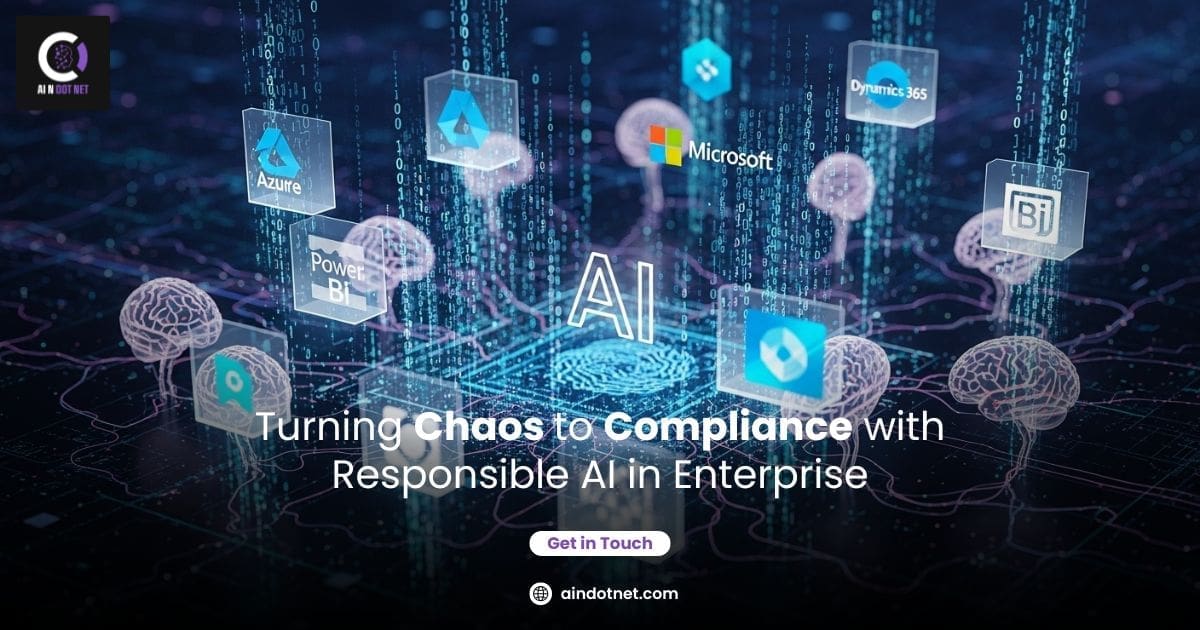
AI at work only creates real value when it’s embedded in daily systems, trusted by security, and driven by quality data, not just prompts. In 2026, Microsoft’s direction reflects that reality: AI shifts from helper to operator. Copilots become domain agents, Azure becomes the AI application server, and low‑code becomes the connective tissue for building, governing, and scaling solutions.
What Changes In 2026?
- AI moves from one‑off assistants to multi‑step, autonomous agents embedded across the Microsoft Cloud.
- Data platforms (Fabric, SQL) standardize semantics and lineage so models and agents act on trusted, governed information.
- Security gets “secure by design, default, and operations,” infusing AI into detection, response, and compliance controls.
Next, let’s look at the core products powering that shift and how they show up in day‑to‑day work.
Key Microsoft AI tools in 2026
- Copilot and Copilot Studio
Copilot evolves into an “AI agent factory.” Instead of single Q&A helpers, organizations configure agents to run multi‑step tasks: triage support tickets, coordinate field service, enrich sales leads, and trigger downstream automations. Copilot Studio becomes the design surface to define goals, guardrails, connectors, and hand‑offs into business systems. For developers and IT, this means repeatable patterns for secure, monitored agent deployment – no shadow AI.
Practical example:
- Sales ops: An agent qualifies leads, drafts outreach, updates CRM, and escalates when human approval is needed.
- IT: An agent resolves common requests, applies policies, and opens incidents when exceptions or risks are detected.
Use your tags naturally in this section:
- Teams working on Microsoft AI development can define agent policies centrally while enabling business units to adapt prompts and workflows locally.
- Solution architects can list concrete AI use cases in .NET that wire Copilot agents to existing APIs, queue processors, and data products.
Azure AI Services and Azure AI Foundry
Azure acts as the runtime and governance layer for models, vector indexes, orchestration, and evaluation. Foundry patterns – prompt management, safety filters, content moderation, agent collaboration, and evaluation harnesses – standardize the path from prototype to enterprise‑grade solution. Observability (latency, cost, safety, and drift) becomes table stakes.
Impact:
- Consistent deployment and rollback strategies for model versions.
- Multi‑agent systems with well‑defined roles and secure connector access to line‑of‑business data.
Power Platform as the AI backbone
Power BI, Power Automate, Power Apps, and Copilot Studio bring low‑code AI to business teams. Natural‑language prompts create automations, app screens, and reports; connectors bridge agents to real systems; governance centers enforce DLP, environments, and security.
What non‑technical teams gain:
- Build approvals, notifications, and data capture with AI‑generated flows.
- Rapidly prototype front‑ends that sit on top of agent workflows.
Next, let’s explore the data foundation that makes those agents trustworthy.
Microsoft Fabric and SQL Server 2025
AI outcomes are only as good as the data beneath them. Fabric and SQL serve as the data backbone – semantic models, data lineage, and unified analytics – so agents and apps resolve terms consistently and decisions can be audited.
What this enables:
- Semantic search that respects business definitions.
- End‑to‑end traceability: from a decision or generated action back to the datasets and transformations used.
Dynamics 365 with embedded AI
Dynamics brings predictive analytics, AI‑augmented planning, and intelligent service workflows directly into Finance, Supply Chain, Sales, and Customer Service. Agents operate within business guardrails, automating case routing, recommending actions, and teeing up approvals.
Outcomes:
- Shorter resolution times in service.
- Tighter demand planning and cash‑flow visibility.
- Sales execution assisted by context‑aware recommendations.
Five Transformation Outcomes Enterprises Target
1) Enhanced productivity and decision speed
AI agents take on repetitive tasks while surfacing context and options to humans. Real‑time analytics reduce meeting cycles and email churn; decisions move to where the data lives.
Tip: Start with high‑frequency tasks where outcome criteria are clear, then expand to adjacent processes.
2) Hyper‑personalized customer experiences
From support to sales, agents tailor interactions by intent, history, and segment behavior – while respecting consent and governance. Personalization elevates loyalty and conversion without sacrificing brand voice.
Tip: Use semantic models and prompt libraries to keep tone and policy consistent across channels.
3) Operational optimization
Manufacturing, logistics, and healthcare benefit from predictive maintenance, route and inventory optimization, and AI‑assisted triage. Agents orchestrate multi‑system actions – reorder, re‑route, reschedule – within defined thresholds.
Tip: Quantify cost‑to‑serve and cycle time before and after each agent rollout.
4) Security and governance
Security is embedded: detection, auto‑remediation playbooks, policy enforcement, and continuous evaluation guardrails. “Secure by default” configurations reduce missteps while telemetry reveals drift and bias.
Tip: Treat prompt and connector configuration as code – versioned, reviewed, and monitored.
5) Workforce transformation and skilling
New roles emerge: agent product owner, safety evaluator, prompt engineer, data steward. Skilling programs align executives, managers, analysts, and engineers on shared methods and success metrics.
Tip: Build role‑based learning paths tied to real projects and measurable outcomes.
Next, let’s map these capabilities to a pragmatic build path for .NET teams and platform owners.
A Build Blueprint For 2026
- Establish data trust
- Define golden sources, semantic models, and lineage in Fabric and SQL.
- Set access and DLP policies early to speed security approvals.
- Ship your first agent in Copilot Studio
- Select a bounded, measurable workflow.
- Connect to production‑ready APIs and scope allowed actions.
- Implement human‑in‑the‑loop for exceptions.
- Standardize orchestration in Azure
- Use Azure AI services for retrieval, function calling, and content safety.
- Add evaluation harnesses: quality, cost, and safety tests in CI/CD.
- Scale with Power Platform
- Expose agent capabilities via Power Apps and Automate for business teams.
- Use environments and solution layering for governance and reusability.
- Close the loop with analytics
- Publish KPIs in Power BI: time saved, cases resolved, accuracy, rework rates.
- Feed outcomes back to improve prompts, Microsoft AI tools, and data quality.
Developer Notes And Learning Pathways
- For engineering teams deep in .NET, slot a focused ML.NET tutorialinto the onboarding plan to teach model integration patterns alongside Azure orchestration and retrieval.
- Maintain a living catalog of AI use cases in .NET that pairs each use case with:
- Required datasets and connectors
- Guardrails and evaluation checks
- UI surfaces (Copilot, Teams, Dynamics, Power Apps)
- Keep a small reference implementation that demonstrates Microsoft AI development best practices: function calling, grounding with enterprise data, tool execution limits, and safe rollback.
Governance And Responsible Ai
- Policy envelopes: Define what an agent can read, do, and write, then monitor.
- Human controls: Require approvals for high‑risk actions; make overrides easy.
- Evaluation: Automate quality checks (factuality, bias, safety) for each release.
- Telemetry: Track prompts, actions, and outcomes for audits and improvement.
Practical Adoption Playbook
- Pick two processes with strong ROI potential.
- Build thin‑slice agents with clear success criteria and escalation paths.
- Publish dashboards; review weekly with stakeholders.
- Expand scope only after data and safety signals are stable.
Where To Place Your Strategic Bets?
- Agent platform: Treat Copilot Studio and Azure orchestration as shared services, not project‑by‑project experiments.
- Data contracts: Invest in Fabric semantics; it pays dividends across every agent.
- Reuse: Share connector libraries, prompt packs, and policy templates.
- Skilling: Develop role‑based journeys for business users, IT, and developers.
Smart Steps
- Teams piloting Microsoft AI tools can accelerate delivery by pairing Copilot Studio agents with governed Power Platform solutions.
- A starter ML.NET tutorial helps .NET teams integrate traditional ML with retrieval‑augmented generation patterns in Azure.
- Catalog your top AI use cases in .NET with repeatable connectors and guardrails so business units can safely adapt them.
A Concise Conclusion
The 2026 Microsoft roadmap turns AI from an assistant into an operator – agents that act with context, guardrails, and measurable outcomes. The winners won’t be those who ship the most pilots, but those who build a trusted backbone: quality data, secure agent platforms, clear governance, and a skilled workforce ready to iterate.
If your team wants hands-on guidance – from scoping high‑value use cases to building governed agent platforms, data semantics, and developer playbooks – AI n Dot Net offers tutorials, reference implementations, and consulting to help you ship real outcomes faster. Reach out to explore workshops, prototyping sprints, or custom roadmaps aligned to your 2026 goals.
