Why AI is pushing enterprises beyond traditional applications and into intelligent, reasoning-driven systems
For decades, enterprise applications have been nothing more than structured CRUD machines — systems that store, retrieve, display, and update data. Even the most “sophisticated” platforms have largely been elaborate interfaces around databases and business workflows.
But that era is ending.
AI is reshaping enterprise software at its foundations.
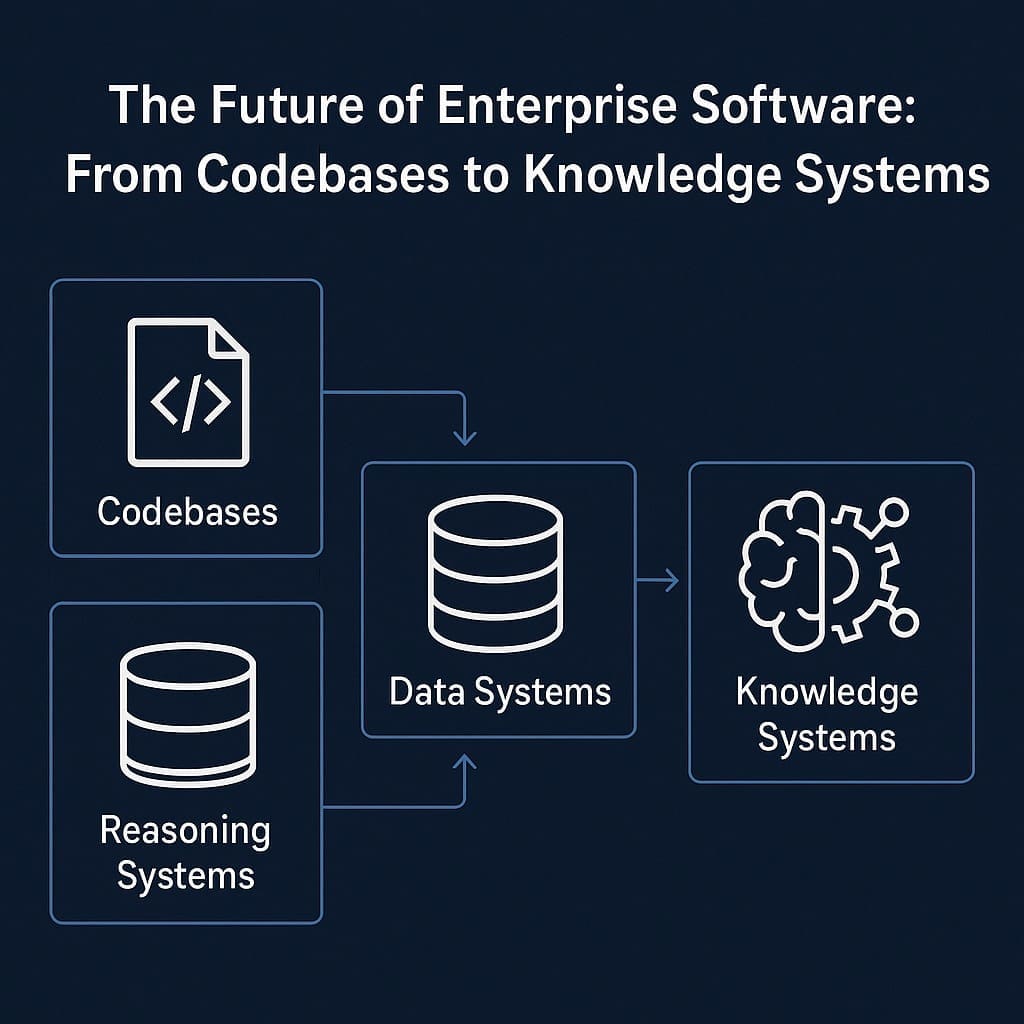
We are transitioning from systems that store data → to systems that understand data → to systems that reason about data → and ultimately systems that represent and evolve organizational knowledge.
The future isn’t more code.
The future is enterprise knowledge systems — intelligent architectures where code, data, rules, and AI reasoning work together.
This shift is already underway, and organizations that understand it now will define the next generation of digital enterprises.
1. Codebases Are Becoming the Least Valuable Part of Enterprise Systems
Most enterprise applications today are defined by:
- their technology stack,
- their framework (Angular, React, Blazor),
- their data storage,
- and the patterns chosen by developers.
But AI-assisted development breaks that model.
Tools like GitHub Copilot, ChatGPT, and Microsoft Copilot are making the “coding” part of development commoditized:
- CRUD controllers can be generated in seconds.
- APIs can be scaffolded automatically.
- Unit tests can be generated with minimal developer input.
- Infrastructure scripts can be produced with natural language prompts.
When code becomes cheap to generate and easy to replace, it loses long-term strategic value.
What grows in value?
The business logic. The knowledge. The rules that define how the enterprise operates.
That becomes the true IP.
2. Knowledge Becomes the System’s Core Asset
In traditional software development, business logic was buried inside thousands of lines of code across:
- services
- controllers
- workflows
- stored procedures
It was fragmented, hard-coded, and difficult to update.
AI changes this dynamic entirely.
Enterprises are moving toward business-layer-first architectures where:
- business rules
- domain constraints
- workflows
- semantic meaning
- operational policies
…are represented explicitly, cleanly, and independently from frameworks.
When business knowledge is well-organized and encoded formally, AI tools can:
- reason about it
- check for inconsistencies
- validate workflows
- identify missing logic
- generate new features based on established rules
The system becomes more than code — it becomes a living knowledge base.
3. Why .NET Is Uniquely Positioned for Knowledge Systems
The .NET ecosystem is evolving into one of the strongest environments for building AI-driven enterprise applications.
.NET supports this transition with:
✔ Domain-Driven Design (DDD) – encourages rich domain models and explicit business logic.
✔ Clean Architecture – isolates business rules from UI and infrastructure.
✔ ML.NET – enables predictive capabilities inside the system itself.
✔ Semantic Kernel – allows orchestration of LLMs, reasoning tools, and AI workflows.
✔ Azure AI – provides scalable cognitive services and enterprise-grade AI APIs.
✔ Copilot ecosystem – integrates directly into development, testing, and DevOps.
The result is an ecosystem where AI becomes part of the architecture, not an afterthought.
.NET applications won’t just fetch data.
They’ll interpret it, predict outcomes, and apply business rules automatically.
4. From CRUD Systems to Reasoning Systems
Most enterprise systems today answer the question:
What happened?
Knowledge systems answer something much more valuable:
What should happen next — and why?
Here’s the progression:
1. Data Systems (1990–2010)
Store information
→ Databases, ERP systems, CRUD apps.
2. Insight Systems (2010–2020)
Interpret information
→ BI dashboards, analytics, reports.
3. Intelligent Systems (2020–2025)
Predict outcomes
→ machine learning models, anomaly detection.
4. Knowledge Systems (2025–2035)
Apply reasoning
→ AI interprets rules, evaluates options, recommends actions, and consults domain knowledge.
In knowledge systems:
- Policies become executable.
- Decisions become explainable.
- Exceptions become predictable.
- Business logic becomes an asset that evolves intelligently over time.
This is where enterprise software is heading — fast.
5. Knowledge Systems Require “Human-in-the-Loop” Governance
When software begins making recommendations, optimizations, and even decisions, enterprise leadership must implement new governance models.
Accountability mechanisms include:
- approval workflows
- audit logs for AI-driven decisions
- explanations of how a decision was reached
- feedback loops where humans correct AI interpretations
- business-rule testing and traceability
AI doesn’t replace people — it requires skilled humans to supervise the intelligence.
Knowledge systems amplify the judgment of experts, not bypass them.
6. Knowledge Is Now the Competitive Moat
Enterprises often think their advantage is:
- technology
- patents
- infrastructure
- data
- headcount
But in the coming decade, the true competitive edge becomes:
The quality, clarity, and structure of your business knowledge.
Why?
Because AI tools can generate code —
but they cannot invent your company’s:
- rules
- constraints
- processes
- exceptions
- decision logic
- operational nuance
Companies with clean, explicit, well-modeled business logic will dominate the AI era.
Companies with messy, tribal, undocumented knowledge will fall behind.
7. What Enterprise Software Will Look Like by 2030
Let’s project the next five years based on current trajectory.
1. Codebases shrink dramatically
Much of the system will be AI-generated and continuously regenerated.
2. Business logic becomes modular and machine-readable
Think: policy files, rule engines, decision trees, semantic models.
3. AI reasoning becomes part of every workflow
Prediction, validation, recommendation, and exception handling.
4. Systems learn from their own history
Enterprise apps will adapt based on patterns in approvals, rejections, and outcomes.
5. Systems become much more conversational
Users interact with enterprise apps via chat and natural language — not forms.
6. Architecture becomes AI-first
Developers design systems knowing that AI agents will participate in workflows.
7. Applications evolve into “Enterprise Knowledge Clouds”
Centralized hubs where rules, semantics, domain models, and reasoning engines live.
This is the direction of modern enterprise architecture — and it’s unfolding now.
8. What Leaders Must Do Now to Prepare
Enterprises that want to stay ahead must begin shifting their priorities.
1. Institutionalize business knowledge
Document rules, policies, workflows, exceptions, decision rationale.
2. Build strong business layers
Clean, testable business logic is the foundation of future AI reasoning.
3. Adopt domain-driven modeling
This is the fastest path to knowledge-based architecture.
4. Integrate AI into the SDLC
Use Copilot and ChatGPT for code scaffolding, testing, refactoring, and analysis.
5. Train teams in AI-era architecture
Developers must think like knowledge engineers, not code mechanics.
6. Create governance frameworks
Establish policies for AI oversight, auditability, and feedback loops.
Organizations that wait will be forced to retrofit later — at enormous cost.
Conclusion: The Future Belongs to Knowledge-Centric Enterprises
The next generation of enterprise software isn’t defined by frameworks, stacks, or tools.
It’s defined by:
- how well an organization understands its own business
- how clearly that knowledge is represented
- and how effectively AI can reason about it
When AI generates the code,
when frameworks become interchangeable,
when data infrastructure becomes commoditized,
the only lasting value is the enterprise’s knowledge.
Companies that restructure their systems around clean, modular, explicit business logic will thrive.
Companies that treat AI as a “feature” or a “tool” will fall behind.
The future is here — and the future is knowledge systems.
Frequently Asked Questions
What is a “knowledge system” in enterprise software?
A knowledge system is an AI-enabled architecture where business rules, policies, logic, workflows, and reasoning are explicit, modular, and machine-readable.
Instead of simply storing or processing data, these systems interpret, reason, recommend, and learn from patterns in business operations.
How are knowledge systems different from traditional enterprise applications?
Traditional applications focus on CRUD operations and user interfaces.
Knowledge systems focus on:
- Representing business rules
- Applying logic automatically
- Predicting outcomes
- Explaining decisions
- Continuously improving with feedback
The main shift is from data-driven to reasoning-driven systems.
Why is AI shifting the importance away from codebases?
Because AI tools like GitHub Copilot and ChatGPT can now generate:
- APIs
- Controllers
- Unit tests
- DTOs
- Logging
- Data access layers
As code becomes faster and cheaper to generate, the unique value of an enterprise shifts to its knowledge — not its code.
Why is the business layer becoming the most valuable part of the system?
Because it is the only layer that represents:
- how the company operates
- what decisions it makes
- how workflows function
- what rules govern behavior
Frameworks, languages, and interfaces will change, but business logic is the durable core that defines the enterprise.
How does AI fit into the .NET ecosystem for building intelligent systems?
AI integrates naturally with .NET via:
- ML.NET (prediction, classification, anomaly detection)
- Azure AI Services (vision, NLP, translation, search)
- Semantic Kernel (LLM orchestration + AI workflows)
- Copilot ecosystem (development, testing, DevOps assistance)
.NET is uniquely positioned because it encourages clean architecture and domain-driven design — essential foundations for knowledge systems.
Will AI replace software developers?
No — it will change their role, not replace it.
AI automates:
- boilerplate code
- test generation
- scaffolding
- repetitive tasks
Developers shift toward:
- architecting knowledge
- designing domain models
- validating business rules
- guiding AI output
- ensuring system integrity
AI amplifies capabilities; it doesn’t eliminate the need for human judgment.
What skills will developers need in the knowledge-system era?
Future-ready developers must learn:
- domain modeling
- business rule design
- writing clean business-layer code
- working with AI-assisted development tools
- prompt engineering
- designing human-in-the-loop workflows
- understanding reasoning systems
Those who understand both business and technology will be the most valuable.
How will enterprise architecture change as knowledge systems emerge?
Architectures will move toward:
- business-layer-first design
- modular rule engines
- explicit policies and workflows
- AI reasoning embedded in services
- lightweight, AI-generated infrastructure
- conversational user interactions
- systems that learn from past decisions
The architecture shifts from framework-centric to knowledge-centric.
What is the biggest risk enterprises face during this transition?
The biggest risk is poorly documented or poorly modeled business knowledge.
If rules, workflows, and decisions are:
- tribal
- fragmented
- undocumented
- coded inconsistently
…AI cannot reason about them effectively.
The organization becomes slow, brittle, and chaotic.
What can enterprises do today to prepare for the future?
Start with these priorities:
- Document business rules and exceptions clearly
- Build clean, testable business layers in .NET
- Adopt domain-driven design for complex operations
- Integrate AI into development workflows
- Create governance and oversight for AI decisions
- Train teams on AI-assisted development best practices
The earlier businesses act, the bigger the advantage they gain.
What industries will benefit the most from knowledge systems?
These sectors stand to gain enormous value:
- finance and banking
- insurance
- healthcare
- logistics and supply chain
- government
- manufacturing
- energy
- legal and compliance-heavy organizations
Any industry where decisions, policies, and workflows are complex will benefit substantially.
What will enterprise software look like by 2030?
By 2030, most enterprise systems will:
- generate large amounts of their own code
- use predictive models for real-time decisions
- integrate LLM-based reasoning
- represent rules in machine-readable formats
- adapt based on historical patterns
- support conversational interfaces
- operate as “Enterprise Knowledge Clouds” rather than monolithic applications
The systems will be self-improving knowledge engines, not static programs.
Want More?
- Check out all of our free blog articles
- Check out all of our free infographics
- We currently have two books published
- Check out our hub for social media links to stay updated on what we publish
