
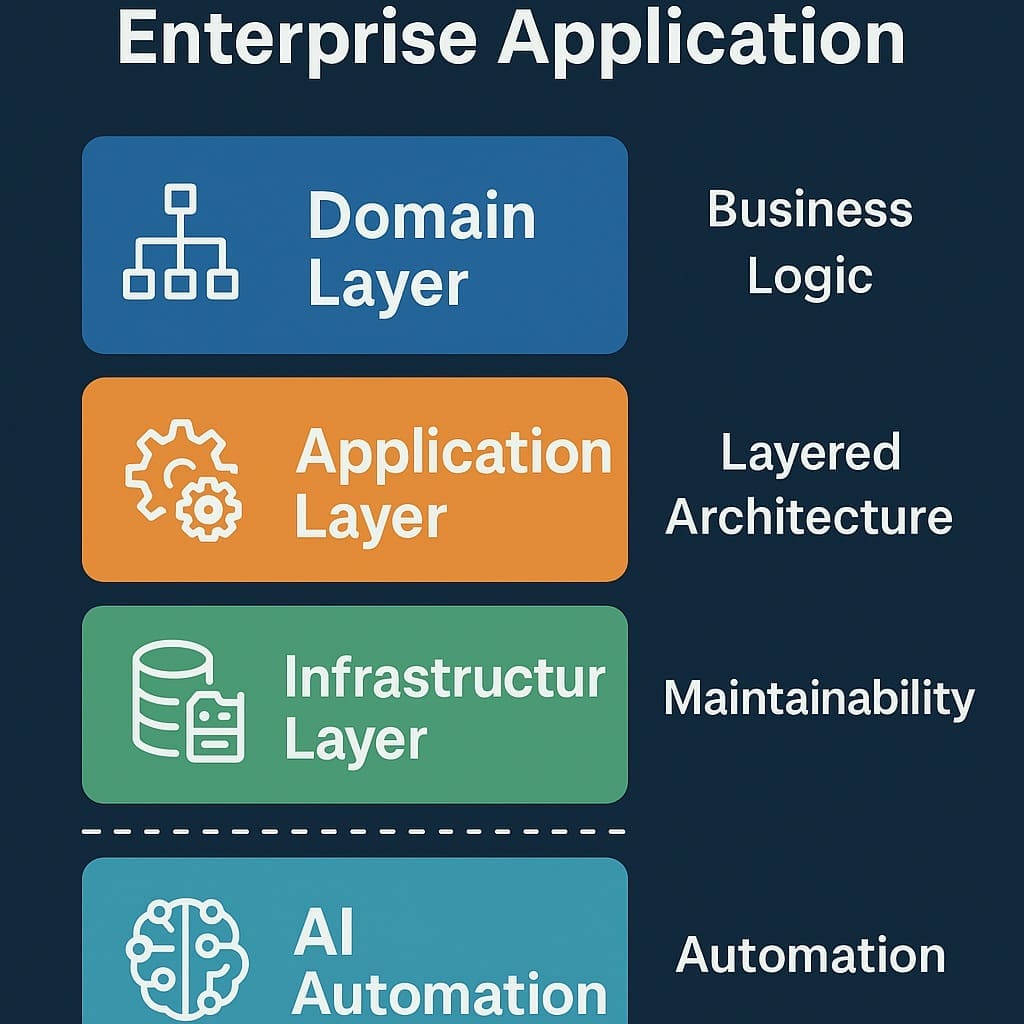
Why Business Layers Matter More Than Ever
Every enterprise application, no matter how modern or AI-assisted, ultimately exists to deliver business value.
That value lives not in the front end, not in the database, but in the business layer — the layer where logic, rules, and decisions define how the business actually operates.
Frameworks evolve. Databases migrate. APIs change.
But the business layer is the one constant that should outlive them all.
Architect’s Axiom: Frameworks come and go — but your business layer endures.
In a world where AI can generate data access code and entire APIs in minutes, the architect’s true role is to design and protect the business layer — because that’s where your company’s intellectual property lives.
The Purpose of Layered Architecture
Layered architecture has been a trusted pattern for decades, but its purpose has never been clearer than it is now.
In .NET (and other enterprise ecosystems), we typically structure solutions around three fundamental layers:
- Domain Layer – Pure business logic and rules.
- Application Layer – Use cases, DTOs, and orchestration of domain logic.
- Infrastructure Layer – Data access, APIs, file systems, and external dependencies.
Each layer has a clear job — and a clear boundary.
When you respect those boundaries, you gain testability, maintainability, and longevity.
Architect’s Axiom: “The more carefully you define your layers, the longer your system will live.”
1. The Domain Layer: Where Truth Resides
The domain layer holds your enterprise’s core logic — the parts that rarely change even as everything else evolves.
These are your business rules, policies, invariants, and calculations.
In a retail system, this might include how discounts are calculated, how taxes are applied, or how inventory thresholds are managed.
In finance, it could define how transactions are reconciled or how fraud detection works.
In short: The domain layer represents what is true about your business.
Your domain should:
- Have no dependencies on frameworks or UI code.
- Never know how data is stored or presented.
- Express logic in human terms, not technical ones.
Architect’s Axiom: Your business layer is your company’s brain — protect it from framework noise.
2. The Application Layer: The Orchestrator
The application layer connects the domain to the outside world.
It handles use cases — the step-by-step instructions for performing operations like creating an order, generating a report, or sending a notification.
The application layer:
- Coordinates domain actions.
- Manages transactions and security.
- Maps between DTOs and domain entities.
- Defines repository interfaces that the infrastructure layer implements.
It’s also where AI-assisted code generation can safely operate.
You can let tools like Copilot or ChatGPT generate repositories, DTOs, and command handlers here — knowing that the real business meaning stays intact in your domain.
Architect’s Axiom: Automation belongs in the application layer — interpretation belongs in the domain.
3. The Infrastructure Layer: The Replaceable Engine
Infrastructure makes things work — but it’s not what makes them valuable.
It includes:
- Databases and ORM configurations (e.g., EF Core Power Tools output).
- File and message handling.
- External APIs, logging, and email providers.
In your architecture, these components are plug-ins — easily replaceable without affecting business rules.
This is where your database-first automation shines:
You can scaffold EF contexts and entities automatically, confident they’re cleanly separated from your business and application logic.
Architect’s Axiom: Treat your infrastructure like an engine — powerful, replaceable, and isolated.
How AI Fits into the Layered Model
AI tools are most effective when they understand context and boundaries.
When you define your architecture cleanly, Copilot and ChatGPT can safely assist in:
- Generating repositories, DTOs, and controllers.
- Writing integration and unit tests.
- Building and wiring dependency injection automatically.
- Documenting API endpoints and domain summaries.
AI accelerates all of these — but only because you’ve structured the architecture clearly first.
Architect’s Axiom: AI can’t design your architecture — but it can thrive inside one.
Automation-First, Validation-Always
Here’s the modern sequence:
- Automate first: Let EF Core Power Tools scaffold the database.
- AI second: Use Copilot or ChatGPT to assemble repositories and services.
- Human third: Validate logic, boundaries, and performance.
You build faster without sacrificing structure or intent.
This process ensures your business layer always remains the single source of truth — insulated from both automation noise and framework churn.
Architect’s Axiom: Automate the repeatable. Architect the meaningful.
Why Business Layers Increase Longevity
A well-built business layer can survive:
- Framework upgrades (.NET 6 → .NET 9)
- Database migrations (SQL → Cosmos DB)
- Front-end rewrites (React → Blazor → whatever comes next)
- Integration with AI pipelines or new APIs
The business logic stays constant — only the adapters around it change.
That’s the definition of architectural resilience.
Practical Example: A Modular .NET Solution
Here’s a real-world modular layout that reflects these layers clearly:
/src
  Company.Product.Domain.Inventory
  Company.Product.Domain.Orders
  Company.Product.Application
  Company.Product.Infrastructure.Data.ERP
  Company.Product.Infrastructure.Email
  Company.Product.WebApi
/tests
  Company.Product.UnitTests
  Company.Product.IntegrationTests
Notice how each domain is its own project — reusable, testable, and portable.
A new API or background job can reference only the projects it needs.
That’s how you scale modularly while maintaining consistency.
Governance: Protecting the Business Core
Architectural governance ensures your layers remain clean over time.
It’s not bureaucracy — it’s future-proofing.
Establish rules for:
- Project dependencies (Domain → Application → Infrastructure only).
- DTO ownership (Application only).
- Database scaffolding process (Infrastructure only).
- Logging and error handling patterns.
These guardrails ensure that even as AI and automation evolve, your business logic remains safe and central.
Architect’s Axiom: If everything depends on your business layer, then protect it like it’s gold — because it is.
Conclusion: The Layer That Outlives Everything
Your business layer is the heartbeat of your software.
It defines what makes your organization unique, how it thinks, and how it acts.
As AI and automation accelerate the mechanics of software development, the architect’s mission remains the same:
Design meaning. Guard logic. Protect the business layer.
Architect’s Axiom: The business layer is where your company’s intelligence actually lives.
🪄 Next in the Series:
“Automation-First Architecture: How to Let AI Build While You Lead.”
We’ll explore how to structure your process so that automation and AI can safely accelerate development — while you retain architectural control and human oversight.
Frequently Asked Questions
What exactly is the “business layer” in software architecture?
The business layer (or domain layer) is where your application’s core rules, policies, and decisions live.
It defines how your organization actually works — things like pricing rules, workflows, or validation logic.
It’s independent of frameworks, databases, or UI technologies so that it can survive change.
Architect’s Axiom: “The business layer is where your company’s intelligence actually lives.”
Why separate the domain, application, and infrastructure layers?
Separation of layers ensures clarity, maintainability, and longevity.
Each layer has a specific responsibility:
- Domain: Business logic and rules.
- Application: Use cases, DTOs, orchestration.
- Infrastructure: Database, APIs, and system dependencies.
This separation makes it easy to test, evolve, or replace one part without breaking the others.
Isn’t layering old-fashioned? Why not just use microservices?
Layering isn’t outdated — it’s a prerequisite for scaling intelligently.
Even microservices benefit from clean internal layers.
A microservice without separation between domain, application, and infrastructure quickly becomes tangled and unmaintainable.
Architect’s Axiom: “You can’t scale chaos — you can only scale clarity.”
How does a database-first approach fit into layered architecture?
In real enterprises, data already exists — so database-first is often the practical choice.
Tools like EF Core Power Tools generate the data layer automatically, giving you clean entity classes and a DbContext.
From there, your domain and application layers can consume those models safely through repositories and services.
Do I need DTOs if EF Core already generates entity classes?
Not always — but usually, yes.
DTOs belong in the application layer to define communication contracts.
They protect your domain from exposure, prevent over-posting, and allow custom shaping of data for APIs or reports.
Use EF entities for persistence, DTOs for transport.
Where does AI fit in the layered architecture model?
AI fits best in the automation and orchestration layers — not the business core.
You can use Copilot or ChatGPT to generate repositories, DTOs, and even use-case handlers, but the meaning behind the logic should always live in your domain.
Architect’s Axiom: “AI can’t design your architecture — but it can thrive inside one.”
What happens if I skip the business layer and just use services or controllers?
You’ll create a short-term gain and a long-term maintenance problem.
Without a business layer, rules spread across controllers, APIs, and jobs — leading to duplication and inconsistency.
A properly defined business layer consolidates logic in one reusable, testable location.
How do business layers help with maintainability?
When logic is centralized, updates happen in one place.
For example, if your pricing rules change, you modify them in the domain — not in multiple controllers or APIs.
That reduces risk and ensures predictable behavior across the system.
How do AI and automation tools impact layered design?
They enhance it, not replace it.
Automation scaffolds your database and APIs.
AI accelerates DTOs, mapping, and unit tests.
But layered architecture ensures those tools operate safely within defined boundaries.
Architect’s Axiom: “Automation builds; AI contextualizes; humans validate.”
What’s the difference between the domain layer and the application layer?
The domain layer expresses business truth — what’s real and consistent across time.
The application layer expresses use cases — the specific actions or workflows users perform.
You might reuse the same domain rules across many applications or APIs.
How does governance protect the business layer?
Governance defines the rules of engagement — which layers can reference which, how DTOs are named, and how dependencies flow.
With governance in place, you ensure clean architecture stays clean — even as automation and AI generate large volumes of code.
How does this architecture handle changing frameworks or front-ends?
Your business layer stays untouched.
If you replace React with Blazor, or move from .NET 7 to .NET 9, only your infrastructure or application layers change.
We assume that most business (or domain) layers will have multiple front ends. One or more Web API front ends, one or web web front ends, one or more console application front ends.
Your domain logic remains the same, ensuring continuity and drastically reducing rewrite costs.
Architect’s Axiom: “The best systems outlive their frameworks — because they were built on meaning, not mechanics.”
Is this approach suitable for small teams or only for large enterprises?
It scales both ways.
For small teams, it prevents chaos and simplifies testing.
For large enterprises, it enforces consistency and makes AI-assisted automation predictable.
With new automation and AI tools – we think development teams will be smaller and produce more.
Clean architecture pays off at every scale.
How do I know if my current architecture has a weak business layer?
Ask three questions:
- Do your developers rely on the database to “remember” logic?
- Are your rules scattered across multiple APIs or jobs?
- Does updating one feature cause ripple effects everywhere?
If yes to any of these — your business layer isn’t strong enough.
How do AI tools like Copilot and ChatGPT fit practically into this process?
Use Copilot for generating repetitive code — DTOs, services, test scaffolds.
Use ChatGPT for designing structure, improving naming, or generating documentation.
Use both to extend, not replace, your architectural thinking.
Architect’s Axiom: “Automate first, validate second, optimize last.”
Want More?
- Check out all of our free blog articles
- Check out all of our free infographics
- Here is the free infographic based on this article
- We currently have two books published
- Check out our hub for social media links to stay updated on what we publish
