Introduction: The Paradox of Fairness in Machines
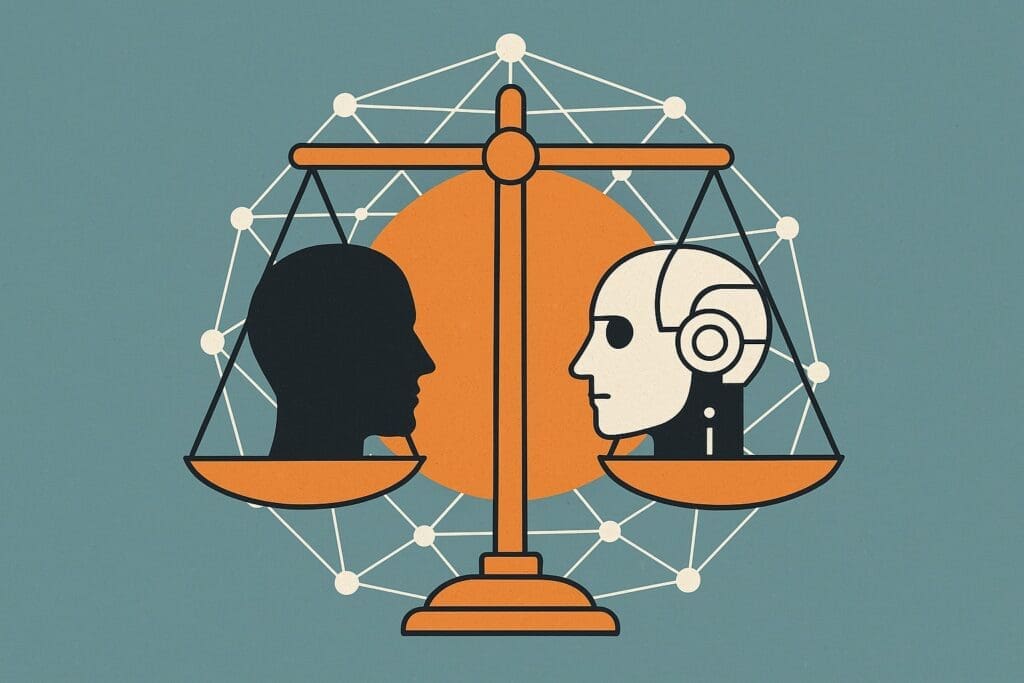
Every company racing to “make AI fair” is, in a sense, chasing a ghost. Fairness sounds like an unimpeachable virtue — who wouldn’t want fair systems, fair algorithms, and fair outcomes? Yet the moment we try to define fairness, we collide with its contradictions.
Is fairness equality? Is it justice? Is it mercy? Depending on your vantage point — legal, ethical, cultural, or mathematical — the answer changes. And when we translate these slippery human ideals into machine code, we risk creating systems that appear fair but may actually distort reality, limit freedom, or even cause new forms of harm.
This article challenges the assumption that “perfectly fair AI” is even possible — or desirable. True AI ethics requires not just eliminating bias, but learning which biases protect us and which destroy trust.
The Illusion of Fairness: Why AI Can’t Be Neutral
AI systems reflect data. Data reflects people. And people, well — they’re complicated.
Every dataset is a snapshot of human priorities, power structures, and compromises. When developers train a model to detect fairness, they often define it through metrics like demographic parity or equalized odds. But each metric encodes a philosophy: what is being equalized, and for whom?
For instance, an algorithm that gives equal approval rates to all demographics might look fair on paper. Yet if one group has historically faced more obstacles, equal approval rates could unintentionally reinforce inequities. Meanwhile, algorithms that “correct” outcomes by boosting disadvantaged groups might be perceived as unfair to others.
In other words: there is no single “fairness function.” There are only tradeoffs — moral, statistical, and political.
Like the Stoic philosophers who argued that virtue isn’t found in outcomes but in disciplined reasoning, responsible AI leaders must accept that fairness isn’t a destination — it’s a method of continuous ethical reflection.
Why “Perfect Fairness” Is a Dangerous Goal
The idea of perfectly fair AI tempts organizations with the illusion of moral certainty. It promises a world where ethics can be solved like math. But this vision is not only false — it’s dangerous.
1. It implies moral simplicity in a morally complex world.
Humans routinely tell “white lies” to soften truth or protect others. We praise discretion in diplomacy, empathy in management, and compassion in leadership — yet expect AI to operate without such nuance. When we force AI into rigid fairness metrics, we strip it of the ability to weigh context, intent, and consequence.
A human HR manager might favor a less qualified candidate because they sense that individual’s potential to grow or stabilize a team dynamic. An AI model, blind to the human context, could label this unfair — even though it’s the more ethical choice for long-term well-being.
2. It discourages moral agency.
When fairness becomes a checkbox, professionals stop thinking deeply about ethics.
Leaders outsource judgment to algorithms, trusting that compliance equals virtue. This moral outsourcing leads to what philosopher Immanuel Kant warned against — the abdication of moral reasoning in favor of mechanical obedience.
AI should assist ethical decision-making, not replace it.
3. It can backfire politically and socially.
In trying to please everyone, “fair AI” can end up pleasing no one.
When one group feels overrepresented and another underrepresented, both lose trust in the system. Perfect fairness becomes the perfect scapegoat: a convenient enemy for whichever side feels slighted.
Real fairness isn’t universal approval — it’s transparent reasoning.
The Case for Necessary Bias
Contrary to popular opinion, not all bias is bad. Some bias is functional — even ethical.
1. Bias as Protection
Guardrails are biases by another name. We build them into cars, medicine, and education to prevent catastrophe. In AI, safety filters that block violent or hateful content are technically biased — they discriminate against certain types of input — but rightly so.
Would you want an AI model that treats hate speech and civility equally in the name of fairness?
2. Bias as Compassion
Sometimes fairness means bending the rules.
A doctor prioritizing a child over an adult in triage is biased — but ethically justified. A hiring model that emphasizes rehabilitation opportunities for people with non-violent criminal records is biased — but socially restorative.
We should aim for ethical bias, not neutral indifference.
The Problem of Data Purity: “Garbage In, Fairness Out”
The more we try to sanitize data of every trace of bias, the more we risk stripping away its realism. Life is messy, and ethical progress is measured not by erasing complexity but by confronting it.
Eliminating “bad data” often erases valuable signals. Imagine training an AI to predict workplace attrition but excluding all records of employee dissatisfaction — you’d get a “fair” but useless model. Similarly, censoring sensitive demographic factors can cripple an algorithm’s ability to detect systemic inequities in the first place.
Paradoxically, removing bias can make systems less fair.
Instead, the focus should shift toward transparency and accountability:
- Label data provenance. Know where it came from.
- Track transformations. Document every step of cleaning and normalization.
- Record decisions. Keep a visible log of why certain attributes were removed or retained.
In short, own your bias — don’t pretend it doesn’t exist.
A Philosophical Parallel: The Buddhist Middle Way
The Buddha taught that suffering arises from extremes — indulgence on one side, denial on the other. The “Middle Way” was not a compromise of weakness but a recognition of balance.
AI fairness debates mirror this same tension. On one extreme, we see reckless algorithms optimizing profit at human expense. On the other, we see overregulated systems that paralyze innovation under the weight of moral perfectionism.
The path forward lies between these extremes — a balanced, mindful approach to AI governance.
Not perfectly fair, not dangerously indifferent — but consciously imperfect and self-correcting.
From Theory to Practice: Building “Ethically Biased” AI
So, what does this look like in practice? Especially for organizations grounded in the Microsoft and .NET ecosystem, where practical implementation matters as much as principle.
1. Design for transparency, not illusion
Use frameworks like Microsoft Responsible AI Standard or AI Fairness Checklist for Azure ML. These tools don’t guarantee fairness — they structure reflection. Implementing ethical review boards, annotation logs, and explainable AI dashboards in .NET + ML.NET workflows helps make ethical reasoning visible.
2. Model the tradeoffs
When developing with ML.NET or Azure AI, simulate how changing fairness thresholds affects outcomes. Use confusion matrices or disparate impact analysis to demonstrate — not hide — bias.
Transparency builds trust; opacity builds paranoia.
3. Adopt moral version control
Just as engineers use Git to track code changes, organizations should version-control ethical choices. Keep a record of when and why fairness parameters, sampling strategies, or exclusion criteria changed. This aligns with .NET DevOps culture and ensures repeatability across audit cycles.
4. Bias testing as continuous delivery
Integrate fairness testing into CI/CD pipelines. Every retrained model should trigger an ethical regression test. Has fairness improved? Degraded? Shifted contextually? Microsoft’s Responsible AI dashboard and Fairlearn can plug into these workflows.
Ethical engineering isn’t a side task — it’s part of the build.
Rethinking “Fair”: The Executive’s Dilemma
Executives often want ethical AI to be like cybersecurity — a checklist, a compliance score, a shield against headlines. But fairness doesn’t work like firewalls. It’s dynamic, situational, and cultural.
A perfectly “fair” AI that ignores human intuition can alienate employees and customers alike. It might make recruitment sterile, decision-making rigid, and customer service robotic. Conversely, a system that allows measured ethical bias — designed guardrails, transparent adjustments, context-aware nudges — can foster trust and safety without moral paralysis.
The question isn’t “Is our AI fair?”
It’s “Do we understand how and why it’s fair — and when fairness stops serving the greater good?”
Conclusion: Fairness as a Discipline, Not a Destination
In the pursuit of AI fairness, professionals across the Microsoft and .NET ecosystem face a hard truth: there will never be a model that treats every case perfectly equally — and that’s okay.
The goal isn’t to make machines more moral than humans; it’s to make humans more mindful of the morality embedded in machines.
Engineers and leaders must cultivate ethical literacy alongside technical literacy. Instead of chasing the illusion of perfect fairness, they should build transparent, explainable, and ethically biased systems that acknowledge imperfection — and manage it with integrity.
That’s not weakness. That’s wisdom.
And in the end, it may be the most fair approach of all.
Want More?
- Check out all of our free blog articles
- Check out all of our free infographics
- We currently have two books published
- Check out our hub for social media links to stay updated on what we publish
