
Setting the Stage
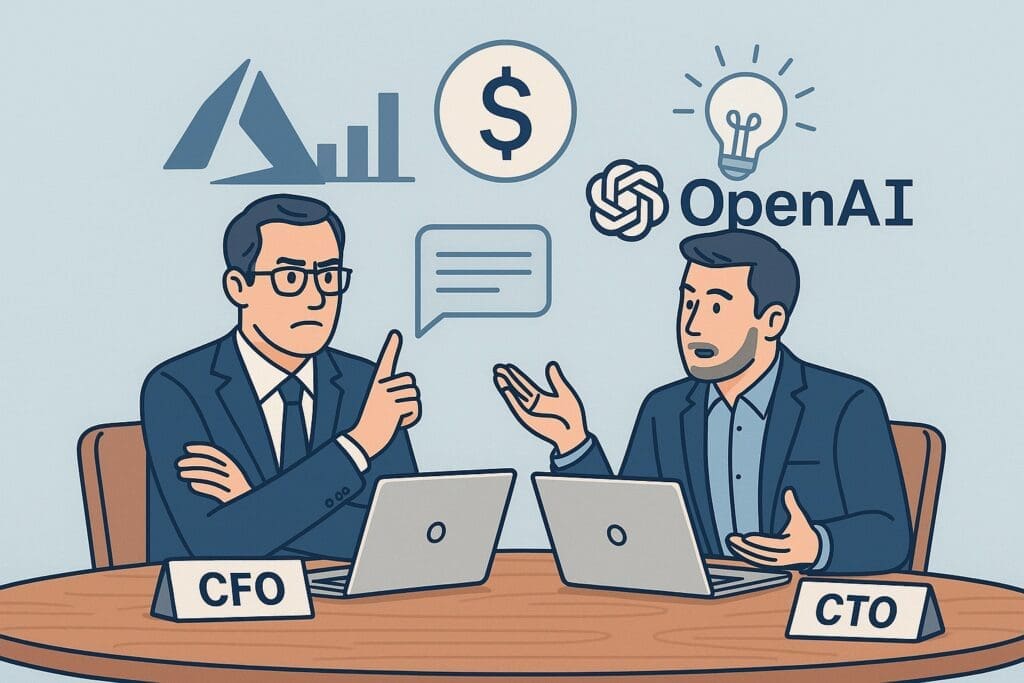
In a quiet boardroom at a mid-sized enterprise that recently integrated Azure OpenAI into its internal applications, two executives are facing a modern dilemma:
How do you reduce AI costs without stifling innovation?
- The CFO (Chief Financial Officer): pragmatic, risk-averse, focused on budgets and measurable ROI.
- The CTO (Chief Technology Officer): visionary, optimistic, and eager to push the boundaries of what Azure + OpenAI + Cognitive Services can do.
Their debate unfolds like a chess match—each move deliberate, each counter backed by reason.
Scene 1: The Cost Question
CFO: “We’ve doubled our Azure OpenAI spend in the last quarter. Our GPT-based chatbot is a hit internally, but finance needs predictability. If these costs keep scaling linearly with user growth, we’ll hit our ceiling before we even deploy company-wide.”
CTO: “That’s a fair point. But keep in mind—innovation doesn’t follow a linear budget line. Our chatbot replaced three help-desk contracts and improved employee satisfaction scores by 40%. That’s ROI in disguise.”
CFO: “ROI, yes—but delayed. The board wants short-term savings. We need to throttle our consumption until we can prove consistent returns.”
CTO: “Throttle too much, and we risk losing the innovation momentum that gives us a competitive edge. Let’s optimize intelligently, not recklessly.”
Scene 2: Understanding Where Azure OpenAI Costs Come From
CFO: “Let’s start with clarity. What exactly drives the cost?”
CTO: “Good question. With Azure OpenAI, cost is influenced by:
- Token usage – Every API call is billed by tokens (input + output).
- Model choice – GPT-4-Turbo costs more than GPT-3.5-Turbo.
- Throughput and concurrency – The number of simultaneous users affects infrastructure costs.
- Cognitive Services add-ons – Vision, speech, and search APIs can double or triple total compute spend if unmonitored.”
CFO: “So, our cost equation is essentially:
Total AI Cost = (Tokens × Model Rate) + (Cognitive Services Calls × Compute Multiplier)
And each factor can be optimized.”
CTO: “Exactly. But optimization doesn’t mean cutting capabilities—it means smart engineering.”
Scene 3: The Stoic Principle of Control
CTO: “You know, this reminds me of Stoicism—the ancient philosophy that teaches focusing only on what we can control. We can’t control the market or API pricing, but we can control how efficiently we use those APIs.”
CFO: “Interesting. So, our ‘control’ here is in usage patterns?”
CTO: “Yes. We can implement caching, reduce unnecessary calls, fine-tune prompts, and introduce lightweight models where possible. Just like the Stoics avoided emotional overreaction, we should avoid over-engineering. Every prompt should earn its cost.”
Scene 4: Strategic Optimization Techniques
1. Prompt Engineering and Token Efficiency
CTO: “The easiest win is prompt optimization. Developers often use verbose instructions. By compressing prompts, using variables, and pruning redundant tokens, you can reduce token usage by 20–40% instantly.”
CFO: “That’s like paying by the word and learning to be concise.”
CTO: “Exactly! Tools like PromptFlow and Semantic Kernel let us measure and optimize prompt length dynamically.”
2. Response Management and Truncation
CFO: “But what about output tokens? I’ve seen our chatbot generate five-paragraph responses for simple questions.”
CTO: “We can cap output length programmatically. Set max_tokens based on query type. Also, store frequent answers in a knowledge base so we don’t query OpenAI for repetitive questions.”
3. Tiered Model Usage
CFO: “We’re using GPT-4 for everything right now. Do we need to?”
CTO: “Not always. A hybrid approach works:
- GPT-3.5-Turbo for routine Q&A or summaries
- GPT-4-Turbo for critical reasoning tasks
- Embeddings or Azure Cognitive Search for fast retrieval tasks”
CFO: “So, tiering models is like choosing between economy, business, and first-class tickets depending on the trip.”
CTO: “Perfect analogy.”
4. Model Caching and Session Memory
CFO: “Can we cache AI results?”
CTO: “Absolutely. Use Redis or Cosmos DB to store query-response pairs. For internal apps, 30–40% of user questions are repeats. Caching converts those from paid API calls to free lookups.”
CFO: “That’s like implementing financial hedging against unpredictable usage.”
5. Cost Monitoring and Quota Governance
CTO: “Azure provides cost analysis tools and API usage dashboards. We can:
- Set usage caps per department
- Track cost per model in real time
- Send alerts when thresholds are exceeded
Combine this with Power BI dashboards for financial visibility.”
CFO: “That bridges our worlds—engineering transparency meets fiscal control.”
Scene 5: Organizational Alignment
CFO: “The challenge isn’t just technical. It’s cultural. Every team wants to experiment with AI. Without governance, we’ll end up with a dozen shadow projects.”
CTO: “Agreed. Let’s establish an AI Center of Excellence (CoE) to manage access keys, review new use cases, and share reusable code. That keeps costs predictable and learning centralized.”
CFO: “Good. Centralization helps finance plan, and shared frameworks help reduce redundant spending.”
Scene 6: Innovation Without Waste
CFO: “How do we balance cost cutting with keeping our engineers inspired?”
CTO: “Give them constraints, not restrictions. Creativity thrives under limits.
We can host monthly AI Hackathons with spending caps. The goal: produce new use cases that either save money or open revenue streams.”
CFO: “So the constraint becomes a catalyst for innovation.”
CTO: “Exactly—like the minimalist architecture movement. Less material, more elegance.”
Scene 7: The Power of Fine-Tuning and Local Models
CFO: “What about fine-tuning models? Isn’t that expensive upfront?”
CTO: “Yes, but over time, a fine-tuned GPT-3.5 model can outperform GPT-4 for narrow tasks at a fraction of the cost. We can also host smaller models locally with ONNX Runtime for inference.”
CFO: “So, pay once, use forever—like purchasing instead of renting intelligence.”
CTO: “Precisely. It’s a classic CapEx vs. OpEx balance.”
Scene 8: Cross-Service Optimization
CFO: “What about the Cognitive Services we’re layering—like speech and vision?”
CTO: “We can optimize by:
- Batch processing: group multiple requests into one API call
- Pre-filtering: use lightweight logic to skip unnecessary processing
- Storage tiering: archive low-value data in cheaper Blob tiers
- Compression: reduce bandwidth costs for media-heavy services”
CFO: “These seem incremental but compound over time.”
CTO: “Exactly. Optimization is a game of inches, not miles.”
Scene 9: Philosophy in the Cloud
CTO: “You know, our debate mirrors the yin and yang of Taoist philosophy. Finance provides the yin—structure, stability, limitation. Technology brings the yang—creativity, motion, expansion. One without the other collapses.”
CFO: “So, harmony—not dominance—is the goal.”
CTO: “Yes. Balance cost and innovation like balancing opposites in nature.”
Scene 10: The Framework of Financial-Technical Harmony
Let’s crystallize their discussion into a practical framework executives can apply:
| Layer | CFO Lens | CTO Lens | Unified Action |
|---|---|---|---|
| Model Management | Prefer cheaper models | Optimize usage across models | Implement tiered GPT strategy |
| Prompt Efficiency | Reduce token spend | Maintain quality of responses | Introduce prompt templates |
| Governance | Enforce budgets | Enable experimentation | Create AI CoE with quotas |
| Innovation | Encourage ROI validation | Support rapid prototyping | Run hackathons under budget limits |
| Visibility | Real-time cost tracking | Developer transparency | Unified Power BI dashboards |
Scene 11: Looking Ahead
CFO: “I’ll admit it—you’ve convinced me. Cost optimization doesn’t have to mean killing innovation. It’s about making smarter, data-driven decisions.”
CTO: “And I’ll admit I’ve learned from your discipline. Guardrails enable freedom. When developers see the cost impact of their designs, they build smarter.”
CFO: “Then let’s formalize this partnership. Finance sets the limits; tech defines how to stay creative within them.”
CTO: “Agreed. Let’s make cost optimization our shared innovation metric.”
Conclusion: A Lesson for the Microsoft/.NET Ecosystem
For organizations in the Microsoft and .NET ecosystem, this dialogue is more than hypothetical—it’s a roadmap.
Azure + OpenAI + Cognitive Services offers immense potential, but unchecked enthusiasm can quickly inflate budgets. Success lies in cross-functional alignment:
- Finance builds the boundaries.
- Technology defines efficient pathways.
- Together, they deliver sustainable AI transformation.
As Seneca once said, “We suffer more in imagination than in reality.” The fear of AI cost overruns shouldn’t stop innovation—it should refine it.
With thoughtful strategy, disciplined engineering, and transparent governance, your enterprise can scale AI that’s not just powerful—but profitable.
Frequently Asked Questions
What are the most effective ways to reduce Azure OpenAI costs?
Focus on prompt optimization, model tiering, caching, and usage monitoring. These four areas can reduce total spend by 30–50% without sacrificing performance.
How can finance teams monitor Azure AI expenses in real time?
Use Azure Cost Management and Power BI dashboards to track usage by department, model, and subscription. Set alerts for threshold breaches.
When should organizations fine-tune models instead of using GPT-4?
When a narrow domain task repeats frequently, a fine-tuned GPT-3.5 or ONNX model provides faster, cheaper performance.
How can developers balance AI cost savings with innovation?
Adopt a framework of “constraints inspire creativity.” Run hackathons, set spending caps, and encourage teams to prove ROI through measurable impact.
What role does governance play in AI cost optimization?
Governance ensures accountability. A centralized AI Center of Excellence can control access keys, set quotas, and promote reusable components that minimize redundant costs.
Want More?
- Check out all of our free blog articles
- Check out all of our free infographics
- We currently have two books published
- Check out our hub for social media links to stay updated on what we publish
