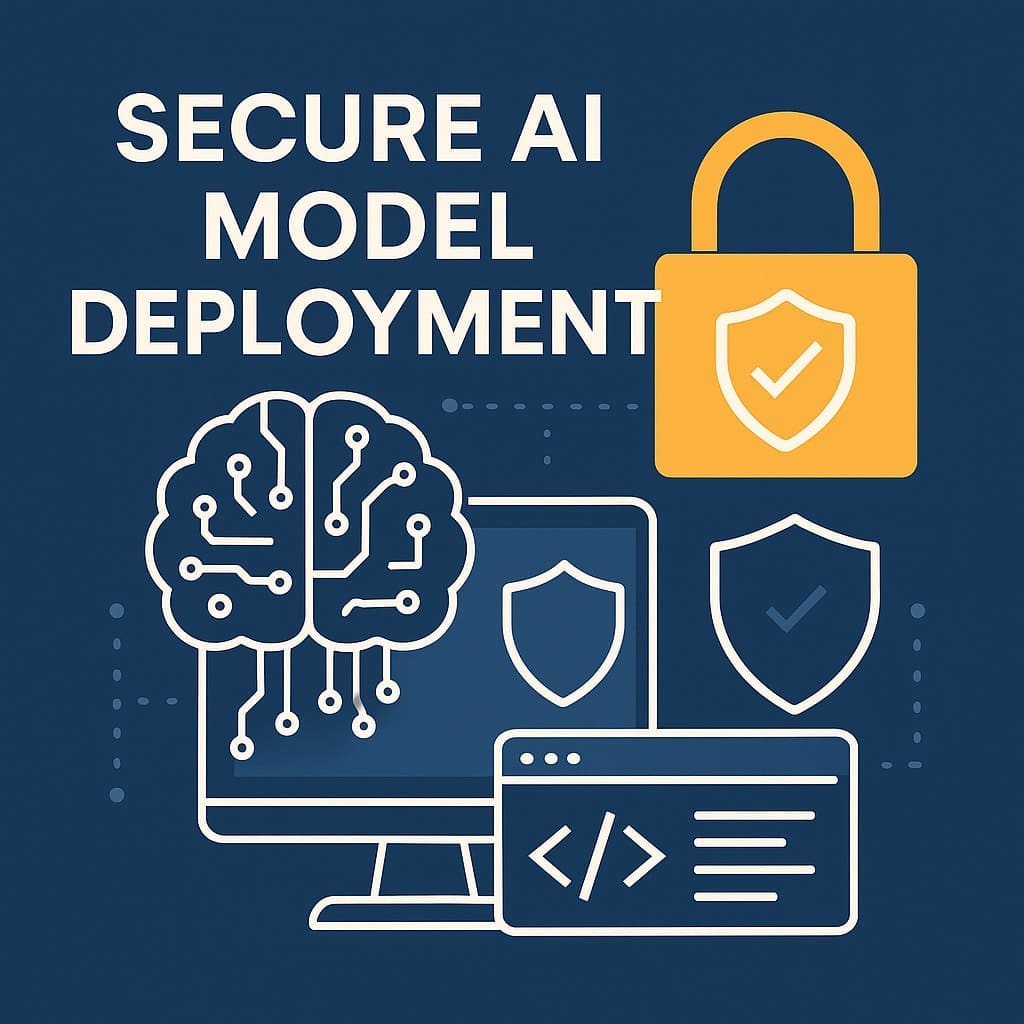
Why Secure AI Deployment Matters
AI systems are no longer just experimental prototypes—they now power critical business processes, financial systems, and healthcare decisions. With this shift comes a new challenge: how do you deploy AI models securely while protecting sensitive data, ensuring compliance, and maintaining trust?
Too many organizations rush to deploy models without the right security frameworks, leaving them exposed to data leakage, adversarial attacks, and regulatory violations. This article outlines best practices for secure AI model deployment—practical steps every CIO, engineering manager, and data science lead should follow.
1. Understand the Security Risks of AI Deployment
Before deploying, you need to evaluate the unique risks AI introduces compared to traditional software.
- Data leakage – improperly configured models can expose training data.
- Adversarial attacks – malicious inputs can fool models into wrong predictions.
- Model theft – exposed APIs make it possible to reverse engineer your model.
- Regulatory penalties – mishandled personally identifiable information (PII) can trigger GDPR or HIPAA fines.
The first step in secure deployment is acknowledging these risks and integrating security into your DevOps lifecycle.
2. Apply Zero-Trust Principles to AI Infrastructure
Traditional perimeter security is not enough. Apply zero-trust security to every stage of deployment:
- Require strong authentication and role-based access control (RBAC) for model endpoints.
- Use encrypted communication (TLS/SSL) for all model interactions.
- Segment networks so that production models don’t directly expose underlying training infrastructure.
Zero-trust ensures that only verified users, services, and systems can interact with your model.
3. Automate Compliance Checks
Compliance is not a one-time box to tick. Instead, build automated compliance pipelines:
- Run static and dynamic code analysis to detect insecure configurations.
- Incorporate model cards and audit logs for explainability and accountability.
- Map deployments against regulations like GDPR, HIPAA, CCPA and industry-specific frameworks.
Automation reduces human error and keeps compliance consistent as models evolve.
4. Secure the Data Pipeline
A model is only as secure as the data flowing through it. Key practices include:
- Encrypt data at rest and in transit (AES-256, TLS).
- Minimize PII before data enters training or inference pipelines.
- Use synthetic data generation or anonymization where possible.
- Monitor for data drift that could signal poisoning attempts.
Data integrity is central to secure AI operations.
5. Harden the Model Serving Environment
Once in production, models need the same level of hardening as any other enterprise service:
- Deploy in containerized environments (Docker/Kubernetes) with restricted privileges.
- Apply continuous vulnerability scanning to containers and dependencies.
- Use rate limiting and throttling to reduce exposure to brute force or inference attacks.
- Consider differential privacy or federated learning for high-sensitivity use cases.
This prevents attackers from exploiting the serving layer.
6. Monitor, Audit, and Update
Security doesn’t end at launch. Post-deployment operations are where most failures occur.
- Enable real-time monitoring for unusual API calls or access attempts.
- Keep immutable logs for forensics and compliance audits.
- Regularly retrain and patch models to address concept drift, vulnerabilities, and new regulations.
Think of your AI model like any other production software: it requires maintenance, monitoring, and updates to stay secure.
7. Build a Culture of Security in AI Teams
Technology alone won’t solve the problem. You need a culture where:
- Data scientists collaborate with DevOps and security engineers.
- Teams are trained on secure coding and ethical AI practices.
- Leadership sets clear KPIs for secure AI delivery (not just speed-to-market).
Security must be part of the organizational DNA, not an afterthought.
Conclusion: Security as a Trust Multiplier
Secure AI model deployment is not just a technical requirement—it’s a strategic business imperative. Enterprises that prioritize security and compliance not only avoid fines and failures but also build trust with customers, regulators, and stakeholders.
By following these best practices—zero-trust, compliance automation, hardened environments, continuous monitoring—you can deploy AI responsibly while still delivering innovation and competitive advantage.
Want More?
Looking to deploy AI securely in a .NET environment? Explore how ML.NET, Azure AI, and modern DevOps pipelines can help you build and scale trustworthy AI systems.
- Free blog articles
- Free Infographics
- Follow us on social media to see much of our content
