
Artificial intelligence isn’t short on hype. What it is short on are real-world success stories that go beyond flashy demos and actually deliver reliable, scalable, and useful systems.
This is where applied researchers and systems integrators step in. They live in the messy middle ground between the lab and the boardroom — between “here’s a cool model” and “here’s a working system that doesn’t collapse at 3 a.m.”
To thrive in this space, you need more than technical brilliance. You need pragmatism, discipline, and a sense of humor (because things will break). Below are 10 rules to guide applied researchers and systems integrators toward long-term success.
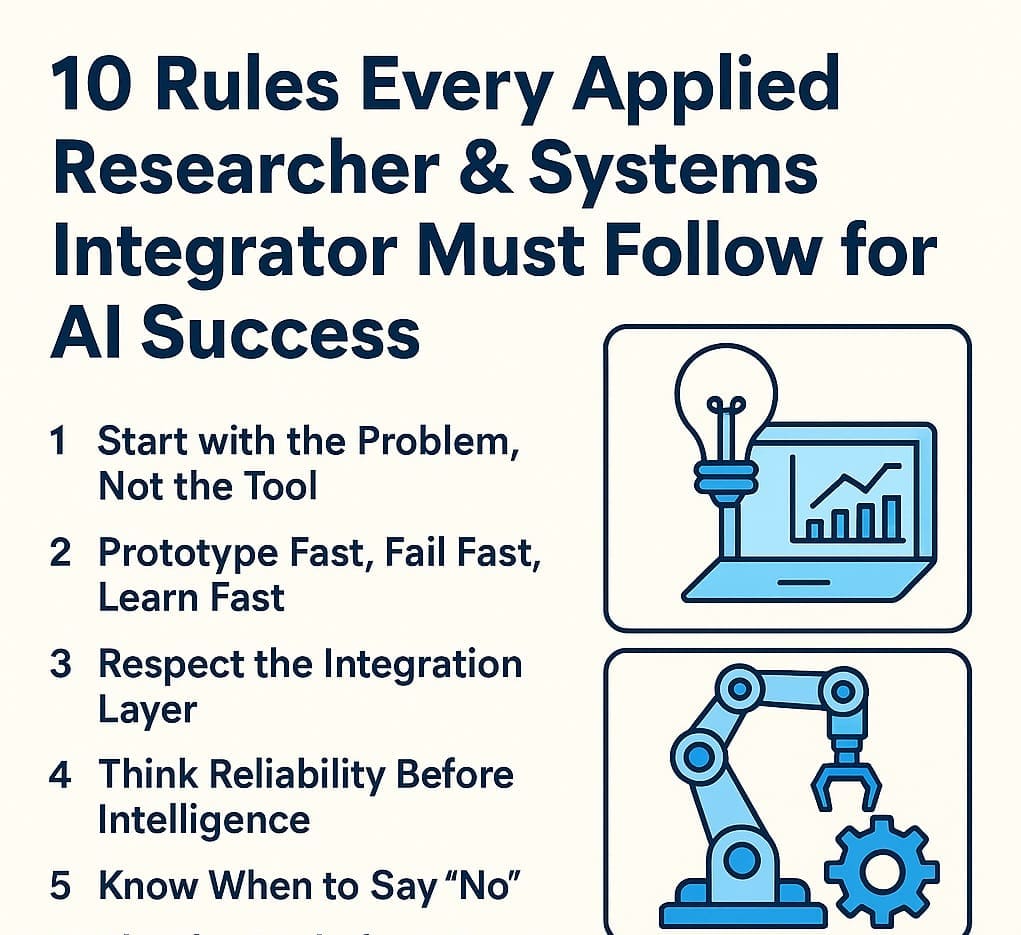
Rule 1: Start with the Problem, Not the Tool
Every failed AI project has one thing in common: it started with the shiny hammer instead of the actual nail.
Ask:
- What’s the real business or operational problem?
- How is it being solved today?
- What pain points are the stakeholders willing to pay to eliminate?
If you can’t answer those questions, you’re not ready to bring AI into the room.
👉 Tip: Executives don’t care that you fine-tuned a transformer. They care that you reduced compliance risk by 20% or cut downtime in half.
Rule 2: Prototype Fast, Fail Fast, Learn Fast
Applied research isn’t about publishing a perfect paper; it’s about proving whether something can work in practice.
- Build a minimal but testable prototype.
- Put it in a real environment (not a sterile sandbox).
- Observe how it breaks.
- Iterate quickly.
The motto here is “Better an ugly truth than a beautiful illusion.”
Think of it as engineering stoicism: expect failure, embrace it, and use it as the raw material for progress.
Rule 3: Respect the Integration Layer
The fanciest AI model means nothing if it doesn’t plug into the existing ecosystem. This is where systems integrators earn their stripes.
- Data pipelines must be reliable and secure.
- APIs should actually conform to standards.
- Monitoring, logging, and error handling can’t be afterthoughts.
Integration is less glamorous than AI research, but it’s where projects live or die.
👉 Analogy: In philosophy, Emerson spoke about “building your own world.” In AI integration, you don’t get that luxury — you’re forced to build in someone else’s messy basement.
Rule 4: Think Reliability Before Intelligence
A mediocre system that works 99.99% of the time beats a brilliant one that fails unpredictably.
- Reliability, uptime, and fault tolerance aren’t extras — they’re survival insurance.
- Build in graceful degradation.
- Have a fallback path that doesn’t involve frantic Slack messages at 2 a.m.
A demo that wows investors but fails under load is like a philosopher who talks endlessly about virtue but steals your lunch when no one’s looking.
Rule 5: Know When to Say “No”
Not every process needs automation. Not every workflow needs AI.
One of the fastest ways to lose credibility is to oversell the fit of AI. Have the courage to say:
- “This problem doesn’t need AI.”
- “The ROI isn’t there yet.”
- “Let’s revisit in a year.”
Long-term trust comes from honesty. The short-term rush of a “yes” can collapse into long-term embarrassment.
Rule 6: Plan for Scale from Day 1
It’s easy to get a prototype running once. The question is: will it still work when:
- There are 10,000 daily requests instead of 10?
- Data comes in from messy, real-world sources?
- Multiple departments or regions are involved?
Design like scale is inevitable, even if your pilot is small. Otherwise, you’re building a castle on sand.
Rule 7: Keep Humans in the Loop
AI systems don’t operate in a vacuum — they exist in dynamic environments filled with messy context.
- Humans are the best fail-safes.
- Humans provide contextual judgment that no model can replicate.
- Systems should elevate human decision-making, not eliminate it.
👉 Case in point: Aviation has had autopilot for decades, but no one boards a plane thinking, “I sure hope the AI lands this alone.”
Rule 8: Document Like Your Life Depends on It
Today’s “clever hack” becomes tomorrow’s “production nightmare” if no one knows how it works.
- Document architectures, data flows, and assumptions.
- Use version control religiously.
- Write tests that future maintainers will thank you for.
Documentation isn’t bureaucracy — it’s a life raft for the poor soul who inherits your system six months from now (and sometimes, that poor soul is you).
Rule 9: Measure Success Beyond the Demo
Executives love slick demos. But success isn’t the applause you get in a conference room; it’s adoption, reliability, and measurable ROI.
- Define success metrics that tie directly to business outcomes.
- Measure continuously.
- Kill projects that don’t move the needle.
Beware of innovation theater — projects that look futuristic but add no value. They’re great for press releases but terrible for careers.
Rule 10: Marry Philosophy with Engineering
Great systems integrators aren’t just engineers — they’re philosophers in disguise.
- Be Stoic: Expect obstacles, design around them.
- Be Pragmatist: Adapt methods to the context, not the other way around.
- Be Transcendentalist: Think beyond current tools; keep an eye on the bigger picture.
AI is about more than circuits and code. It’s about systems that adapt to the world — and systems that shape the world in return.
Conclusion: The Pragmatist’s Playbook
Applied researchers and systems integrators are the bridge-builders of the AI world. The lab can produce breakthroughs, and the boardroom can fund initiatives, but without practical rules of engagement, projects stall.
If you follow these 10 rules, you’ll avoid the traps of overselling, underbuilding, and innovation theater. You’ll design systems that last — not just systems that demo well.
And most importantly, you’ll sleep better knowing your robots won’t face-plant the moment someone pulls the plug.
Want More?
- Check out all of our free blog articles
- Check out all of our free infographics
- We currently have two books published
- Check out our hub for social media links to stay updated on what we publish
