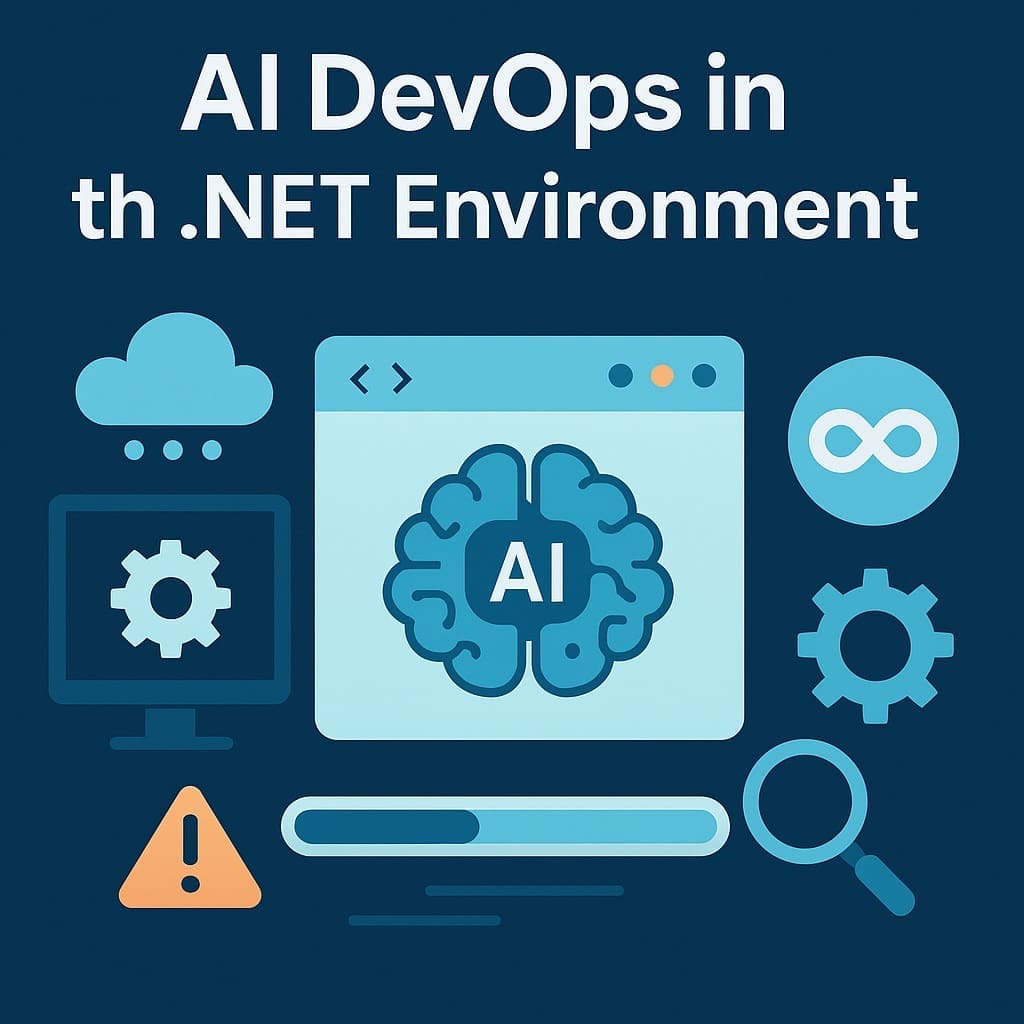
Why AI Needs DevOps in .NET
Building machine learning models is only half the battle. The real challenge lies in deploying, monitoring, and maintaining them at scale. Traditional software has long benefited from DevOps practices, but AI introduces new complexities—data drift, retraining, and compliance.
For organizations building on .NET and ML.NET, applying AI DevOps principles ensures models move from prototype to production with security, reliability, and agility.
1. The Case for AI DevOps in .NET
Unlike standard applications, AI systems evolve after deployment. They face:
- Model drift – predictions degrade as data changes.
- Resource complexity – GPUs, large data pipelines, and containerization.
- Regulatory oversight – explainability, audit trails, and compliance.
Without DevOps practices tailored for AI, teams risk “proof-of-concept purgatory” where models never scale. AI DevOps bridges this gap by applying automation, governance, and monitoring to the machine learning lifecycle.
2. Core Components of AI DevOps in .NET
A strong AI DevOps pipeline in .NET should include:
- Version control for models and data – Use Git + DVC (Data Version Control) to track datasets and trained models.
- Automated builds and testing – Validate ML.NET models through unit tests and integration tests.
- CI/CD pipelines – Deploy models via Azure DevOps, GitHub Actions, or Jenkins with automated workflows.
- Monitoring and alerting – Track performance metrics, latency, and anomalies in deployed models.
These practices create a repeatable, reliable path from experimentation to production.
3. CI/CD Pipelines for ML.NET Models
In a .NET environment, ML.NET integrates naturally with existing CI/CD pipelines. Steps to implement:
- Preprocessing validation – Ensure data schemas and feature engineering are consistent.
- Model training stage – Automate training with ML.NET CLI or C# scripts.
- Testing stage – Compare new model accuracy against baselines before promotion.
- Deployment stage – Package models as NuGet libraries, Docker containers, or REST APIs.
This continuous cycle ensures models are tested and production-ready before release.
4. Infrastructure and Tooling
A robust .NET AI DevOps stack may include:
- Azure Machine Learning + ML.NET for managed pipelines.
- Kubernetes + Docker for scalable deployments.
- ONNX Runtime for optimized inference across hardware.
- Application Insights / Prometheus for observability and performance metrics.
These tools extend standard DevOps to address AI-specific challenges.
5. Monitoring and Retraining
Post-deployment, monitoring is critical:
- Data drift detection – Alerts when input data no longer resembles training data.
- Model decay tracking – Automatic triggers for retraining when accuracy drops.
- Security checks – Logs, authentication, and role-based access to prevent unauthorized use.
Integrating retraining workflows into CI/CD pipelines ensures models adapt continuously.
6. Governance and Compliance
AI DevOps is not just technical—it’s about responsible deployment. In regulated industries, teams should:
- Maintain audit trails of training datasets, hyperparameters, and versions.
- Document models with model cards for transparency.
- Apply RBAC (role-based access control) to production APIs.
This builds trust and compliance into the pipeline.
Conclusion: From Prototype to Production with Confidence
For .NET teams, combining DevOps principles with ML.NET and Azure tooling transforms AI initiatives from fragile experiments into robust, scalable systems.
By embracing CI/CD pipelines, automated monitoring, retraining, and governance, organizations can deploy AI with confidence—delivering measurable business outcomes while maintaining security and compliance.
AI DevOps in .NET isn’t just about models—it’s about building a disciplined pipeline that ensures AI actually delivers.
Want More?
Want to see how ML.NET and Azure DevOps can power your AI workflows? Start building pipelines that make AI production-ready, secure, and scalable.
- Free blog articles
- Free Infographics
- Follow us on social media to see much of our content
