Introduction: The Hype and the Fear
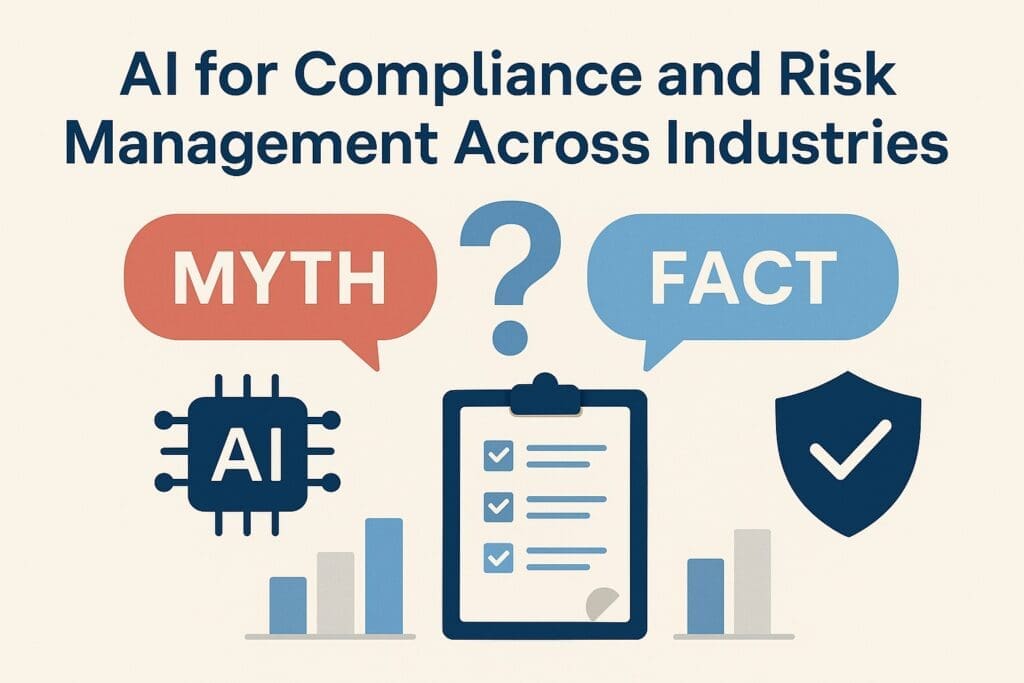
When executives hear the phrase AI for compliance and risk management across industries, they often react in two extremes:
- Hype: “AI will automate compliance and eliminate risk overnight!”
- Fear: “AI is a black box that regulators will never approve!”
The truth, as usual, lies somewhere in between. To separate fact from fiction, let’s bust some of the most common myths surrounding AI in compliance and risk management. Along the way, we’ll draw lessons from history and philosophy—because the struggle to balance risk, trust, and innovation is not new.
Myth #1: AI Will Eliminate Compliance Teams
The Myth: Once AI is in place, compliance officers and auditors will be redundant.
The Reality: AI can process mountains of data faster than humans—but it cannot interpret regulatory nuance or ethical context.
Example
- AI can detect suspicious transaction patterns in banking (anti-money laundering).
- But it still requires compliance officers to review, validate, and make judgment calls.
AI reduces the grunt work, but humans remain the final arbiters. Think of AI as the X-ray machine: it highlights areas of concern, but the radiologist (compliance officer) provides the diagnosis.
Myth #2: AI Is Too “Black Box” for Regulators
The Myth: Regulators will never accept AI because it can’t explain its decisions.
The Reality: Explainable AI (XAI) and audit trails are closing the gap.
Tools and Techniques
- SHAP and LIME provide visual explanations of model outputs.
- Model versioning and logging (using Azure ML registries in the Microsoft ecosystem) create traceability.
- Regulators are increasingly open to AI if organizations can demonstrate auditability and transparency.
Philosophically, this echoes Stoicism’s demand for reasoned clarity: Epictetus taught that actions should be grounded in logic that can be explained. AI, when paired with explainability frameworks, moves from “mystery oracle” to “reasoned assistant.”
Myth #3: AI Compliance Is Only for Finance and Healthcare
The Myth: Only industries like banking and healthcare need AI for compliance and risk management.
The Reality: Every industry faces compliance and risk challenges.
Broader Applications
- Manufacturing: AI predicts equipment failures, reducing safety violations.
- Retail: AI monitors supply chains for sustainability compliance.
- Government: AI automates records management and FOIA responses.
- Energy: AI ensures environmental and safety standards are met at scale.
Compliance isn’t limited to “heavily regulated” sectors—it’s woven into the fabric of every modern industry.
Myth #4: AI Introduces More Risk Than It Reduces
The Myth: By introducing AI, companies multiply their risks—bias, cyberattacks, data breaches.
The Reality: AI does introduce new risks, but it also mitigates far more risks than it creates when implemented responsibly.
Risk Mitigation Examples
- Fraud Detection: Machine learning flags anomalies faster than humans.
- Cybersecurity: AI systems identify intrusions and patch vulnerabilities in real time.
- Supply Chain: Predictive AI reduces disruptions and regulatory fines.
This is the Middle Way of Buddhism applied to technology: avoiding extremes of blind adoption or total rejection. Balanced implementation of AI reduces net risk.
Myth #5: AI Is Too Expensive for Compliance Use Cases
The Myth: Only Fortune 500s can afford AI for compliance and risk management.
The Reality: Cloud-based AI platforms and pre-trained models have drastically lowered the barrier.
Microsoft/.NET Ecosystem Advantage
- Azure AI provides pre-built models for anomaly detection, document classification, and regulatory monitoring.
- ML.NET allows in-house .NET developers to build lightweight compliance models without switching to Python.
- Power Automate + Copilot Studio can streamline compliance workflows at a fraction of the cost of custom-built systems.
The cost of non-compliance (lawsuits, fines, reputational damage) far outweighs the cost of AI adoption.
Myth #6: AI Will Always Be Biased and Unfair
The Myth: AI is inherently biased, so it can never be trusted in compliance decisions.
The Reality: AI bias is real—but manageable.
Methods to Address Bias
- Use diverse training datasets.
- Implement bias detection algorithms during retraining cycles.
- Enforce governance frameworks like ISO/IEC 42001 and NIST AI RMF.
Bias in AI is like bias in human decision-making: unavoidable, but improvable with awareness, process, and accountability.
Myth #7: AI Decisions Cannot Be Challenged
The Myth: Once AI makes a decision, it’s final and unquestionable.
The Reality: AI outputs should be seen as decision support, not decision replacement.
Industry Examples
- Healthcare: AI suggests treatment options, but doctors make the call.
- Insurance: AI recommends premium adjustments, but agents approve them.
- Legal: AI reviews contracts, but lawyers interpret the fine print.
In Stoic terms, AI provides the impressions, but humans retain the assent. Decision-making authority remains with professionals.
Myth #8: AI Compliance Requires Starting from Scratch
The Myth: To use AI for compliance, companies must rebuild systems entirely.
The Reality: Most organizations can integrate AI into existing infrastructure.
Microsoft Example
- Use Azure Cognitive Search to enhance existing document repositories.
- Apply ML.NET models on top of current .NET business apps to flag anomalies.
- Extend Power BI dashboards with AI-driven compliance metrics.
AI can often be a bolt-on enhancement, not a rip-and-replace overhaul.
Historical Analogy: The Printing Press and Legal Oversight
When the printing press emerged in the 15th century, authorities feared chaos—books spreading unregulated ideas! Over time, publishing laws and oversight frameworks evolved, balancing free expression with governance.
AI for compliance and risk management mirrors this story: initial fear, followed by structured oversight, leading to lasting societal benefits.
Executive Playbook: Practical Steps
For executives in the Microsoft/.NET ecosystem, here’s a roadmap to separate myth from reality:
- Start Small: Pilot AI in a single compliance use case (e.g., document classification).
- Integrate Logging: Use Application Insights and Azure ML for audit trails.
- Empower Compliance Teams: Train staff to interpret AI outputs, not fear them.
- Automate Reporting: Use Power BI for regulator-friendly dashboards.
- Review Bias: Implement quarterly bias checks on models.
- Govern Systematically: Adopt ISO/IEC 42001 or NIST AI RMF to formalize oversight.
Conclusion: From Myths to Measured Action
The myths about AI for compliance and risk management across industries stem from extremes of optimism and pessimism. Reality lies in between: AI is neither a magic compliance machine nor a regulatory nightmare.
For professionals in the Microsoft/.NET ecosystem, the key is measured implementation:
- Use existing Azure and ML.NET tools.
- Build auditability and explainability into every model.
- Empower compliance officers with decision support, not replacement.
In short, executives who move past the myths and embrace pragmatic, transparent AI adoption will not only meet compliance demands but also turn risk management into a strategic advantage.
Want More?
- Check out all of our free blog articles
- Check out all of our free infographics
- We currently have two books published
- Check out our hub for social media links to stay updated on what we publish
