Introduction: The Developer–Executive Disconnect in AI
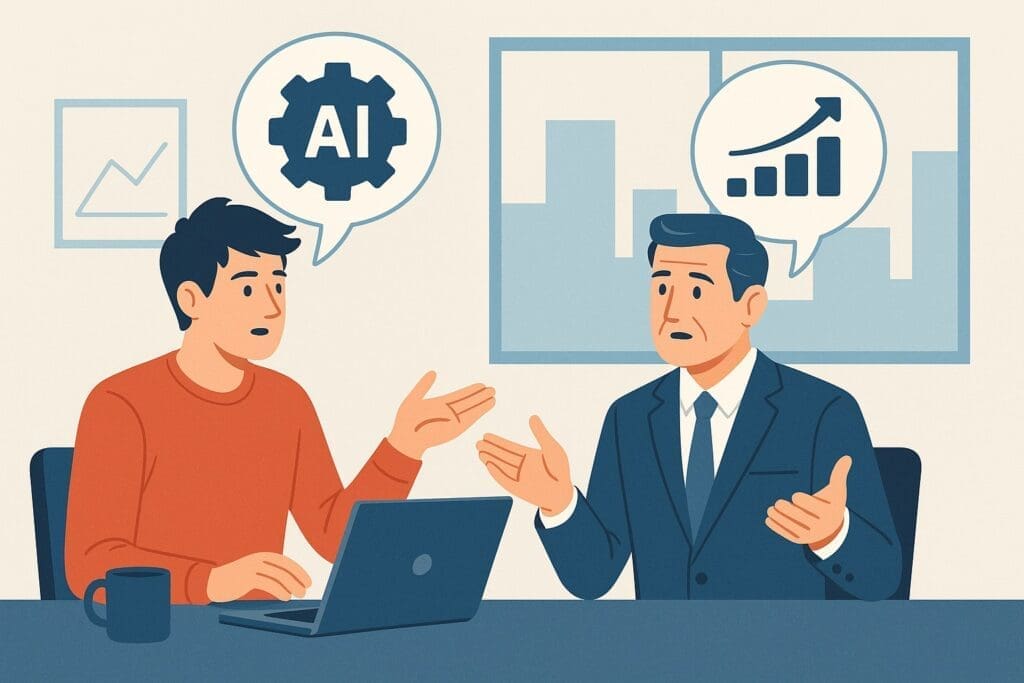
Artificial intelligence promises transformation, innovation, and competitive edge. Executives are under pressure to deliver—fast. But between the boardroom pitch and the first successful model, there’s often a yawning gap filled with confusion, scope creep, and missed expectations.
At the center of it all? Developers.
Too often, developers are tasked with executing an AI strategy that was handed down without the technical context, infrastructure reality, or timeline feasibility to succeed. The result? Burnout, blame games, and failed pilots.
This article highlights what developers wish executives knew before declaring “Let’s add AI.”
1. 🚫 AI Is Not “Just Another Feature”
From the outside, AI might seem like a natural extension of existing software projects—just another line item in the backlog. But from the inside, AI introduces an entirely different paradigm.
- Traditional development is deterministic; AI is probabilistic.
- Software has known inputs and outputs; AI works on likelihoods.
- Bugs in software are logic errors; bugs in AI can be unclear data, biased training, or incorrect assumptions.
Developer POV: “We’re not just writing code—we’re building systems that learn from messy, incomplete, and sometimes contradictory data.”
Executive takeaway: AI requires data pipelines, experimentation time, and new quality metrics. It’s not plug-and-play.
2. 🧪 Proof-of-Concept ≠ Production
Executives love seeing quick wins—a chatbot answering customer questions, a model predicting sales. But what starts as a slick proof-of-concept in a dev sandbox often fails when pushed into production.
Why?
- Data used in POCs is usually cleaned and curated—real-world data isn’t.
- POCs rarely include security, logging, or governance.
- Scaling from “demo” to “daily use by 5,000 employees” is non-trivial.
Developer POV: “We can demo magic, but operationalizing it takes engineering muscle, infrastructure, and time.”
Executive takeaway: Build in time and budget to harden models for production use—plan for logging, monitoring, security, and retraining.
3. ⏱️ Realistic Timelines Matter More Than Optimism
AI timelines can’t be dictated solely by market cycles or boardroom urgency. Model training takes iteration. Data cleaning is tedious. Feedback loops must be built.
Compressing timelines doesn’t accelerate progress—it often guarantees failure.
Developer POV: “AI is R&D. We’re not delaying—we’re learning. Fast iteration with feedback beats rushed delivery with rework.”
Executive takeaway: Set strategic deadlines, but involve engineering early to sanity-check estimates. Buffer for the unknown.
4. 📦 Garbage Data = Garbage Results
One of the most common sources of frustration is data quality. Executives often assume the company’s data is “AI-ready.” It rarely is.
- Missing values, inconsistent formats, and mislabeling are common.
- Historical data often reflects outdated or biased processes.
- No amount of model tuning will fix bad data.
Developer POV: “We’re not being negative when we say the data’s a problem—we’re being realistic.”
Executive takeaway: Invest in data engineering and governance before expecting intelligent outcomes.
5. 🔄 Model Accuracy Is Not Enough
A model might be 90% accurate—but that doesn’t mean it’s useful. Developers worry about contextual utility, not just raw metrics.
- Does the model’s output fit into existing workflows?
- Can users trust and act on the results?
- Is the accuracy stable over time?
Developer POV: “We care about adoption, not just accuracy. If no one uses it, we’ve wasted our time.”
Executive takeaway: Ask how AI fits the business workflow, not just the business goals.
6. 🙋♂️ Developers Need a Seat at the Strategy Table
Too often, strategic decisions are made in silos. Developers are looped in late—after the RFPs are issued, tools selected, and expectations set.
This creates disconnects:
- Chosen tools may not work with your stack.
- Assumptions about capabilities may be wrong.
- Unnecessary costs get locked in early.
Developer POV: “We could’ve saved you six figures if you brought us in earlier.”
Executive takeaway: Treat senior developers and architects as advisors, not just implementers.
7. 🧠 Not Every Developer Is an AI Engineer
This one’s critical.
AI projects often assume any developer can pivot into AI overnight. But:
- AI requires knowledge in data science, ML frameworks, and statistics.
- AI DevOps differs from traditional CI/CD.
- Debugging models is a skill in itself.
Developer POV: “Give us time to learn—or bring in the right expertise.”
Executive takeaway: Upskill your team, pair them with experienced data scientists, or hire/contract accordingly.
Final Thought: Trust Is the Real Bottleneck
At the heart of every failed AI project is usually not bad code—but bad communication.
Developers thrive when their insights are heard, their constraints are respected, and their role is valued beyond the keyboard.
Executives thrive when their vision is translated realistically into action.
The best AI projects aren’t just technical—they’re empathetic. They succeed when everyone understands the realities behind the buzzwords.
Call to Action
🔍 Want to bridge the gap between your AI vision and successful delivery?
Explore our Boardroom-to-Buildroom resources—infographics, videos, and real-world checklists—designed to help every role succeed in AI implementation.
