Introduction: The Promise vs. Reality of Low-Code AI
Low-code and no-code AI platforms are often marketed as the fastest way to bring artificial intelligence into your organization. They promise pre-built models, drag-and-drop workflows, and a smooth path from idea to production.
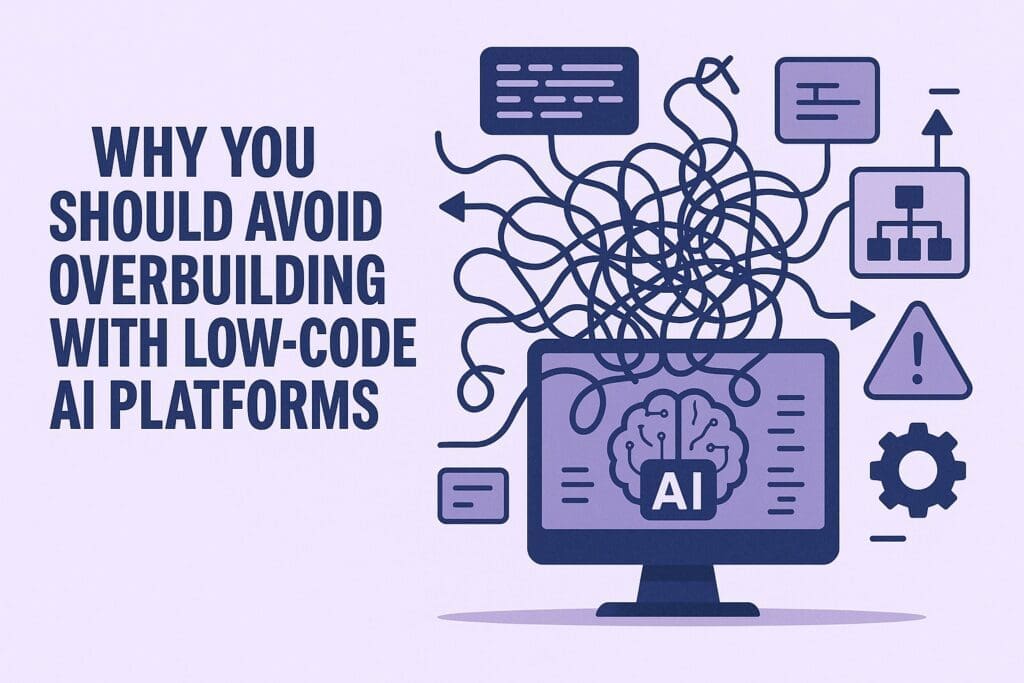
But here’s the reality: while low-code AI can be valuable for prototyping and simple automations, overbuilding on these platforms creates long-term risks that can undermine your entire AI strategy.
This article explains why organizations should be cautious about overcommitting to low-code AI platforms—and what to consider instead.
The Lure of Low-Code AI
Low-code platforms gained traction because they:
- Accelerate development — business analysts and citizen developers can spin up AI workflows without writing much code.
- Provide pre-trained models — common use cases like sentiment analysis, document processing, or anomaly detection are available out-of-the-box.
- Reduce initial costs — organizations can test ideas quickly without building a full development team.
For small-scale projects or proofs of concept, this is genuinely useful. But when organizations start building critical systems on these platforms, problems arise.
Why Overbuilding on Low-Code AI Is Risky
1. Hidden Technical Debt
Low-code platforms abstract away complexity, but they also hide critical details.
- Black-box models — you may not know what data the models were trained on, or how to fine-tune them responsibly.
- Limited monitoring — visibility into performance drift, fairness, or compliance may be restricted.
- Integration shortcuts — connectors and automations can create brittle pipelines that break under scale.
The result? Technical debt that compounds—and costs more to unwind later than if you had built a clean, maintainable architecture from the start.
2. Vendor Lock-In and Rising Costs
What starts as a cheap subscription often escalates.
- Scaling beyond a few use cases usually triggers steep licensing fees.
- Data residency and storage requirements may force you into a single vendor ecosystem.
- If you outgrow the platform, migrating your models and workflows into a custom .NET or Azure AI system can be costly and disruptive.
In other words, the quick win today can create a strategic straitjacket tomorrow.
3. Limited Customization and Control
Most low-code AI tools shine with simple use cases—but hit walls quickly:
- Need domain-specific tuning? You may not be able to.
- Want to implement complex workflows? The drag-and-drop UI may not support it.
- Require enterprise-grade governance? Features may be immature or nonexistent.
For businesses with unique data, processes, or compliance needs, these limitations are deal-breakers.
4. Security and Compliance Blind Spots
Organizations in healthcare, finance, or government must operate under strict regulatory frameworks (HIPAA, GDPR, CCPA). Low-code platforms often lack:
- Fine-grained access control
- Audit trails for model predictions
- Transparent explainability features
That can put the business at risk—not just technically, but legally.
A Smarter Path Forward: Hybrid and .NET-Centric AI
So what’s the alternative? It’s not “throw out low-code.” It’s about using it wisely.
- Use low-code for prototypes — explore feasibility and gather feedback quickly.
- Migrate proven ideas into .NET — leverage ML.NET, ONNX, and Azure AI to build scalable, transparent, and compliant systems.
- Apply proper engineering discipline — version control, testing, monitoring, and security from the beginning.
- Adopt hybrid strategies — combine the accessibility of low-code with the flexibility and robustness of custom development.
This approach keeps your innovation cycle fast while ensuring production systems are reliable and future-proof.
Key Takeaways
- Low-code AI is a great prototyping tool, but a poor foundation for enterprise-scale systems.
- Overbuilding creates technical debt, vendor lock-in, and compliance risks.
- Organizations should balance low-code’s speed with custom .NET solutions for long-term stability.
- A hybrid strategy—fast iteration with low-code, production-grade development in .NET—offers the best of both worlds.
Conclusion
Low-code AI platforms can feel like a shortcut to success, but shortcuts rarely lead to sustainable growth. By recognizing their limits and resisting the urge to overbuild, your organization can experiment quickly, scale wisely, and protect long-term value.
In AI, the goal isn’t just speed—it’s building systems that scale and last.
Want more?
Check out all of our resources at our hub
