
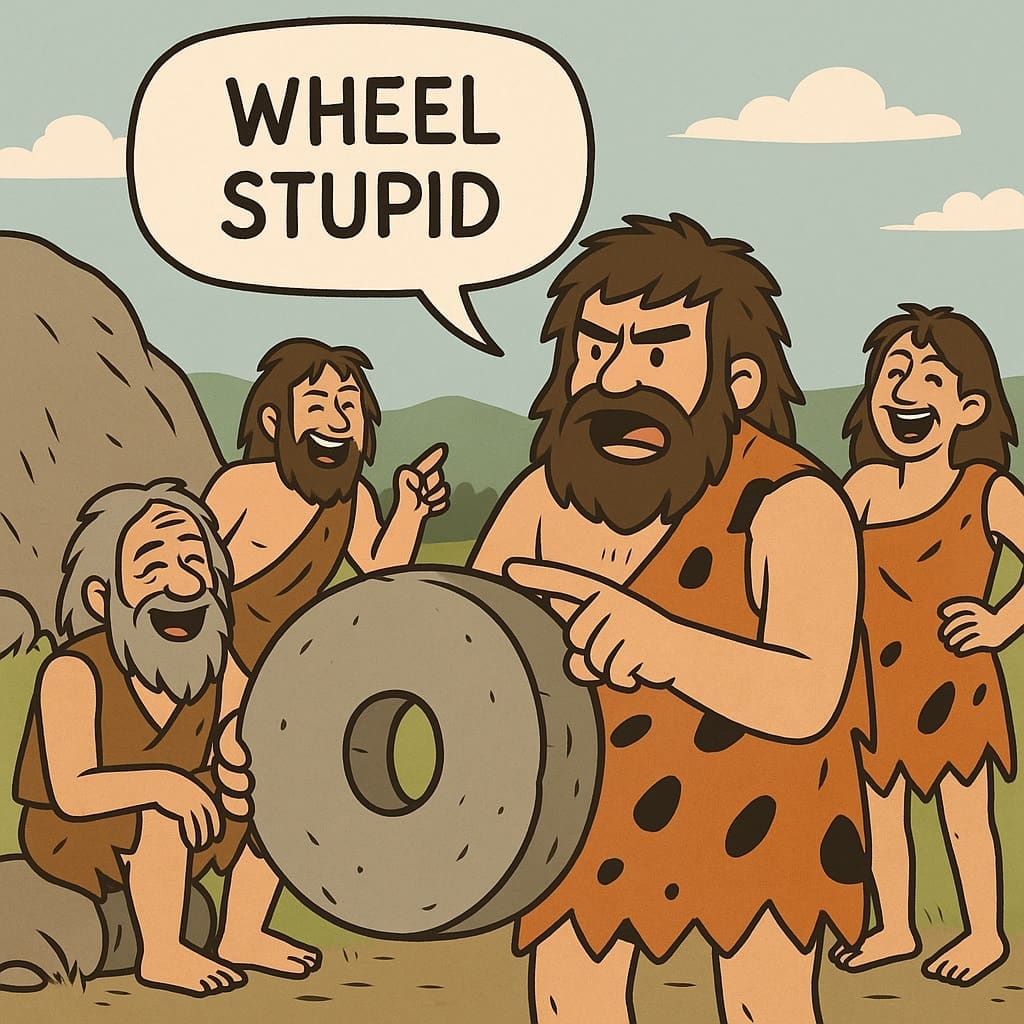
Caveman Story Time
Long, long ago… Caveman invent wheel. Caveman very proud. Caveman shout:
Look tribe! Big round rock! Change world!
Tribe gather. Tribe not impressed.
Objection 1: One Wheel Useless
Wheel roll two feet. Wheel fall over. Tribe laugh.
Wheel stupid. Rock better. At least rock stay put.
Objection 2: Road Too Bumpy
Path full of mud, roots, big rock. Wheel bounce, crack, break.
Ha! Can’t even cross dirt. Stick with dragging mammoth hide. More reliable.
Objection 3: Already Have Better Tools
Tribe already use log rollers, sled, strong back muscles.
Why new thing? Old thing work fine. Wheel waste time.
Objection 4: Dangerous Innovation
Wheel roll wrong way. Smash hunter foot. Burn chief stew.
Wheel evil. Ban wheel. Save tribe.
Objection 5: No Scale
One wheel no help. Need frame, axle, two wheels, maybe four. Too hard.
Who build frame? Who waste time? Go hunt deer instead.
And so tribe laugh, eat roasted squirrel, and forget wheel.
But one day, another caveman add axle, frame, four wheels… Suddenly tribe not laughing. Tribe moving. Tribe trading. Tribe growing empire. Civilization roll forward.
Theoretical vs. Applied Innovation
Here’s the key: the first caveman was a theorist. He invented the wheel, but the wheel alone was a novelty. No one “got it.”
It took an applied researcher to connect the dots—wheel + wheel + frame = cart. Cart + horses = chariot. Applied innovation is what made the idea world-changing.
This pattern repeats throughout history:
- Electricity meant little until it powered the lightbulb.
- The internet was academic until browsers and search engines made it practical.
- The wheel was just a round rock until someone applied it.
And now: LLMs are the wheel of our time.
Fear of New Tech (a.k.a. Fire Bad!)
Of course, wheels weren’t the only invention people mocked.
Think about fire.
Fire scary. Burn hair. Fire bad. Stick with cold meat.
At first, fire seemed more dangerous than useful. It burned food, burned huts, and burned fingers. For a while, many tribes wanted nothing to do with it.
But eventually, fire meant cooked meat, warmth in winter, metallurgy, and a leap in human survival.
Every breakthrough follows this arc:
- First, fear and mockery. (“Wheel stupid. Fire dangerous. LLM hallucinate.”)
- Then, grudging adoption. (“Wheel maybe good for hauling rocks. Fire maybe good for stew. LLM maybe good for drafting email.”)
- Finally, civilization-changing use. (“Wheel build empire. Fire forge swords. LLM transform business, medicine, law.”)
The pattern never changes. First ridicule, then adoption, then revolution.
Fast-Forward to Today: Wheels = LLMs
The objections sound the same:
- “LLM hallucinate.”
- “LLM no work in messy real world.”
- “LLM no better than Google search.”
- “LLM dangerous. Bad for tribe.”
- “LLM not scale.”
And they’re all true… if you look at the raw “wheel.”
But once applied researchers build frames, carts, and chariots around LLMs—real applications, integrated workflows, AI copilots, business tools—the usefulness becomes obvious.
The Real Lesson
Every new invention starts out looking silly or useless.
The theorists give us the raw invention.
The applied researchers give us civilization.
So yes, a bare wheel falls over. A bare fire burns fingers. And a bare LLM hallucinates.
But once the right applied minds get to work, all three keep humanity rolling forward.
👉 Don’t laugh too hard at the caveman with his “useless” invention.
👉 Don’t dismiss the LLM before the applied innovators build the frame.
History’s clear: today’s useless wheel is tomorrow’s civilization.
Want More?
- All of our free blog articles?
- Free Infographics
- Our hub outlines our social media
