Introduction: Why Prototyping Matters in High-Stakes Projects
Government departments are under constant pressure to deliver public value while protecting taxpayer dollars.
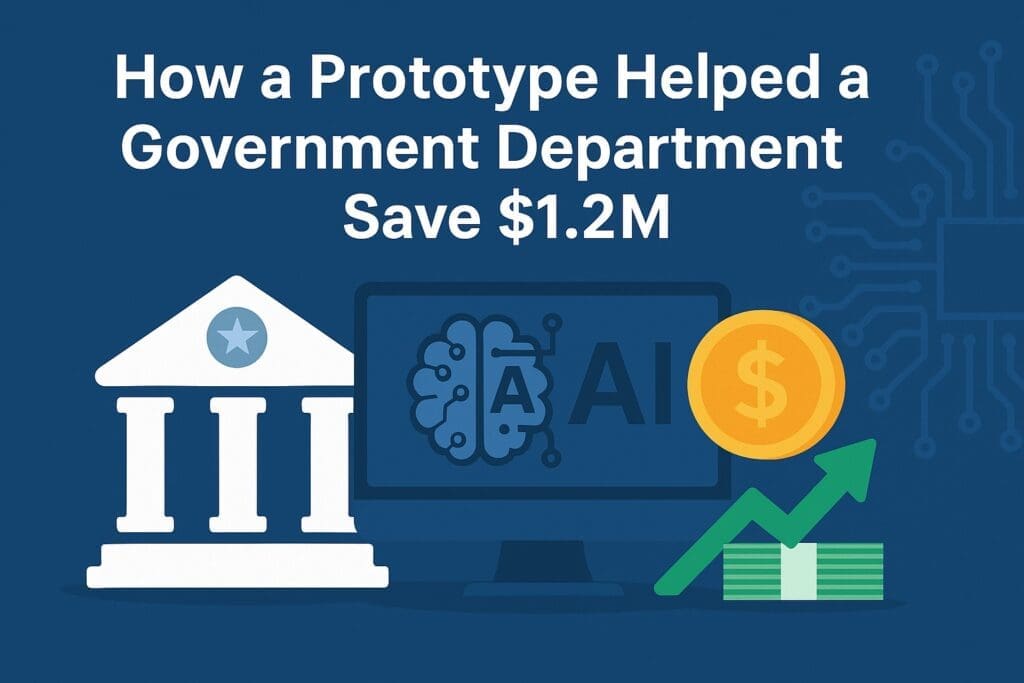
In this case study, a U.S. government agency faced a high-risk, high-cost technology project—but a small AI prototype ultimately saved them $1.2 million before full deployment.
This isn’t just a story about cost savings—it’s a blueprint for how prototyping AI solutions can prevent expensive mistakes in both public and private sectors.
The Challenge: A Complex, High-Cost AI Initiative
The department planned to implement an AI-powered document classification system to process and route millions of forms annually.
Projected full deployment cost: $1.5 million over 18 months.
Key project goals:
- Automate document categorization with >90% accuracy.
- Reduce manual processing time by 60%.
- Integrate seamlessly with existing legacy systems.
The Risk:
Jumping straight into full development without validating assumptions could lead to an expensive, underperforming system.
The Solution: Build a Proof-of-Concept Prototype
The agency’s technical lead proposed a prototype-first approach:
- Duration: 10 weeks
- Budget: $250,000
- Tech stack: C#/.NET, ML.NET for AI model training, Azure Cognitive Services for OCR.
Prototype objectives:
- Validate AI accuracy with real-world document samples.
- Test integration with legacy databases.
- Measure processing speed under realistic workloads.
- Identify potential compliance/security issues early.
The Results: Measurable Success Before Full Rollout
The prototype revealed three critical insights:
- AI Accuracy Gap: Initial models achieved 82% accuracy—below the required 90%—but improvements were possible with additional training data.
- Integration Hurdles: Legacy systems required more API customization than expected.
- Workflow Redesign: Automating classification revealed inefficiencies in upstream document intake that could be fixed alongside AI deployment.
Financial Impact:
Because these issues surfaced early, the department avoided:
- $900,000 in rework costs for a flawed full-scale deployment.
- $300,000 in licensing and infrastructure tied to an overbuilt initial design.
Net Savings: $1.2 million before the first production release.
Why Prototypes Deliver ROI in Government Projects
Prototyping delivers benefits beyond cost savings:
- Risk Mitigation: Identifies technical, operational, and compliance risks early.
- Stakeholder Alignment: Visual, working models help non-technical decision-makers understand scope.
- Faster Iteration: Feedback loops in weeks, not months.
- Informed Investment: Moves funding decisions from assumption to evidence.
Lessons Learned from This AI Prototype Case Study
- Validate Assumptions Before Full Spend – Don’t trust theoretical ROI models without real-world testing.
- Involve End Users Early – Their workflow insights can prevent technical missteps.
- Track Metrics During Prototyping – Accuracy, throughput, and integration time are leading indicators of project health.
- Plan for Transition – Successful prototypes should be designed to evolve into production-grade systems.
Conclusion
This $1.2M savings story proves that AI prototyping is not an optional step—it’s a strategic safeguard.
For government departments and enterprises alike, a small upfront investment in a working prototype can prevent massive budget overruns and deliver solutions that actually work.
If your organization is considering a large-scale AI deployment, start with a prototype—it may be the best investment you ever make.
For more of our resources:
