Introduction: Why Security Comes First in AI
Artificial Intelligence is transforming the way businesses operate, but for C# developers working in .NET environments, integrating AI is no longer just a question of performance and accuracy. It’s a question of trust, compliance, and security.
The General Data Protection Regulation (GDPR) is the toughest privacy law in the world. It sets a high bar for how organizations collect, process, and store personal data. For developers, that means AI systems can’t be built with “move fast and break things” attitudes. They must be designed to respect privacy from the start.
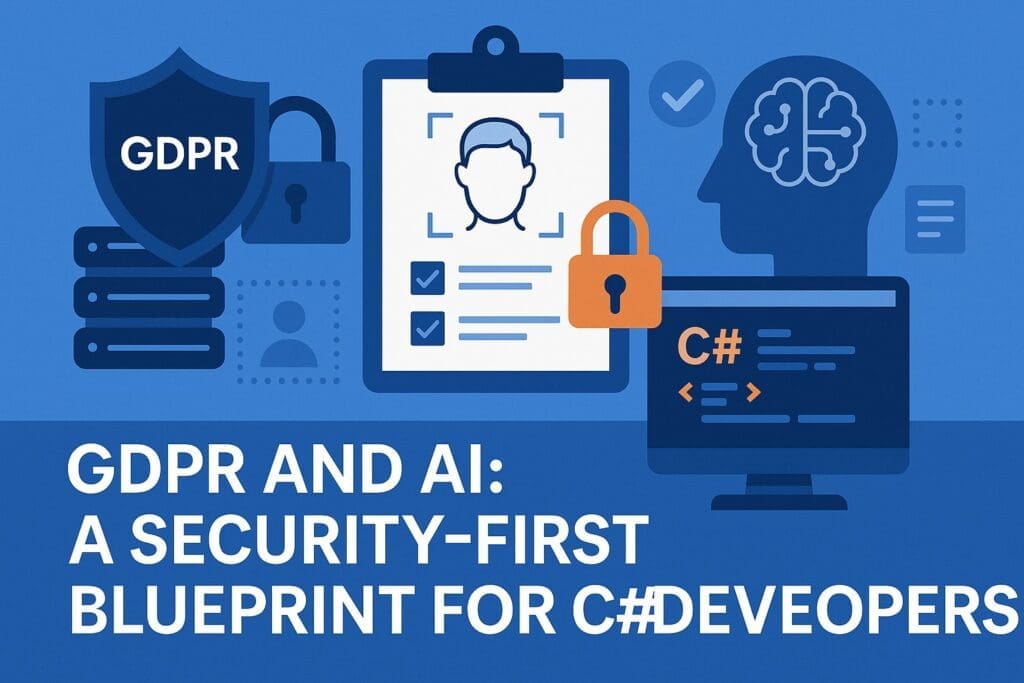
In this guide, we’ll walk through a security-first blueprint for building GDPR-compliant AI apps in C#. You’ll learn how to:
- Apply GDPR principles directly to AI workflows
- Implement consent, encryption, and audit trails in C#
- Avoid common compliance pitfalls
- Build trust while reducing legal and reputational risk
Why GDPR Matters for AI Development
AI thrives on data. But GDPR enforces strict rules around how personal data is handled.
- Legal Risk: Non-compliance can result in fines up to €20 million or 4% of global turnover.
- Ethical Risk: Mishandling personal information erodes user trust.
- Operational Risk: Without compliance, scaling AI systems into new markets becomes difficult.
For developers, GDPR isn’t abstract—it’s a practical design constraint that shapes how code is written, tested, and deployed.
The Security-First Blueprint for GDPR-Compliant AI in .NET
Step 1: Data Minimization
Only collect and store the data you absolutely need. Strip out personally identifiable information (PII) before persisting training or inference records.
var record = new CustomerRecord
{
    Id = Guid.NewGuid(),
    // Only keep non-sensitive fields
    Age = input.Age,
    PurchaseCategory = input.PurchaseCategory
};
Step 2: Explicit User Consent
GDPR requires freely given, specific, informed, and unambiguous consent. Developers must enforce it programmatically.
public bool HasConsent(User user)
{
    return user.ConsentGiven
        && user.ConsentTimestamp > DateTime.UtcNow.AddYears(-1);
}
Step 3: Encryption in Transit and at Rest
Sensitive data must be encrypted both while stored and when sent across networks.
using (Aes aes = Aes.Create())
{
    aes.Key = Convert.FromBase64String(config["EncryptionKey"]);
    ICryptoTransform encryptor = aes.CreateEncryptor(aes.Key, aes.IV);
    // Use encryptor to secure user data before saving to DB
}
Step 4: Audit Trails for AI Decisions
AI systems that affect users must be explainable. Keep detailed logs of automated decisions.
public void LogDecision(string modelName, string decision, Guid userId)
{
    _logger.LogInformation(
        $"Model={modelName}, Decision={decision}, User={userId}, Timestamp={DateTime.UtcNow}");
}
Step 5: Role-Based Access Control (RBAC)
Only authorized personnel should have access to AI training data, logs, and model decisions.
[Authorize(Roles = "DataScientist, SecurityOfficer")]
public IActionResult ViewSensitiveModelLogs() => View();
Applying GDPR Principles to AI
- Lawfulness, fairness, transparency: Document how models use personal data.
- Purpose limitation: Don’t reuse data for training new models without consent.
- Accuracy: Monitor outputs to prevent bias and misrepresentation.
- Storage limitation: Define and enforce retention policies.
- Integrity and confidentiality: Protect all data with strong security measures.
These principles aren’t optional—they must be embedded directly into code and system design.
Common Developer Pitfalls
Even experienced developers can unintentionally break GDPR rules when building AI systems. Watch out for:
- Collecting “just in case” datasets with excessive personal data.
- Keeping logs that expose sensitive PII in plain text.
- Storing training data indefinitely without retention limits.
- Delivering “black box” AI with no explainability for decisions.
Each of these practices risks compliance failure—and worse, a loss of user trust.
The Business Case: Why Mid-Sized Companies Can’t Ignore GDPR
For mid-sized companies, GDPR compliance is more than a legal obligation. It’s a competitive advantage:
- Trust as currency: Customers prefer vendors who can prove data protection.
- Partnership readiness: Enterprises require GDPR compliance from partners.
- Risk reduction: A strong security posture reduces both financial and reputational damage.
By making GDPR part of your AI development blueprint, you demonstrate professionalism and readiness to operate at scale.
Wrapping Up: Security Is the Feature
For C# developers, GDPR isn’t just a regulation to navigate—it’s a design principle. By implementing data minimization, encryption, consent, audit trails, and RBAC directly in your .NET applications, you create AI systems that are not only functional, but also trustworthy.
In today’s world, security is the feature users value most. Build with it from the beginning, and you’ll be ahead of the curve.
Next Steps
- 📥 Check out our free resource AI Compliance and Security: How to Build Trustworthy AI Using Existing Processes. Use Your Existing DevOps, Testing, and Security Practices to Stay Compliant and Secure.
- 📘 Read our book AI Simplified: Harnessing Microsoft Technologies for Cost-Effective AI Solutions to learn more about secure AI adoption.
- ✉️ Subscribe to the AInDotNet newsletter for practical compliance strategies in .NET development.
