Introduction: When Growing Pains Become Business Headaches
Running a mid-sized business is like standing on a tightrope. On one side, you’ve outgrown the scrappy startup days when manual workarounds were acceptable. On the other, you don’t yet have the deep pockets of Fortune 500 enterprises that can throw armies of employees or multimillion-dollar technology budgets at every problem.
That tension creates a very real set of headaches: limited staff stretched too thin, inefficient processes eating away at margins, compliance risks that won’t go away, and customers who expect a level of speed and personalization that feels impossible to deliver without massive investments.
This is where artificial intelligence (AI) steps in—not as hype, but as a practical toolkit for solving pain points that drain mid-sized organizations of time, money, and opportunity.
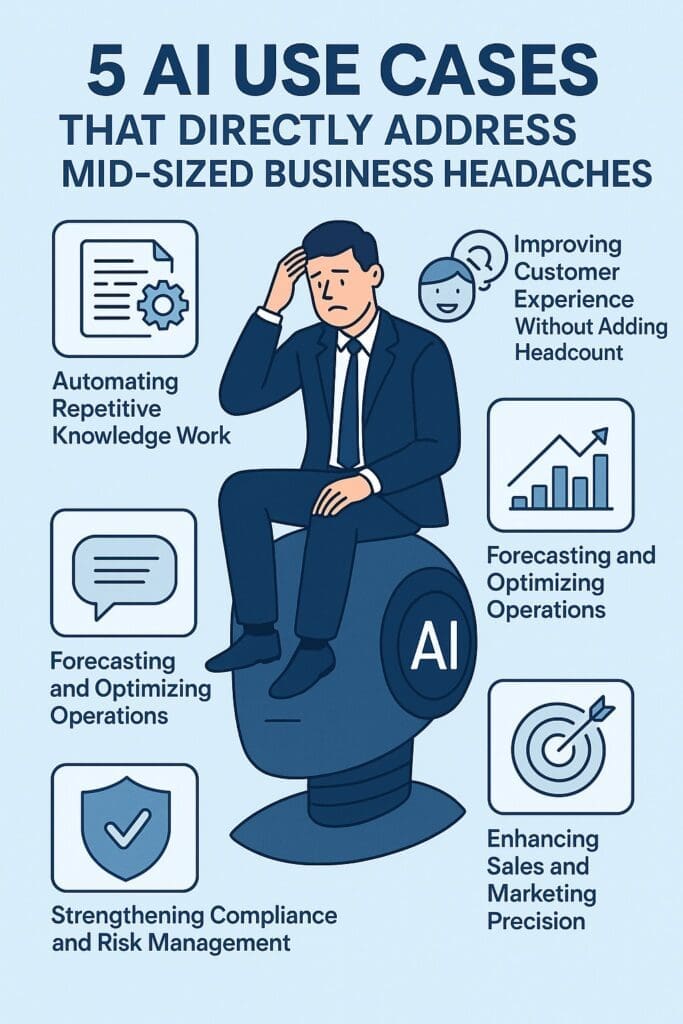
In this article, we’ll explore five real-world AI use cases designed to tackle those headaches directly. Each use case is backed by real business examples, potential ROI, and insights into why mid-sized companies can’t afford to wait on AI adoption.
1. Automating Repetitive Knowledge Work
The Headache:
Ask any mid-sized business team what wastes the most time, and you’ll hear familiar themes: copying data from one system to another, creating weekly reports, scanning invoices, or processing basic forms. These tasks are repetitive, error-prone, and uninspiring—but still necessary.
The AI Fix:
- Intelligent Document Processing (IDP): AI can extract data from invoices, contracts, or forms with high accuracy.
- Robotic Process Automation (RPA): Software bots, supercharged with AI, can handle repetitive clicks, copy-paste tasks, and simple workflows.
Benefits:
- Up to 70% reduction in manual workload for repetitive tasks.
- Dramatically fewer data entry errors.
- Employees free to focus on creative or customer-facing work.
Case Example:
A regional insurance provider deployed AI-driven IDP to handle claims forms. What once took staff hours now takes minutes, cutting overall processing time by 40% and reducing errors that led to costly rework.
SEO Tip: For mid-sized businesses searching terms like AI automation for SMBs or reduce manual workload with AI, this use case is a perfect content hook.
2. Improving Customer Experience Without Adding Headcount
The Headache:
Mid-sized companies compete with larger players on service quality but can’t match them in staffing. Customers expect 24/7 support, personalized answers, and instant response—expectations that feel unattainable without tripling your call center budget.
The AI Fix:
- AI Chatbots: Handle FAQs, appointment scheduling, and simple requests instantly.
- Virtual Assistants: Integrate with CRM systems to pull customer history and deliver personalized responses.
- Smart Escalation: When the AI encounters complex issues, it routes them to human reps with full context.
Benefits:
- Always-on support without hiring extra staff.
- Consistent service quality across channels.
- Improved customer satisfaction scores.
Case Example:
A mid-sized e-commerce retailer added an AI-powered chatbot to its website and mobile app. Within three months, the chatbot resolved 60% of support queries automatically. Human agents were freed up to focus on high-value interactions—without increasing headcount.
SEO Tip: Use long-tail keywords like AI customer service for mid-sized businesses and AI chatbots SMB support to capture buyers researching solutions.
3. Forecasting and Optimizing Operations
The Headache:
Supply chain bottlenecks, seasonal demand spikes, and budgeting surprises are especially painful for mid-sized firms. A single bad forecast can lead to stockouts, missed revenue, or piles of unsold inventory tying up cash flow.
The AI Fix:
- Predictive Analytics: AI models use historical data, market signals, and external factors to forecast demand more accurately.
- Optimization Models: Recommend staffing schedules, reorder points, or pricing adjustments based on real-time data.
- Scenario Planning: Test “what if” models before committing resources.
Benefits:
- Reduce overstocking and stockouts.
- More reliable demand forecasts.
- Stronger financial predictability.
Case Example:
A mid-sized manufacturing company implemented AI forecasting tools. Within six months, they cut inventory costs by 15% while maintaining on-time delivery performance.
SEO Tip: Keywords like AI for demand forecasting and AI operations optimization SMB align with search intent for executives facing supply chain headaches.
4. Strengthening Compliance and Risk Management
The Headache:
Mid-sized businesses face the same compliance and regulatory requirements as large enterprises—without the same legal and compliance teams to manage them. Whether it’s HIPAA in healthcare, GDPR in Europe, or financial reporting regulations, the risk of fines and audit failures is real.
The AI Fix:
- Anomaly Detection: AI flags unusual patterns in transactions or employee activity.
- Automated Compliance Checks: Systems can automatically validate documents, workflows, and reporting against compliance standards.
- Audit Trails: AI systems generate detailed logs to prove accountability during audits.
Benefits:
- Reduced risk of penalties.
- Faster, more accurate compliance reporting.
- Greater transparency across business processes.
Case Example:
A mid-sized healthcare provider used AI compliance tools to monitor patient record access and reporting. The system cut reporting time in half while preventing dozens of potential compliance violations.
SEO Tip: Optimize with search terms like AI compliance for SMBs or AI risk management mid-sized companies.
5. Enhancing Sales and Marketing Precision
The Headache:
Marketing budgets at mid-sized businesses are tight, and wasted ad spend hurts more than it does for large corporations. Sales teams often chase leads without a clear view of who’s most likely to convert.
The AI Fix:
- Customer Segmentation: AI identifies high-value customer segments with precision.
- Lead Scoring: Predictive models rank leads by conversion likelihood.
- Personalized Campaigns: AI tailors messages, timing, and offers to each audience.
Benefits:
- Higher ROI on campaigns.
- Better alignment between sales and marketing.
- Increased conversion rates with personalized offers.
Case Example:
A regional retailer adopted AI-driven campaign optimization. Instead of blasting promotions to everyone, they delivered tailored offers. The result: a 25% boost in campaign ROI within the first quarter.
SEO Tip: Target long-tail keywords like AI marketing for SMBs and AI lead scoring for mid-sized business.
Pulling It Together: Why Mid-Sized Companies Can’t Afford to Ignore AI
Mid-sized businesses live in a world of constraints—limited budgets, lean teams, and rising expectations. AI doesn’t erase those constraints, but it changes the math. Suddenly, doing more with less becomes possible.
The five use cases above aren’t futuristic—they’re proven, off-the-shelf solutions being implemented by companies just like yours today. Whether you want to reduce repetitive work, keep customers happy, forecast more accurately, stay compliant, or grow revenue, AI gives you leverage you didn’t have before.
Next Steps: How to Get Started Without Breaking the Bank
- Download our free AI Terminology Cheat Sheet to build your AI vocabulary in minutes.
- Check out our book, AI Simplified: Harnessing Microsoft Technologies for Cost-Effective Artificial Intelligence Solutions — written for mid-sized companies looking to implement AI without massive budgets.
- Subscribe to the AInDotNet newsletter for case studies, prototypes, and best practices tailored to Microsoft .NET environments.
The sooner mid-sized businesses start experimenting with AI, the sooner they can turn today’s headaches into tomorrow’s competitive advantages.
