
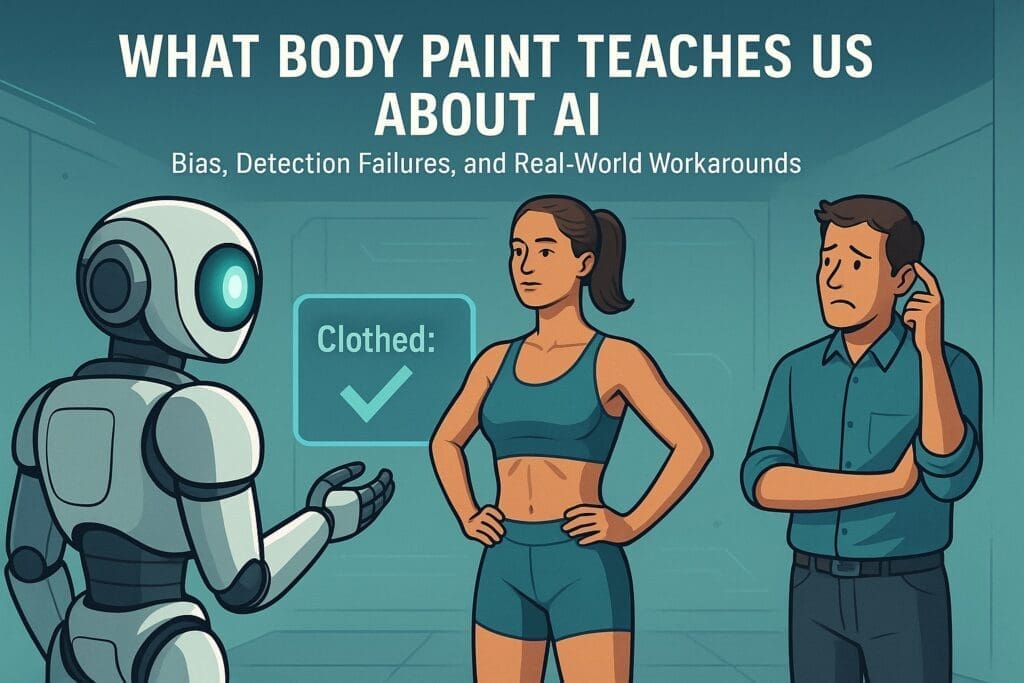
Artificial Intelligence is often hailed as precise, impartial, and even clinical. But every now and then, it gets blindsided—by something as human, creative, and unexpected as body paint.
Yes, you read that right. People are fooling AI nudity detectors using realistic body paint. And while it’s an amusing story on the surface, it’s also a powerful teaching tool that exposes the cracks in modern AI systems.
Welcome to the world of algorithmic blind spots, bias by omission, and the strange things you learn when users find creative ways to outsmart your model.
How Does AI Nudity Detection Work?
Contrary to what many assume, AI doesn’t “understand” nudity the way humans do. Instead, it relies on:
- Skin detection: Percentage of visible skin in an image
- Body ratio estimation: Pose detection and geometric relationships
- Contrast and color clustering: Searching for signs of fabric or patterns
These models are often trained on large datasets of labeled images—most of which are drawn from predictable and idealized sources. That introduces an unintentional bias: the AI becomes very good at detecting nudity on young, fit, symmetrical bodies… and not so great with anything outside that range.
Why Body Paint Works (But Only for Some)
Body painting artists have figured out how to create the illusion of clothing using shadows, lines, and textures. To the human eye, it may look like nudity with a few brushstrokes. But to the AI model? It’s “clothed.”
However, this hack doesn’t work for everyone. Older individuals or those with more body fat often trigger false positives—even when fully clothed—because their body shapes deviate from the model’s expectations.
So what we’re seeing isn’t just an amusing trick. It’s a glaring case of algorithmic privilege—where some people can “game” the AI, and others can’t, purely based on how well their appearance matches the model’s internal bias.
When the Users Out-Innovate the Engineers
As someone who’s built automated systems for decades, one pattern never fails:
Testers will try to break your system.
Users will find creative ways around it.
And often, their workaround points to a flaw in the system—a missing requirement, an unstated constraint, or a lack of real-world diversity in the original plan.
That’s exactly what this body paint phenomenon is: a workaround. Not malicious. Not a hack in the traditional sense. It’s a creative user response to a flawed or incomplete system.
Clearly, young testers weren’t testing body paint. 😂
So What Does This Teach Us?
Here are the core lessons hidden beneath the body paint:
- AI sees patterns—not meaning.
- Bias enters through the data you feed it.
- Edge cases are often real-world use cases.
- User behavior reveals blind spots better than specs ever will.
- System design isn’t finished until real people interact with it.
In short: Want to understand AI? Watch what breaks it.
Want the Visual Summary?
We created a professional (and slightly cheeky) infographic based on this topic:
👉 Download the free Infographic: 5 Things the Body Paint Hack Teaches Us About AI
It’s short, insightful, and perfect to share with colleagues who like their AI lessons served with a side of humor.
Final Thought
You don’t need a scandal to uncover AI flaws. Sometimes, all it takes is a little body paint, a curious mind, and an AI system built on blind assumptions.
This story may be funny, but the lesson is serious:
Your AI is only as smart as the boundaries you give it—and the people you test it on.
Want more?
Check out all of our resources at our hub
