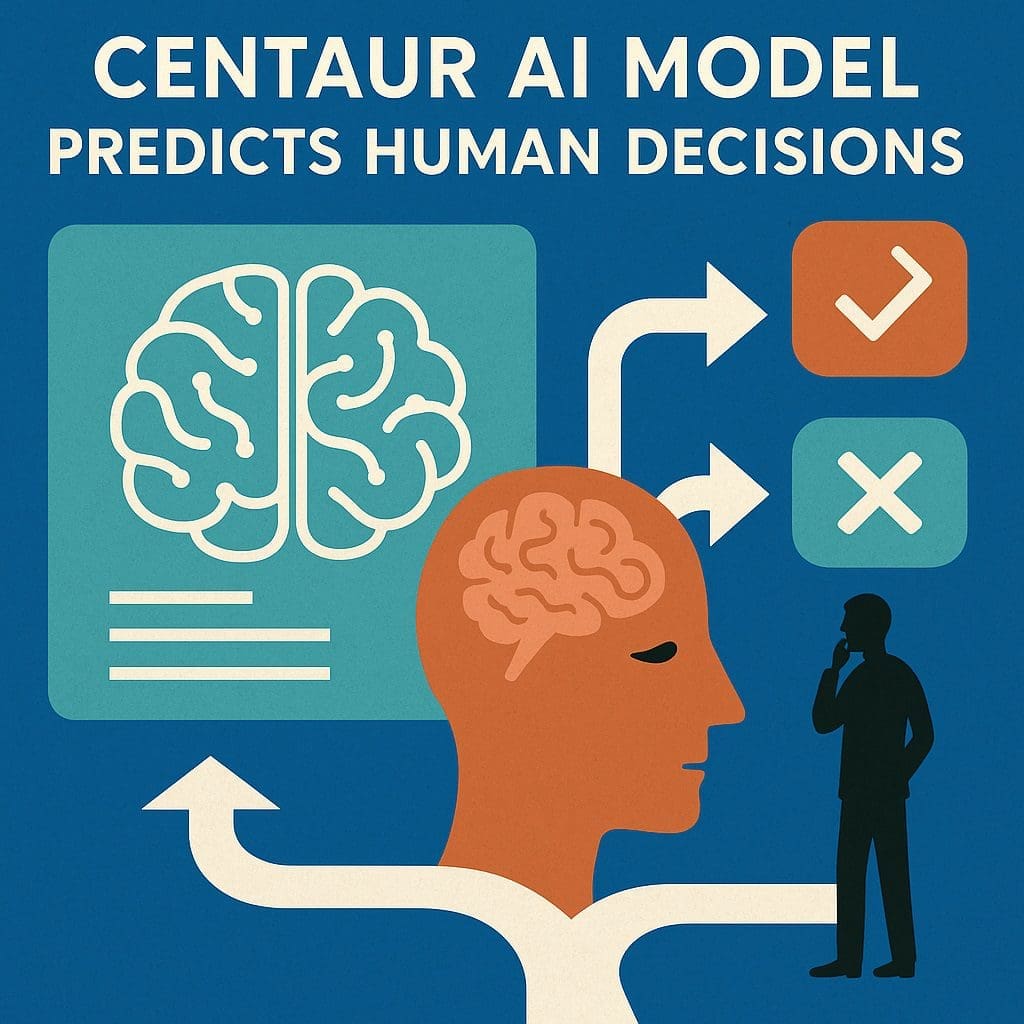
🧠 What is the Centaur Model?
On July 2, 2025, Nature published a groundbreaking study: “A foundation model to predict and capture human cognition.” The researchers fine-tuned a large language model using a dataset called Psych-101, which included over 10 million decisions made by 60,000+ people across 160 psychology experiments.
The result? A model called Centaur that can predict how humans will behave in new decision-making scenarios—just by reading a natural language description of the task.
In 31 out of 32 cognitive tasks, it outperformed all traditional cognitive models, including some of the most established theories in behavioral psychology.
🧩 What Makes This AI Model Different?
Centaur doesn’t just memorize tasks—it generalizes. It doesn’t rely on handcrafted cognitive rules like “loss aversion” or “expected value calculations.” Instead, it learns directly from trial-by-trial human behavior and adapts its predictions accordingly.
In a sense, Centaur is to cognitive science what GPT was to text prediction: a foundation model that captures a wide range of human responses without being explicitly programmed to do so.
Key achievements:
- General-purpose behavioral prediction across domains
- Alignment with neural patterns in the human brain
- Acceleration of in silico experimentation for behavioral science
🔧 Applied AI vs. Theoretical AI: Bridging the Gap
As I’ve written before (read here), theoretical AI often lives in a vacuum—perfect models that solve toy problems. Applied AI, on the other hand, lives in the messy, complex, real world.
Centaur is interesting because it walks the line between both. It’s built using massive theoretical architectures (LLMs), but it’s been fine-tuned and validated in a pragmatic, application-first way—on real decision-making data.
This is the kind of tool businesses need. Not perfect theory. Not academic elegance. But systems that work across scenarios, learn from messy data, and integrate easily into existing pipelines.
💼 How Business and Government Can Use This
Here’s where Centaur-like models get exciting for applied AI in Microsoft environments:
- Behavioral Simulations: Test user journeys, marketing strategies, or decision flows before deploying them.
- Human-AI Interaction: Use predictive cognition to guide chatbot responses or adapt interfaces in real time.
- AI-Assisted Training: Model how humans learn or make mistakes, and build better adaptive training tools.
- Scenario Planning: Predict decision-making under uncertainty—critical for leadership, crisis management, or military strategy.
🧰 How Could This Be Recreated in a Microsoft Stack?
While Centaur is a transformer-based LLM fine-tuned with custom infrastructure, similar principles can be applied using:
- ML.NET: Train models using tabular behavior data with custom loss functions.
- Azure Machine Learning: Fine-tune existing foundation models or deploy ensemble systems.
- Semantic Kernel: Build modular reasoning pipelines using prompt engineering, context memories, and planning skills to simulate decision-making flow.
Would it replicate Centaur’s power? Probably not. But it could prototype targeted behavioral systems using tools you already know and trust—and without $10M compute clusters.
⚠️ Ethical Boundaries and Real-World Risks
We can’t ignore the implications.
If a model can predict human decisions with 95–97% accuracy, what’s to stop:
- Political actors from manipulating public sentiment?
- Marketers from exploiting decision biases?
- Employers from profiling employees’ behaviors?
As with any AI breakthrough, predictive power must be matched with ethical oversight, transparency, and human governance.
🧭 Final Take: Is This the Future of AI?
Centaur is a glimpse into the future of applied behavioral AI. Not AGI. Not sentience. But a smarter way to:
- Simulate human reasoning,
- Accelerate research and experimentation,
- And make AI more useful in business, education, and society.
But it’s still just a tool. In the right hands, it can transform industries. In the wrong hands, it can erode trust.
As professionals building AI systems, we must ask ourselves: Are we using this technology to assist human reasoning—or to replace it?
👇 Related Articles You May Enjoy
- AI at the Tactical Edge: Closing the Gap Between Theoretical and Applied AI
- Applied AI in .NET: Bridging Theoretical Innovations with Real-World Solutions
- Data Governance in AI Projects: Lessons for Microsoft-Centric Teams
- AI Ethics, Compliance, and Security: A Practical Guide for Modern Enterprises
