Most enterprise AI problems are not caused by weak models.
They are caused by weak execution.
Organizations jump from workflow discussions straight into:
- chatbots
- copilots
- prompt chains
- low-code automation
- agent frameworks
before they have built stable backend capabilities.
Capability Realization is Pillar 3 of the Enterprise AI Architecture (EAA). It turns defined work into stable, reusable, contract-defined, observable capabilities that can be safely exposed through APIs, applications, copilots, chatbots, and later AI agents. Pillar 3 is where enterprise AI stops being an idea and starts becoming dependable execution.
If your business is struggling with:
- fragile AI logic hidden in prompts
- workflows that keep changing during implementation
- systems that are hard to test or audit
- agent excitement before stable execution exists
this is the place to focus.
Common enterprise AI problems this page is designed to solve
Many organizations are using AI, but very few are building real enterprise AI systems. Many current AI approaches rely on chatbots layered onto existing apps, copilot-style tools, prompt-driven workflows, or agent frameworks without stable task foundations. This produces systems that are fragile, hard to debug, poorly aligned to business logic, unauditable, and hard to scale beyond pilots.
Typical failure patterns include:
- business rules hidden in prompts
- UI layers carrying logic they should not own
- capabilities that cannot be tested independently
- failures that are opaque
- AI behavior that is difficult to audit
- orchestration introduced before execution is stable
This is not mainly a model problem.
It is an execution and architecture problem.
Pillar 3 exists to solve that by creating stable, reliable capability units before services, interfaces, or agents are layered on top.
What Capability Realization means inside Enterprise AI Architecture
Pillar 2 defines the work.
Pillar 3 turns that work into execution.
In the current EAEM / EAA structure, Pillar 3 is the stage that:
- creates reliable executable capabilities
- defines capability construction
- addresses sourcing decisions
- establishes integration contracts
- defines observability requirements
This is where one defined unit of work becomes a capability that is:
- bounded
- testable
- observable
- versionable
- governable
- reusable
Simple version:
Pillar 2 clarifies the work.
Pillar 3 makes that work executable.
Why enterprise AI needs stable capabilities before interfaces and agents
Chatbots, copilots, and agents are interfaces and orchestration layers — not the foundation of enterprise intelligence.
They can:
- select tasks
- sequence tasks
- present results
But they are only as reliable as the capabilities they call.
Without stable backend capabilities:
- prompts hide business rules
- logic becomes untestable
- failures become opaque
- risk increases sharply
That is why Pillar 3 matters. It creates the stable execution layer that later interfaces, services, and agents depend on.
The core principle: capability-first, not UI-first
Enterprise systems evolved from UI-centric systems with tightly coupled logic, to API-centric systems with reusable services, and now toward capability-centric systems where reusable intelligence is implemented as explicit backend capabilities. In that model:
- business intelligence is implemented as explicit backend capabilities
- each capability is callable, testable, observable, and governed
- interfaces are disposable
- AI is an implementation detail, not the system itself
That principle fits Pillar 3 exactly.
The core idea is simple:
Intelligence belongs in governed backend capabilities, not in the interface.
That does not reject interfaces, copilots, or agents. It puts them in the right place.
What a capability is
A capability is a well-defined unit of backend intelligence that performs a specific business task. A capability is defined as having:
- explicit inputs and outputs
- clear constraints and permissions
- logging and auditability
- test coverage
- versioning
- ownership
Capabilities may use AI internally.
But AI does not define the capability — the business task does.
Examples of enterprise capabilities might include:
- drafting a compliance-ready response
- analyzing structured business data
- summarizing domain-specific information
- supporting decision workflows
- preparing outputs for human review
The important thing is that each capability is stable enough to be reused across multiple consumers.
What Pillar 3 actually does
Capability Realization focuses on five things:
1. Turns unit tasks into stable execution
A capability should map to a defined unit of work, not a vague activity cluster.
2. Creates contract-defined interfaces
Capabilities need explicit inputs, outputs, and versionable contracts so downstream systems are protected from hidden behavioral change. The EAA materials explicitly tie Pillar 3 to integration contracts.
3. Makes execution observable
Capabilities must be logged, monitored, and auditable. Observability is a core Pillar 3 concern, not an afterthought.
4. Supports sourcing discipline
Pillar 3 also includes build vs buy vs integrate decisions. Capability sourcing discipline is explicitly part of the EAA execution framework.
5. Prepares safely for later reuse and autonomy
Stable capabilities can later be exposed through APIs, applications, copilots, chatbots, and AI agents without duplicating logic.
Why this matters in the real world
Capability first design aligns with how enterprise systems actually operate:
- long life cycles
- multiple consumers
- regulatory oversight
- multiple teams
- change over time
That makes Pillar 3 especially valuable for:
- medium to large enterprises
- government agencies
- regulated environments
- long-lived systems with real accountability
It enables:
- incremental AI adoption
- human-in-the-loop execution
- safe experimentation
- cleaner debugging
- measurable ROI
Most importantly, it prevents AI from collapsing software discipline.
What Capability Realization does not do
Pillar 3 is powerful, but it is intentionally bounded.
It does not:
- decide which initiatives matter most
(that belongs to the Enterprise AI Operating Model) - define business intent and acceptable risk
(that belongs to Pillar 1) - discover the workflow and decision topology
(that belongs to Pillar 2) - justify centralizing intelligence into enterprise AI services
(that belongs to Pillar 4) - approve autonomy
(that belongs much later, after capabilities are stable)
Pillar 3 creates dependable execution.
It does not replace the rest of the architecture.
Typical implementation pattern
A practical implementation stack that works well as a mental model for Pillar 3:
- domain capability libraries
- skill / capability layer
- data and knowledge layer
- thin API layer
- observability and governance
For Microsoft-centric organizations, Pillar 3 maps naturally to:
- C#
- .NET
- ASP.NET Core
- OpenAPI / Swagger
- SQL Server
- Semantic Kernel
- Application Insights / logging
- enterprise security controls
This matters because EAA does not require a platform shift. It leverages enterprise infrastructure many organizations already trust.
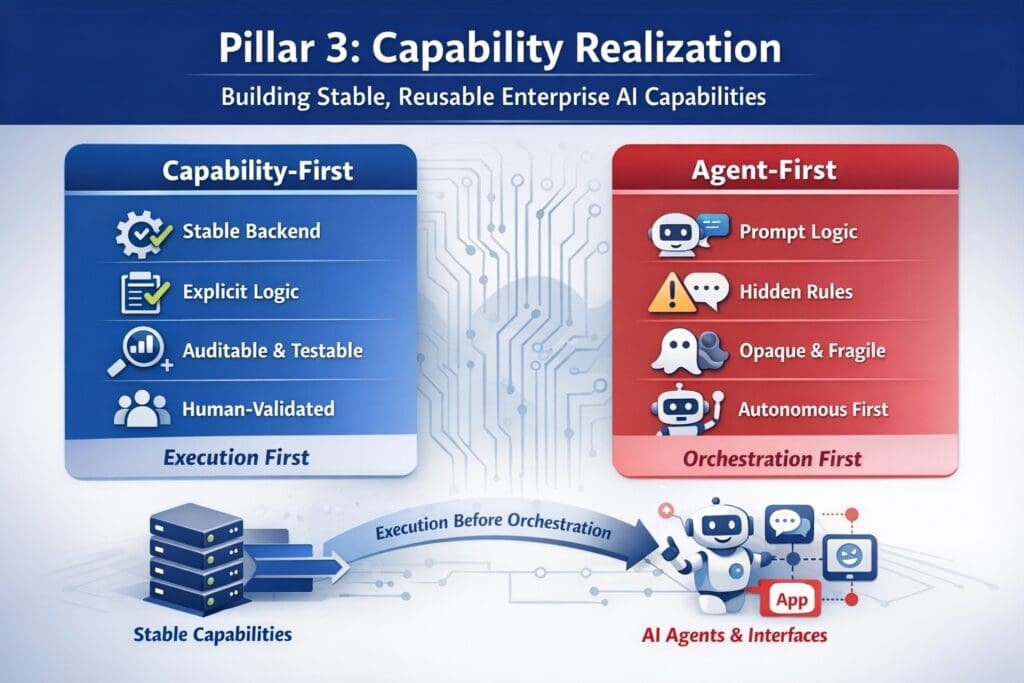
Capability-first vs agent-first
Capability-first
- stable, testable backend
- explicit business rules
- auditable
- human-validated first
- scales safely
Agent-first
- prompt-driven logic
- hidden rules
- opaque behavior
- autonomous by default
- breaks unpredictably
Pillar 3 does not reject agents.
It prepares for them correctly.
Preparing for AI agents without building them yet
AI agents require:
- stable tasks
- clear contracts
- permissions
- audit trails
- predictable behavior
Pillar 3 establishes those foundations before autonomy is introduced. That is intentional — and safe.
Simple version:
Human-selected execution comes first.
AI-selected orchestration comes later.
Main deliverables of Pillar 3
A solid Pillar 3 output package should include:
- capability definitions
- capability cards
- test matrix
- integration contracts / API specification
- observability requirements
- sourcing decisions
- capability gate approval record
These align with the broader documentation architecture, where capability templates, sourcing discipline, artifact standards, and observability requirements are all part of the EAA framework.
In .NET systems – we:
- Create a library with the capability first unit tasks
- Use AI to create a Web API layer that conforms to OpenAPI specification
- OpenAPI tools create SDKs and MCP client capabilities
- AI creates tests
- AI can create User Interfaces, AI assistants, chatbots that call these tested capabilities
Relationship to Pillar 2 and Pillar 4
Pillar 2 → Pillar 3
Pillar 2 defines:
- workflows
- decisions
- unit tasks
- operational boundaries
Pillar 3 then turns that defined work into reliable executable capabilities.
Pillar 3 → Pillar 4
Once capabilities are stable and reusable, Pillar 4 determines whether some of that intelligence should be elevated into reusable enterprise AI services.
Simple version:
- Pillar 2 = define the work
- Pillar 3 = make the work executable
- Pillar 4 = centralize reusable intelligence where justified
Bottom line
Capability Realization is Pillar 3 of Enterprise AI Architecture because enterprise AI must become dependable execution before it becomes interface, service, or agent behavior.
Pillar 3 creates:
- stable backend capabilities
- explicit contracts
- observability
- sourcing discipline
- safe reuse
Without Pillar 3, AI remains fragile experimentation.
With Pillar 3, AI starts to behave like enterprise infrastructure.
Next steps
Explore Pillar 4 — AI Core Applications
Review Pillar 2 — Work Definition
Schedule a Capability Architecture Diagnostic
Frequently Asked Questions
What is Capability Realization in enterprise AI?
Capability Realization is Pillar 3 of Enterprise AI Architecture. It turns defined work into stable, executable, testable, observable enterprise capabilities.
Why is capability-first design important for enterprise AI?
Because enterprise AI requires business logic to be explicit, testable, observable, and auditable. Hiding logic in prompts, UI layers, or ad hoc agent flows creates fragile systems that are hard to govern and scale.
What is a capability in this framework?
A capability is a well-defined backend unit of intelligence with clear inputs, outputs, permissions, logging, ownership, and testability. It may use AI internally, but the business task defines the capability.
Can capabilities be reused across multiple applications?
Yes. One of the core goals of capability-first design is reuse across APIs, internal tools, web apps, copilots, chatbots, and future AI agents without duplicating logic.
Is Capability Realization anti-agent or anti-chatbot?
No. It does not reject chatbots or agents. It defines where they belong: as interfaces and orchestration layers that call backend capabilities, not as the place where business logic should live.
Is Pillar 3 only for .NET and Microsoft technologies?
No. The principles are platform-agnostic, but they map naturally to Microsoft-centric enterprise environments using C#, .NET, ASP.NET Core, OpenAPI, and related enterprise tooling.
What comes after Capability Realization?
After capabilities are stable, the architecture can determine whether reusable intelligence should become AI Core Applications in Pillar 4, and only later whether autonomy is justified.