Microsoft has excellent cloud products. AWS has excellent cloud products. Google has excellent cloud products.
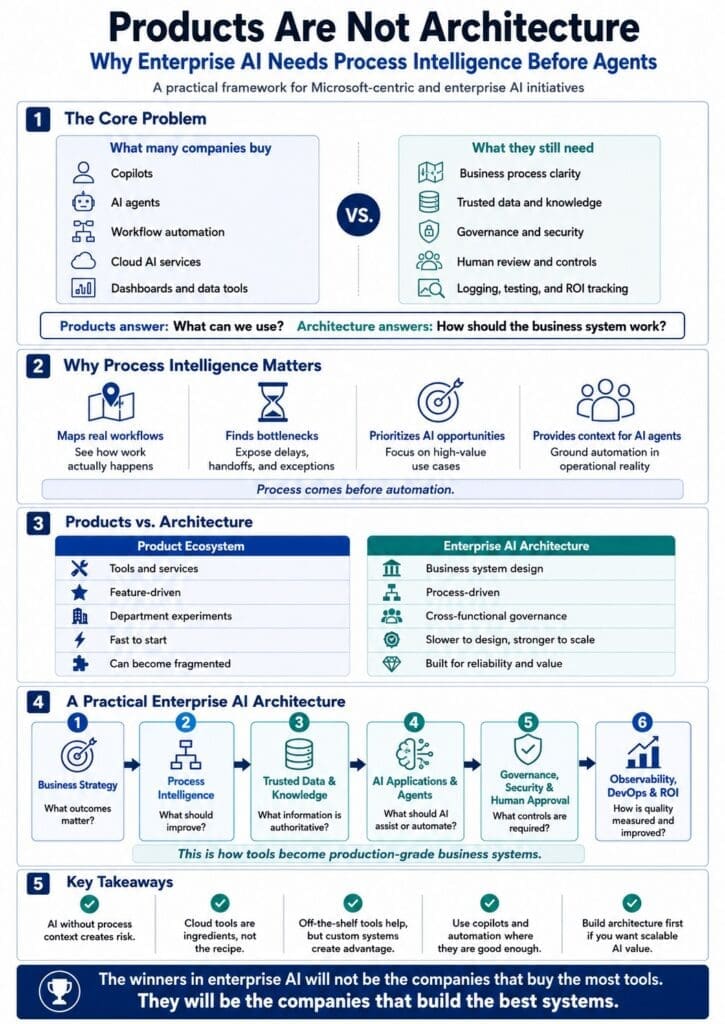
But products are not architecture.
That distinction matters more now than ever because many organizations are rushing into AI by buying tools, enabling copilots, experimenting with agents, and automating workflows without first answering a more important question:
How should AI fit into the way our business actually operates?
That is the difference between buying AI products and building an enterprise AI architecture.
The AI Tool Trap
Right now, a lot of enterprise AI conversations sound like this:
“We are rolling out Copilot.”
“We are experimenting with AI agents.”
“We are building Power Automate workflows.”
“We are using Azure OpenAI.”
“We are testing AWS Bedrock.”
“We are creating a data lakehouse.”
Those may all be useful activities. But none of them, by themselves, represent an enterprise AI architecture.
A product answers:
What can we use?
Architecture answers:
How should the system work?
That is a much harder and more valuable question.
An enterprise AI architecture has to define how business processes, data, applications, workflows, security, governance, human review, logging, evaluation, DevOps, and ROI measurement work together.
Without that architecture, companies risk creating a collection of disconnected AI experiments instead of production-grade business systems.
AI Needs Process Context
One of the most important ideas gaining traction in enterprise AI is process intelligence.
Process intelligence is not just another analytics category. It is becoming a practical foundation for understanding how work actually happens across the enterprise.
Before a company automates a workflow or deploys an AI agent, it should understand:
What process is being improved?
Where are the bottlenecks?
Which steps are manual?
Where do approvals happen?
Which exceptions occur repeatedly?
Which systems are involved?
Which handoffs create delays?
Which controls are required?
Which parts of the process create competitive advantage?
That matters because AI without process context can become dangerous, expensive, or simply useless.
If the current business process is broken, blindly adding AI may only help the organization do the wrong thing faster.
Copilots Are Tools. Agents Are Tools. Architecture Is the Plan.
Copilots can improve productivity.
AI agents can automate tasks.
Power Automate can orchestrate workflows.
Azure AI can provide powerful model capabilities.
Microsoft Fabric can unify data.
Power BI can visualize results.
These are all valuable tools.
But the architecture must decide where each tool belongs.
For example:
Should AI only recommend an action, or should it execute the action?
When should a human approve the result?
What data is trusted?
What knowledge sources are authoritative?
What gets logged?
How are prompts, responses, and decisions audited?
How are errors detected?
How is quality measured?
How is ROI calculated?
How are AI systems versioned, tested, deployed, and maintained?
Those are architectural questions, not product questions.
Microsoft Has the Tools, But Businesses Still Need the Architecture
For Microsoft-centric organizations, this is especially important.
Microsoft provides a powerful enterprise technology stack: Microsoft 365, Copilot, Copilot Studio, Power Platform, Power Automate, Power BI, Fabric, SharePoint, Teams, Azure AI, Azure OpenAI, Azure AI Search, SQL Server, .NET, Visual Studio, GitHub, Azure DevOps, Entra, Purview, Defender, Application Insights, and Azure Monitor.
That is an impressive toolbox.
But a toolbox is not a building plan.
A business still needs to decide how these tools should be connected into production-grade AI systems.
That is where many organizations struggle.
They confuse product adoption with business transformation.
They confuse automation with process improvement.
They confuse AI experimentation with AI architecture.
They confuse vendor capability with enterprise readiness.
The Real Competitive Advantage Is Not the AI Tool
Most companies can buy access to the same AI tools.
Your competitors can use Copilot.
Your competitors can use Azure AI.
Your competitors can use AWS.
Your competitors can use Google Cloud.
Your competitors can buy off-the-shelf AI products.
So where does competitive advantage come from?
It comes from your business processes, your proprietary knowledge, your operational discipline, your customer understanding, your data, your employees, your workflows, and your ability to turn technology into measurable business value.
That is why custom AI systems matter.
An off-the-shelf AI product may help with a generic business function. But it usually reflects someone else’s assumptions about how work should be done.
A custom AI system can reflect your process, your data, your controls, your terminology, your customer experience, your exceptions, and your competitive strategy.
That does not mean every AI system should be custom built.
It means businesses should be intentional.
Use off-the-shelf tools where they are good enough.
Use Copilot where productivity assistance is enough.
Use Power Automate where workflow automation is enough.
Use custom .NET and Azure AI applications where the process is important enough to justify ownership, differentiation, integration, governance, and control.
Enterprise AI Architecture Starts With the Business Process
A practical enterprise AI architecture should begin with the process, not the product.
The sequence should look more like this:
- Identify the business process.
- Map how the process actually works.
- Find bottlenecks, delays, handoffs, exceptions, and manual work.
- Identify where AI can assist, recommend, summarize, classify, extract, predict, or automate.
- Determine what data and knowledge sources are trusted.
- Decide what AI can do independently and what requires human approval.
- Build or configure the right solution.
- Log prompts, responses, actions, exceptions, approvals, and outcomes.
- Evaluate accuracy, quality, cost, speed, and business impact.
- Continuously improve the process and the AI system.
That is architecture.
It is not as exciting as saying “deploy agents everywhere.”
But it is much more likely to work.
The Missing Layer: From AI Products to AI Systems
The enterprise AI market is moving quickly. Vendors are releasing powerful tools. Analysts are identifying important trends. Executives are pushing for adoption. Employees are experimenting. Developers are building prototypes.
But the missing layer in many organizations is the practical architecture that connects all of it.
That architecture needs to answer:
How does AI support business strategy?
How do we identify the right use cases?
How do we avoid automating bad processes?
How do we integrate with existing systems?
How do we protect sensitive data?
How do we govern AI actions?
How do we measure quality?
How do we prove ROI?
How do we move from prototype to production?
How do we build systems that survive real business complexity?
These are not small questions.
They are the difference between AI theater and AI value.
Products Are Ingredients. Architecture Is the Recipe.
Cloud vendors provide powerful ingredients.
Analysts identify important market patterns.
Consultants provide guidance.
Internal teams understand the business.
But someone still has to design and build the system.
That is where enterprise AI success will increasingly be decided.
Not by who buys the most AI tools.
Not by who announces the most pilots.
Not by who creates the most agents.
But by who builds the best architecture for applying AI to real business processes.
The future of enterprise AI will not belong to companies that simply buy AI products.
It will belong to companies that understand their processes, control their data, govern their systems, measure their results, and build AI into the way their business actually operates.
Because products are not architecture.
And AI tools are not the same thing as AI systems.
Reference
This article was triggered by the Gartner report “Magic Quadrant for Process Intelligence Platforms”
Frequently Asked Questions
What is enterprise AI architecture?
Enterprise AI architecture is the structured plan for how AI fits into a business. It defines how AI connects to business processes, data, applications, security, governance, human review, logging, testing, deployment, and ROI measurement.
It is not just a list of AI tools. It is the operating model that explains how AI should create reliable, measurable business value.
Why aren’t AI products enough?
AI products are useful, but they do not automatically create business value. Copilots, AI agents, workflow automation tools, dashboards, and cloud AI services are implementation options.
Architecture determines how those tools should be used, where they fit, what they are allowed to do, what data they can access, how results are reviewed, and how success is measured.
What does “products are not architecture” mean?
It means buying AI tools is not the same as designing an AI-enabled business system.
A company can buy Microsoft Copilot, Azure AI, Power Automate, AWS Bedrock, or other AI tools and still lack a coherent AI architecture. The tools may be powerful, but the business still needs a plan for process improvement, data governance, security, logging, human approval, quality control, and ROI tracking.
Why does process intelligence matter for enterprise AI?
Process intelligence helps businesses understand how work actually happens. It can reveal bottlenecks, delays, handoffs, exceptions, compliance gaps, and automation opportunities.
This matters because AI agents and automation systems need operational context. Without understanding the real process, companies risk automating broken workflows or giving AI tools responsibility without enough business grounding.
Should businesses start with Copilot, Power Automate, or custom AI applications?
It depends on the use case.
Copilot is often a good starting point for personal productivity, document work, meetings, email, and knowledge assistance.
Power Automate is useful for workflow automation, approvals, notifications, and integrations.
Custom AI applications are better when the process is strategic, complex, highly integrated, security-sensitive, or a source of competitive advantage.
The practical answer is not “one tool for everything.” The right architecture uses each tool where it fits best.
When are off-the-shelf AI tools good enough?
Off-the-shelf AI tools are often good enough for common business functions, general productivity, summarization, basic automation, simple document handling, and low-risk internal workflows.
They are especially useful when the process is not unique, the business risk is low, and the company does not need deep customization or competitive differentiation.
When should a business build a custom AI system?
A business should consider a custom AI system when the workflow is important, unique, complex, highly regulated, or directly tied to competitive advantage.
Custom systems are also valuable when the business needs deep integration with existing databases, custom .NET applications, industry-specific rules, proprietary knowledge, detailed logging, advanced security, human approval workflows, or measurable ROI tracking.
How does this apply to Microsoft-based businesses?
Microsoft-based businesses already have many strong building blocks: Microsoft 365, Copilot, Copilot Studio, Power Platform, Power Automate, Power BI, Fabric, SharePoint, Teams, Azure AI, Azure OpenAI, SQL Server, .NET, Azure DevOps, Entra, Purview, Defender, and Azure Monitor.
But those products still need to be organized into a working architecture. A Microsoft-centric enterprise AI strategy should define how these tools connect to business processes, trusted data, custom applications, governance, security, DevOps, monitoring, and ROI.
What is the biggest mistake companies make with enterprise AI?
The biggest mistake is starting with tools instead of business processes.
Many companies ask, “What AI product should we buy?” before asking, “What business process should we improve?”
That leads to scattered pilots, disconnected automation, unclear ROI, security concerns, and AI systems that do not scale.
What is the right starting point for enterprise AI?
The best starting point is a specific business process.
Identify a process that is expensive, slow, manual, error-prone, document-heavy, customer-facing, or strategically important. Then analyze how the process works today, where the bottlenecks are, what data is trusted, what decisions are required, and where AI can assist or automate safely.
From there, choose the right tools and architecture.
How can companies avoid failed AI pilots?
Companies can reduce failed AI pilots by starting with measurable business outcomes, not technology experiments.
A strong AI pilot should define the business process, success metrics, data sources, security requirements, human review points, logging requirements, deployment path, and ROI model before development begins.
The goal should not be to prove that AI is interesting. The goal should be to prove that AI can improve a real business process.
What is the main takeaway?
The winners in enterprise AI will not be the companies that buy the most AI tools.
They will be the companies that understand their processes, control their data, govern their systems, measure their results, and build AI into the way their business actually operates.
Products are ingredients. Architecture is the recipe.
