Most enterprise AI confusion starts with a category error.
Organizations keep talking as if prototype, MVP, and production are just three points on the same smooth line, where each stage is basically the previous one plus more polish.
That is wrong.
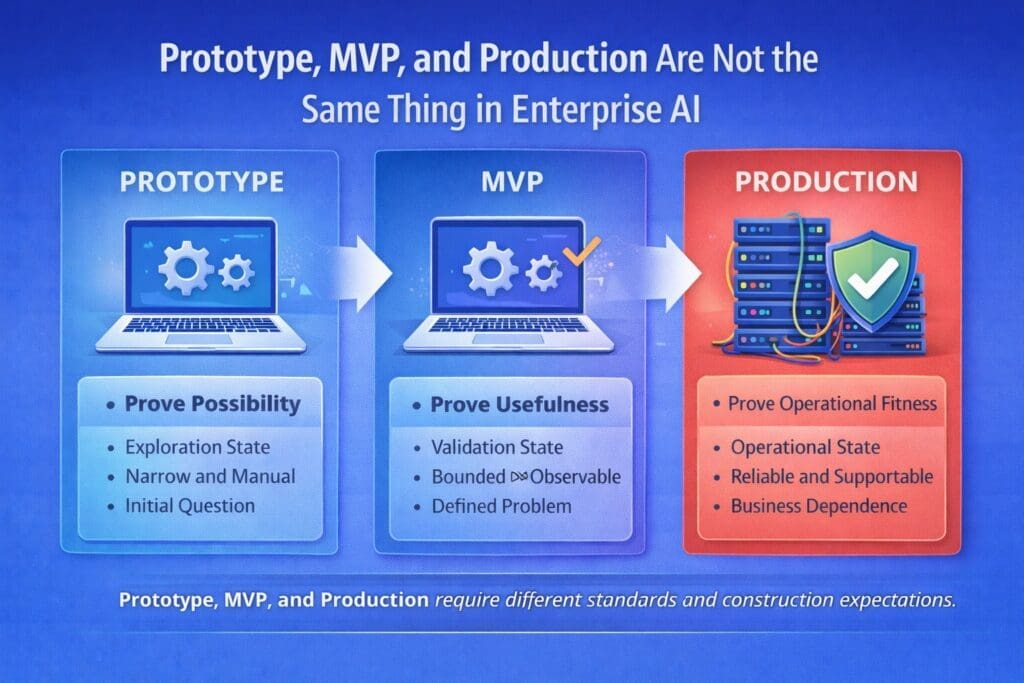
Prototype, Minimally Viable Product (MVP), and production are not the same thing. They are different construction states with different goals, different expectations, different risks, and different engineering requirements. Your April content plan states this directly: prototype, MVP, and production require different engineering expectations, not just more polish.
That distinction matters because many enterprise AI initiatives look good early, gain momentum fast, and then collapse under production reality. Not because the original idea was worthless, but because the organization never changed its standards as the initiative moved from exploration toward real operational use.
If you treat a prototype like an MVP, or an MVP like a production system, you create the exact kind of confusion that causes enterprise AI to stall.
Why This Distinction Matters in Enterprise AI
In enterprise software, sloppy stage definitions create predictable damage.
A prototype gets oversold.
An MVP gets under-supported.
A production system gets promoted too early.
Leadership thinks the hard part is done.
Technical teams inherit support problems they did not sign up for.
Governance and operational reality show up late.
That is one reason your April plan focuses so heavily on the gap between demos and production. Organizations keep confusing model output with production readiness, and that mistake blocks real progress.
When teams do not distinguish these construction states clearly, they make poor decisions about:
- funding
- staffing
- support ownership
- logging
- workflow integration
- risk management
- user expectations
- governance
- promotion criteria
So the distinction is not semantic. It is operational.
What a Prototype Actually Is
A prototype exists to answer one basic question:
Can this idea work at all?
That is it.
A prototype is usually built to explore feasibility, learn quickly, and reduce uncertainty around a narrow concept. It is not supposed to prove operational maturity. It is not supposed to carry business dependence. It is not supposed to survive enterprise complexity.
A prototype often has characteristics like:
- narrow scope
- controlled examples
- incomplete edge-case handling
- manual support behind the scenes
- weak or temporary logging
- loose governance assumptions
- limited change control
- low concern for long-term maintainability
That is normal. There is nothing wrong with prototypes being rough.
The mistake happens when stakeholders see a prototype working and start assuming the system is halfway to production.
It usually is not.
What an MVP Actually Is
An MVP is not just “a better prototype.”
An MVP is the first serious attempt to solve a real business problem under bounded real-world conditions.
That means an MVP sits in a middle state. It should be more disciplined than a prototype, but it still should not be mistaken for a fully production-ready enterprise system.
An MVP should prove more than technical feasibility. It should start proving:
- workflow fit
- user usefulness
- bounded business value
- manageable operational risk
- realistic supportability in a limited context
An MVP usually needs:
- a defined use case
- a named business owner
- clearer success criteria
- known users or departments
- some level of observability
- explicit review or override paths
- limited but real operational responsibility
- a bounded rollout scope
An MVP should answer a different question than a prototype:
Can this solve a real problem usefully enough to justify advancing further?
That is a higher standard.
What Production Actually Means
Production is not “the MVP plus time.”
Production means the organization is willing to depend on the system in real work.
That changes everything.
Once a system reaches production, it is no longer being judged mainly on promise. It is being judged on reliability, supportability, traceability, risk management, and business fitness.
A production AI system usually needs:
- clear business ownership
- defined support responsibility
- strong logging and observability
- exception handling
- fallback behavior
- review and escalation paths
- governance alignment
- release and change control
- performance expectations
- user guidance
- ongoing monitoring
- realistic maintenance expectations
A production system answers a different question again:
Can this operate reliably and responsibly inside the business?
That is not the same as feasibility.
That is not the same as usefulness.
That is enterprise survivability.
Prototype, MVP, and Production Have Different Goals
One reason teams confuse these stages is that they never state the goal of each stage clearly.
Here is the blunt version.
Prototype goal
Prove possibility.
MVP goal
Prove bounded business usefulness.
Production goal
Prove dependable operational fitness.
Those are different missions. If your team does not say which mission it is currently in, people will project their own assumptions onto the work.
And that is where trouble starts.
Why Enterprises Keep Mixing These Up
There are a few common reasons this happens.
1. Good demos create false confidence
A prototype that produces compelling output looks more mature than it really is. That is why so many enterprise AI efforts seem strong in demos and weak in production.
2. People confuse output quality with system readiness
Useful output is only one part of readiness. It says very little about supportability, workflow fit, governance, or failure handling.
3. Leadership often rewards visible progress over operational maturity
A prototype is easy to show. Operational readiness is harder to show. That creates bias toward promoting things too early.
4. Teams postpone hard conversations
Ownership, logging, review paths, exception handling, and governance are less exciting than a demo. So they get delayed until later.
5. No promotion gates exist
Your Week 2 plan recommends defining MVP versus production gates early and making each initiative declare what must be true before it graduates.
That is one of the clearest fixes.
The Wrong Way to Think About AI Maturity
A lot of organizations think about maturity like this:
Prototype -> MVP -> Production
Same thing, just more finished
That model is too simplistic.
It encourages people to assume:
- prototype problems can be cleaned up later
- support can be figured out after launch
- governance can be bolted on later
- ownership will emerge naturally
- logging is a technical detail, not a design requirement
- production is mostly a project-management milestone
That kind of thinking creates fragile AI systems.
The Better Way to Think About AI Construction States
A better model is this:
Prototype
Exploration state
MVP
Validation state
Production
Operational state
That framing is much more useful because it changes what you expect from each stage.
In an exploration state, you are allowed to be rough.
In a validation state, you need bounded discipline.
In an operational state, you need enterprise-grade reliability and accountability.
That is a cleaner mental model.
What Should Be True at the Prototype Stage
A prototype does not need to be elegant. But it should still be honest.
At minimum, a prototype should have:
- a clearly stated question it is trying to answer
- narrow scope
- known assumptions
- explicit limitations
- a clear statement that it is not production-ready
- a basic understanding of what would have to change to advance
The key is not overbuilding.
The key is not overselling.
A prototype is successful if it helps the organization learn whether the idea deserves further investment.
What Should Be True at the MVP Stage
An MVP needs more structure.
It should have:
- a defined business problem
- a specific workflow context
- a named owner
- identified users
- measurable success criteria
- initial logging or observability
- bounded rollout scope
- review or override rules
- known risk level
- a clear decision about what evidence would justify production advancement
This is where many organizations are still too loose. They build something more advanced than a prototype, call it an MVP, but still cannot answer basic operational questions.
That usually means it is not really an MVP yet. It is just a larger prototype.
What Should Be True at the Production Stage
Production demands the hardest standard.
Before an enterprise AI system is treated as production-capable, the organization should be able to answer questions like:
- Who owns business outcomes?
- Who supports the system?
- What is logged?
- How are exceptions handled?
- What happens when output is wrong?
- When is human review required?
- What governance evidence exists?
- How are changes controlled?
- What are the escalation rules?
- What happens during outages or degraded behavior?
- What user expectations have been set?
If those questions do not have grounded answers, the initiative is not ready for production, no matter how good the demo looked.
Why the Model Is Usually Not the Hardest Part
Your Week 2 plan makes this contrarian point clearly: the harder parts are often integration, workflow fit, ownership, supportability, and governance, not the model itself.
That is why these construction states matter so much.
A prototype can succeed mainly because the model performs well on curated examples.
An MVP starts revealing whether the workflow and user context are actually workable.
Production reveals whether the full operational system can survive real business conditions.
Those are different layers of difficulty.
Why Microsoft-Centric Organizations Need This Discipline
Microsoft-centric organizations often have strong advantages:
- existing workflow platforms
- familiar developer tooling
- .NET integration paths
- Azure services
- Power Platform options
- established security and identity environments
Those are real strengths.
But they can also create a false sense that moving from prototype to MVP to production is easier than it really is. When the tool ecosystem is broad, teams can build quickly. That speed is useful, but it can hide stage confusion.
Fast prototyping does not eliminate the need for construction order.
It makes construction order more important.
A Practical Promotion Model for Enterprise AI
If you want a more disciplined way to manage AI maturity, use explicit promotion gates.
Promote from Prototype to MVP only when:
- the use case is real, not just interesting
- there is a named owner
- the workflow context is known
- measurable value can be defined
- rollout can be bounded safely
Promote from MVP to Production only when:
- support ownership is explicit
- observability exists
- exception handling is defined
- review and escalation paths are clear
- governance requirements are satisfied
- operational responsibility is accepted
- the business is truly prepared to depend on the system
That is much better than promoting initiatives based on excitement.
Final Thought
Prototype, MVP, and production are not the same thing.
They are not different levels of polish on the same object. They are different construction states with different purposes.
A prototype proves possibility.
An MVP proves bounded usefulness.
Production proves operational fitness.
When organizations blur those distinctions, they create predictable failure:
- prototypes get oversold
- MVPs get underdesigned
- production systems get promoted too early
- support and governance show up late
- trust breaks down
If enterprise AI is going to work beyond the demo stage, teams need to stop using these labels casually and start treating them as real engineering and operating model boundaries.
That is how you move from experimentation to disciplined implementation.
Enterprise AI Operating Model CTA
If your organization is struggling to move AI initiatives from early experimentation toward real operational value, this is exactly why we created our Enterprise AI Operating Model—a structured system for discovering, selecting, validating, and advancing the right enterprise AI initiatives. It helps Microsoft-centric organizations apply more discipline, construction order, and production awareness across the full lifecycle of enterprise AI. You can learn more here: Enterprise AI Operating Model
Frequently Asked Questions
What is the difference between a prototype and a Minimally Viable Product (MVP) in AI?
A prototype tests whether an idea may be technically possible. An MVP tests whether the idea can solve a real business problem under bounded real-world conditions.
What makes an AI system production-ready?
A production-ready AI system has clear ownership, support responsibility, logging, exception handling, review paths, governance alignment, and operational reliability for real business use.
Why do enterprises confuse prototype, MVP, and production?
They often confuse useful output with system readiness, reward visible demos over operational maturity, and fail to define promotion gates early.
Is a good AI demo enough to justify production deployment?
No. A good demo can prove potential, but production requires supportability, observability, workflow fit, governance, and clear operational ownership.
Why should Microsoft-centric organizations care about construction states?
Because fast prototyping with Microsoft tools can create false confidence. Teams still need disciplined gates between exploration, validation, and production.
