AI agents need more than access to enterprise data. They need trustworthy business context, consistent definitions, and an architecture that distinguishes retrieved information from authoritative facts.
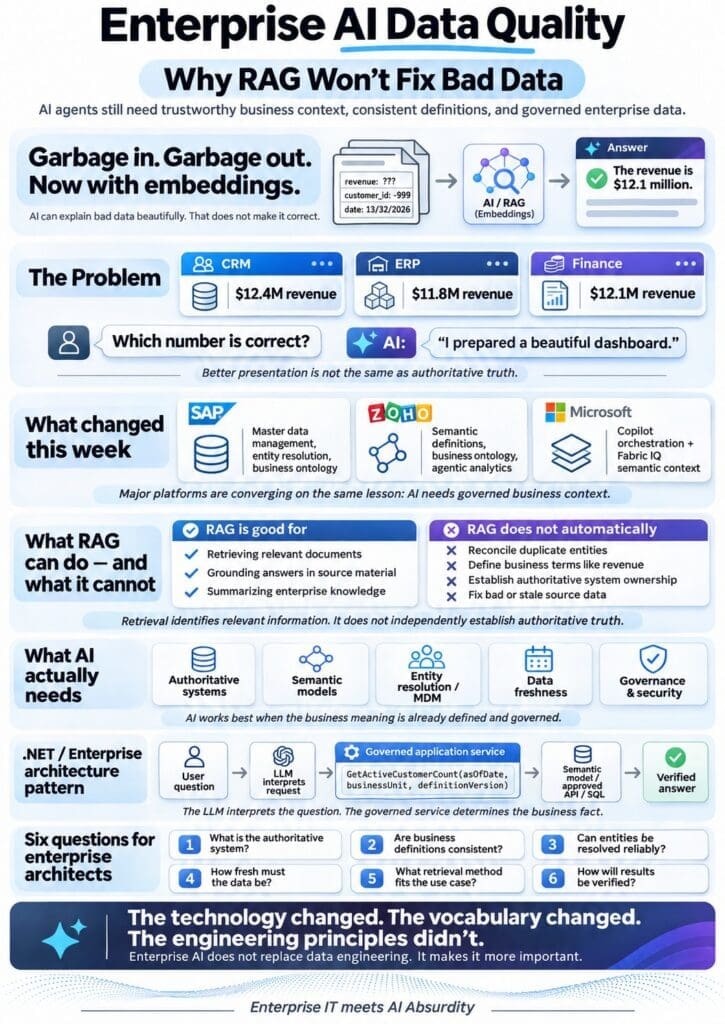
In the 1990s, enterprise software developers learned an important lesson.
Garbage in, garbage out.
An application could execute perfectly.
The database could be properly normalized.
The SQL queries could be syntactically correct.
The reports could be beautifully formatted.
But if the underlying data was incorrect, the application could still produce incorrect business results.
Organizations invested heavily in data validation, relational databases, referential integrity, data integration, master data management, and business intelligence.
Not because these activities were particularly exciting.
But because business applications cannot reliably operate on information they don’t understand.
Then generative AI arrived.
We discovered that large language models could interpret natural language, retrieve documents, summarize information, and generate sophisticated explanations.
We added embeddings.
Vector databases.
Retrieval-augmented generation.
Knowledge graphs.
Autonomous agents.
And suddenly, some organizations began behaving as though connecting an LLM to their data had eliminated decades of unresolved data-quality problems.
It hadn’t.
We simply gave those problems a more conversational interface.
An AI agent can explain incorrect information remarkably well. That doesn’t make the information correct.
1. The Enterprise Data Problem We Never Completely Solved
Consider a common situation in a medium-sized enterprise.
The organization has a customer relationship management system, an ERP application, a billing system, and a support platform.
Each application contains customer information.
Unfortunately, they don’t all represent customers the same way.
The CRM system identifies a customer as Acme Incorporated.
The ERP system identifies the same organization as ACME LLC.
The billing system has a record for Acme Holdings.
The support platform contains separate records for several regional locations.
Now imagine an executive asking:
“How many active customers do we have?”
That sounds like a simple question.
But answering it correctly requires resolving several underlying issues.
Do the records represent the same legal entity?
Do subsidiaries count as separate customers?
Does an organization become active when it signs a contract, places an order, receives an invoice, or makes a payment?
What happens when a customer hasn’t purchased anything for eighteen months but still has an active support agreement?
Which application owns the authoritative status?
These are business-data questions.
They existed long before AI.
And they aren’t automatically resolved by giving an LLM access to all four applications.
2. What Happened This Week
At SAP TechEd on October 27–29, 2026, SAP introduced additional capabilities designed to provide AI agents with reliable enterprise data and business context.
One important development was the integration of SAP Reltio master data management into SAP Business Data Cloud.
SAP described the need to reconcile customer, supplier, product, and other business records across different systems.
The company also introduced an Ontology Manager for creating domain-specific representations of business entities and their relationships.
The underlying objective is straightforward.
An AI agent needs to understand that differently named records may represent the same business entity.
It also needs to understand the business relationships and rules that make those records meaningful. SAP News Center
On October 28, Zoho announced agentic analytics capabilities incorporating semantic definitions and ontologies.
Zoho specifically discussed the importance of defining business terms such as revenue and active customer so AI agents don’t independently interpret those concepts differently.
Microsoft has been pursuing a related approach through Fabric IQ, Power BI semantic models, and Microsoft Copilot.
Its September announcements expanded the use of existing governed business definitions in Copilot Chat and Cowork. Zoho
These announcements should not be interpreted as vendors suddenly discovering data management.
All three companies have longstanding data and analytics businesses.
What is significant is how prominently business semantics and trusted context are becoming part of enterprise AI architecture.
The ability to generate an answer is no longer the entire challenge.
The answer has to mean the right thing.
3. A Vector Database Is Not a Data Quality Solution
Retrieval-augmented generation is useful technology.
It allows an AI application to retrieve relevant information and include that information in the context provided to a language model.
Embeddings make it possible to identify semantically similar content, even when the wording differs.
This can be valuable for searching policies, contracts, technical documentation, support articles, and other unstructured information.
But semantic similarity is not the same as business identity.
Consider two customer records.
One belongs to Acme Manufacturing LLC.
The other belongs to Acme Manufacturing Services LLC.
Their names are similar.
They share an address.
Their descriptions contain nearly identical terminology.
A vector search may correctly identify them as semantically related.
But should those records be merged?
Not necessarily.
They may represent separate legal entities.
They may have different tax identifiers.
They may operate under different contractual relationships.
They may have separate payment responsibilities.
An embedding cannot independently establish the authoritative business relationship.
That requires additional evidence, defined rules, and an appropriate entity-resolution process.
Retrieval identifies potentially relevant information. It does not automatically establish authoritative truth.
4. Data Quality and Data Meaning Are Different Problems
Enterprise architects should distinguish between data quality and semantic consistency.
Data quality concerns whether information is accurate, complete, timely, valid, and appropriately maintained.
For example, a customer’s address may be outdated.
A product identifier may be missing.
An invoice may reference a nonexistent account.
Those are data-quality problems.
Semantic consistency concerns what the information means.
For example, the sales department may define revenue as the total value of signed contracts.
Finance may define revenue according to recognized accounting transactions.
Operations may use shipped-order value.
All three numbers could be correct according to their respective definitions.
The problem occurs when someone asks a question that doesn’t specify which definition applies.
An LLM might select one.
It might combine them.
It might provide a plausible explanation for the discrepancy.
But it cannot reliably determine the organization’s authoritative definition unless that information is available and properly represented.
That’s why semantic models matter.
They connect business terminology to governed calculations, relationships, dimensions, and data sources.
5. We’ve Been Building Semantic Layers for Years
Anyone who has worked extensively with Microsoft business intelligence should recognize this problem.
Power BI semantic models exist partly to establish reusable business definitions.
Measures, relationships, hierarchies, and dimensions provide consistent ways to interpret enterprise information.
A revenue measure can apply specific filters and business rules.
A customer dimension can establish relationships between transactions and accounts.
A reporting date can determine which records belong in a particular period.
This isn’t a new requirement created by generative AI.
It’s established data modeling.
Microsoft Fabric IQ extends these ideas by providing business context through semantic models and ontologies.
Microsoft’s documentation describes ontologies as representations of business entities, relationships, properties, rules, and actions.
The ontology functionality remains in preview, while governed Power BI semantic-model context is already available in supported Copilot experiences. Microsoft Learn
The important architectural development is not that semantic modeling has become obsolete.
It’s that AI creates additional consumers of the semantic models organizations already maintain.
That makes those investments more valuable.
6. The Difference Between Accessing Data and Understanding Data
Imagine an AI agent with read access to an ERP database.
The agent can inspect customer records.
It can retrieve invoices.
It can examine orders.
It can summarize account activity.
But does it understand the business rules?
Does it know which invoice statuses indicate recognized revenue?
Does it distinguish a canceled transaction from a refunded transaction?
Does it know whether subsidiaries should be consolidated?
Does it understand how historical currency conversions are handled?
Does it know which records the requesting user is permitted to see?
Database access doesn’t answer those questions.
Neither does access to table names and column descriptions.
The agent needs additional context.
Some context may be represented through database schemas.
Other context belongs in semantic models.
Some business rules should be implemented in deterministic application services.
Security restrictions should be enforced independently.
And some decisions require human interpretation because the business rules themselves are incomplete or ambiguous.
The ability to query a database is not equivalent to understanding the business represented by the database.
7. What RAG Should Actually Do
I am strongly in favor of retrieval-augmented generation.
But its responsibilities should be clearly defined.
RAG is particularly useful when the application needs to work with unstructured or semi-structured knowledge.
An enterprise assistant might retrieve a customer’s contract, relevant policy documents, previous correspondence, and technical documentation.
The LLM can then interpret and summarize that information.
That’s a valuable capability.
But suppose the same assistant needs to determine the customer’s outstanding balance.
Should it retrieve an old PDF statement and estimate the current balance from the document?
Probably not.
If the organization has an authoritative accounts-receivable system, that system should provide the current balance.
The architecture can use RAG for the contractual terms and a governed API or query for the financial amount.
The LLM can combine those results into a useful explanation.
That is a more appropriate division of responsibilities.
Use retrieval for knowledge. Use authoritative systems for authoritative transactions and facts.
There will be exceptions.
The distinction should be based on the type of information and the required assurance, not on an absolute rule against using RAG with structured data.
8. A Microsoft/.NET Architecture for Trustworthy Enterprise AI
Consider an enterprise AI assistant built using ASP.NET Core, C#, SQL Server, Microsoft Entra ID, and Microsoft Foundry.
The application answers customer-account questions.
A user asks:
“How many active customers did we have at the end of September?”
A poorly designed approach might send raw schemas to an LLM and allow it to generate arbitrary SQL.
That can work for some analytical tasks.
But it creates unnecessary ambiguity when the organization already has a governed definition of an active customer.
A better architecture exposes a typed application capability.
For example:
GetActiveCustomerCount(asOfDate, businessUnit, definitionVersion)
The application service validates the caller’s identity and permissions.
It determines the applicable business definition.
It retrieves the result from an approved semantic model, governed view, or deterministic query.
It returns a structured response containing the value, reporting date, definition version, and source information.
The LLM can then explain the result.
The model doesn’t need to invent the definition.
And it doesn’t need unrestricted database access to produce a useful answer.
The distinction is straightforward.
The LLM interprets the question. The governed application service determines the business fact.
9. SQL Server Still Has Important Responsibilities
Thirty years of Microsoft enterprise application development produced some useful technologies.
Primary keys.
Foreign keys.
Unique constraints.
Check constraints.
Transactions.
Stored procedures.
Views.
Indexes.
Concurrency controls.
None of these becomes unnecessary because an LLM can generate SQL.
Suppose a financial system must prevent the same invoice from being paid twice.
The system should enforce that business invariant through appropriate application and database controls.
An AI agent shouldn’t be trusted to avoid duplicate payments merely because a prompt says:
“Please don’t pay the same invoice twice.”
Similarly, customer identifiers should be managed through reliable business processes.
An AI agent can help identify suspicious duplicates.
It can recommend records for reconciliation.
But merging customer records may have legal, operational, and historical consequences.
The final decision should be governed by established rules and appropriate authority.
Modern SQL Server capabilities, including vector functionality in SQL Server 2025, expand what developers can build.
They don’t invalidate relational integrity or transaction management.
10. Master Data Management Is Becoming More Important
Master data management addresses a foundational enterprise problem.
Different systems often maintain different representations of the same business entities.
Customers.
Products.
Suppliers.
Employees.
Locations.
Accounts.
An MDM capability can help identify related records, reconcile attributes, establish authoritative identifiers, and maintain governed relationships.
But MDM is not simply merging every similar record.
A company and its subsidiaries may need to remain distinct.
Two suppliers may share a parent company while having separate contractual obligations.
A customer may have multiple billing accounts for legitimate reasons.
Effective master data management preserves those distinctions.
The goal isn’t to create one enormous record containing every piece of information about an organization.
The goal is to establish consistent, governed identities and relationships appropriate to the business.
For AI agents operating across multiple enterprise applications, those relationships become particularly important.
An agent cannot safely automate a business process if it cannot determine which entity the process concerns.
11. Business Context Should Be Governed, Not Recreated in Every Prompt
One architectural mistake I see in enterprise AI prototypes is placing complex business definitions directly into prompts.
For example:
“An active customer is someone who purchased something in the previous twelve months, except for certain account types, unless they have a current contract.”
That might be sufficient for a demonstration.
But what happens when the business definition changes?
Which applications use the new definition?
Which agents still use the old one?
How do we test the rule?
Who approved the change?
How do we reconstruct a historical decision?
If the definition affects operational or financial outcomes, placing it solely in a prompt creates unnecessary governance problems.
A better approach makes the definition a managed enterprise asset.
It can be documented.
Versioned.
Tested.
Approved.
Reused across applications.
And evaluated consistently.
The LLM can retrieve or reference the definition.
But the governing rules should exist independently of a particular model’s interpretation.
12. Data Freshness Is Another Architectural Requirement
Even correct data can become misleading when it is stale.
Suppose the customer support system updates an account status immediately.
The ERP system synchronizes the information every fifteen minutes.
The analytical warehouse refreshes nightly.
The knowledge index refreshes weekly.
All four systems may contain valid information.
But they represent different points in time.
An AI agent asked about the current account status could retrieve an outdated record.
The answer might be perfectly grounded in that record.
It would still be wrong for the user’s purpose.
This is why enterprise AI architecture needs explicit freshness requirements.
Which use cases require real-time data?
Which can tolerate hourly updates?
Which need historical snapshots?
Should an agent disclose the age of the information?
Should it refuse to answer when the data is too old?
Those decisions belong in the system design.
Not merely in the model prompt.
13. Better Citations Don’t Automatically Mean Better Answers
One of the significant improvements RAG brings to enterprise AI is source attribution.
An assistant can identify the documents or records that support its answer.
That’s useful.
But there’s an important limitation.
A citation establishes a connection between an answer and a source.
It does not independently establish that the source is accurate.
Suppose an outdated policy document contains the wrong reimbursement threshold.
The assistant retrieves it.
The assistant accurately quotes it.
The assistant provides a perfect citation.
The answer is still wrong under the current policy.
The solution is not to eliminate citations.
It’s to combine citations with source governance.
Documents need owners.
Policies need effective dates.
Superseded versions need appropriate treatment.
Authoritative sources need to be distinguished from informal working documents.
This is another familiar enterprise information-management problem.
AI makes it easier to retrieve and explain information.
It doesn’t remove the need to manage that information.
14. Data Quality Is Also a Security and Governance Issue
When an agent gains access to multiple enterprise systems, data quality problems can intersect with security problems.
Suppose two customers have similar names.
An agent retrieves the wrong account.
If it merely generates a general summary, the consequence may be limited.
But if the agent performs a financial transaction or changes a customer record, the consequences become more significant.
The architecture needs to enforce tenant boundaries, customer identity, and record-level authorization independently.
It should not rely on the LLM correctly interpreting a customer name.
For consequential operations, validated identifiers and trusted authorization context are essential.
This is another reason to separate analysis from execution.
An LLM may help identify a potentially matching customer.
A deterministic service should verify the authoritative identifier and permissions before modifying the record.
15. What Enterprise Architects Should Do Before Expanding AI
Before adding more agents or connecting additional data sources, I would examine six questions.
First: What are the authoritative systems?
For each business entity and important operational fact, determine which system owns the information.
Second: Are business definitions consistent?
Document important metrics, relationships, and rules in reusable semantic or application layers.
Third: Can business entities be resolved reliably?
Establish appropriate customer, supplier, product, and account identities across systems.
Fourth: How fresh must the information be?
Define acceptable data latency and what the application should do when information exceeds that limit.
Fifth: What is the right retrieval method?
Use semantic retrieval for appropriate knowledge tasks and governed structured queries or APIs when authoritative values are required.
Sixth: How will results be verified?
Evaluate not only whether the agent generates a convincing answer, but whether it uses the correct source, definition, identity, reporting period, and authorization context.
These aren’t new AI-specific inventions.
They’re established enterprise architecture responsibilities.
AI gives us additional reasons to perform them well.
16. The Business Case for Better Data Engineering
One of AI’s greatest potential benefits is making enterprise knowledge and capabilities more accessible.
A department manager should be able to ask meaningful questions without knowing SQL.
A customer-service employee should be able to retrieve relevant account information without navigating six applications.
An executive should be able to examine operational performance without commissioning a new report for every question.
These are valuable outcomes.
But the value depends on whether the information can be trusted.
If every AI response requires a human analyst to reconcile contradictory business definitions, the organization may achieve less productivity improvement than expected.
If incorrect customer identities produce errors in downstream automation, the costs can exceed the savings.
If employees stop trusting the answers, adoption suffers.
Therefore, investments in data quality, semantic modeling, and governance are not separate from the AI business case.
They are part of it.
A better model can improve reasoning.
A better retrieval system can improve access.
But neither compensates reliably for an enterprise that has never defined what its own data means.
Conclusion: We Didn’t Invent Data Engineering for Decoration
The announcements from SAP, Zoho, and Microsoft illustrate an important shift.
Enterprise AI is moving beyond generating impressive responses.
Organizations increasingly want agents that can understand their business, work across applications, and perform useful operations.
That requires more than capable language models.
It requires consistent data.
Authoritative identities.
Reliable relationships.
Governed business definitions.
Appropriate retrieval methods.
Independent authorization.
And verifiable outcomes.
We already know much of this.
We’ve spent decades building data-driven enterprise applications.
The fundamentals haven’t disappeared.
If anything, AI makes them more important.
A vector database can make enterprise information easier to find.
An LLM can make that information easier to understand.
An agent can make the resulting capabilities easier to use.
But none of those technologies automatically fixes incorrect, inconsistent, or poorly governed data.
Perhaps that’s the most entertaining contradiction of enterprise AI.
We spent thirty years trying to eliminate garbage data.
Then invented a technology capable of explaining that garbage in beautifully written English.
The technology changed.
The vocabulary changed.
The engineering principles didn’t.
Research Sources and Editorial Notes
October 29 — SAP: Advancing SAP Lakehouse and New Data Fabric Innovations
SAP explains its master data management, entity resolution, knowledge graph, and ontology developments.
SAP’s October 29 technical announcement
October 28 — SAP TechEd 2026
SAP’s event coverage includes enterprise agents, deterministic business workflows, semantic context, and governance capabilities.
October 28 — Zoho Analytics
Zoho’s announcement discusses agentic analytics, semantic definitions, business ontologies, and the importance of consistent enterprise terminology.
October 28 — Microsoft Copilot Harness
Microsoft explains the multi-model agent orchestration system now available through Microsoft Foundry.
Microsoft’s Copilot harness announcement
September 28 — Microsoft Fabric IQ
Microsoft explains how governed business definitions and semantic models connect to Copilot and enterprise AI.
Microsoft’s Fabric IQ announcement
Independent industry perspective — Gartner, May 11, 2026
Gartner warns that inadequate semantic context can make enterprise agents inaccurate and inefficient. Its projected benefits from improved semantics are forecasts, not demonstrated universal performance improvements.
Gartner’s analysis of semantic foundations for enterprise AI
Important distinction: The humorous examples involving customer counts, conflicting revenue figures, and vector-database architecture reviews are fictional. They illustrate genuine architectural failure modes; they are not claims that SAP, Zoho, or Microsoft experienced those specific incidents.
Planning an Enterprise RAG Implementation?
Before selecting vector databases, embedding models, or AI frameworks, make sure your data architecture can support reliable business outcomes.
AInDotNet helps organizations evaluate RAG opportunities, design governed AI architectures, and implement production-ready solutions using .NET, SQL Server, Azure, and AWS.
Frequently Asked Questions
Can retrieval-augmented generation (RAG) fix poor data quality?
No. RAG retrieves relevant information and provides it to an AI model for generating responses. It does not automatically correct inaccurate records, reconcile conflicting business definitions, or establish authoritative data sources. RAG can incorporate data validation and quality controls, but those capabilities must be explicitly designed into the solution.
Do vector databases replace master data management (MDM)?
No. Vector databases support similarity search and retrieval, while master data management establishes authoritative business identities, relationships, and data governance. Vector search can help identify potentially duplicate customer or product records, but determining whether those records represent the same business entity requires additional evidence, business rules, and appropriate controls.
What is the difference between RAG and an enterprise semantic layer?
RAG retrieves information relevant to a user’s question. An enterprise semantic layer provides governed definitions of business entities, metrics, relationships, and calculations. For example, RAG might retrieve a quarterly financial report, while a semantic model defines how recognized revenue is calculated. Enterprise AI applications can combine both approaches to produce more reliable answers.
How should an AI agent handle conflicting information from CRM, ERP, and financial systems?
The agent should use established data ownership rules, governed business definitions, and authoritative systems to determine the appropriate result. It should also consider reporting periods, data freshness, and the requesting user’s permissions. When conflicting information cannot be reliably reconciled, the agent should disclose the discrepancy rather than invent a definitive answer.
Can SQL Server 2025 support RAG without a separate vector database?
Yes. SQL Server 2025 includes native vector capabilities that can support embedding storage and similarity search within an existing relational database architecture. Depending on workload requirements, organizations can implement RAG without introducing a separate specialized vector database. Performance, scalability, retrieval quality, and operational requirements should still be evaluated before selecting an architecture.
What should organizations do before deploying enterprise AI agents?
Organizations should identify authoritative data sources, establish consistent business definitions, assess data quality, resolve critical entity-identity problems, and define security and governance requirements. They should also establish data freshness expectations and evaluate whether AI-generated answers use the correct sources, definitions, and authorization context. These foundational engineering practices are essential for trustworthy enterprise AI.
