
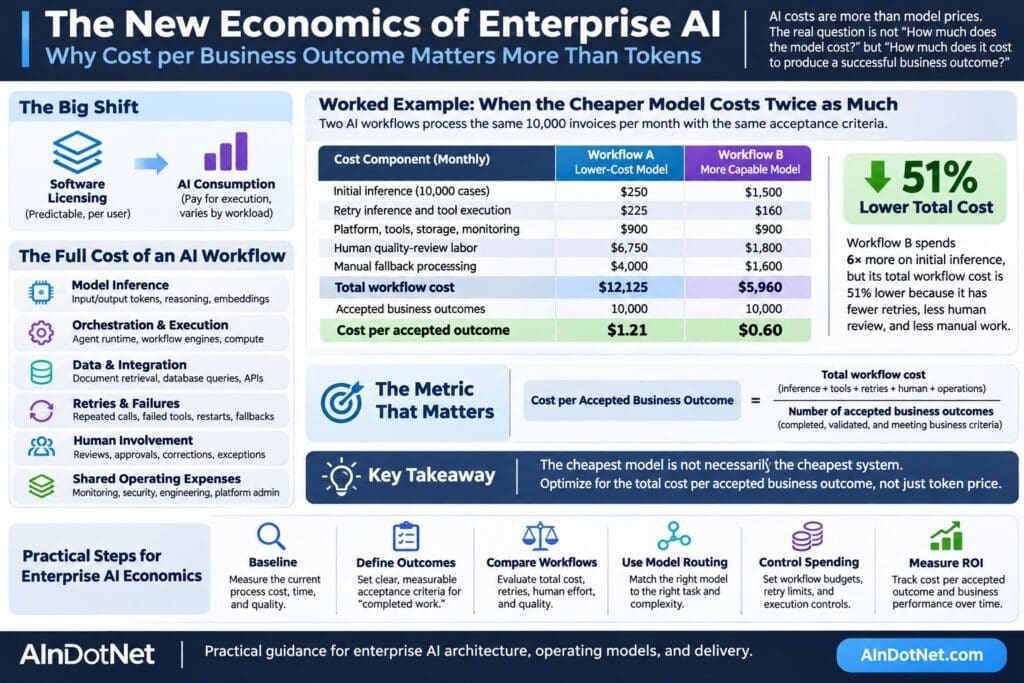
Enterprise AI is entering a new economic phase. For years, organizations evaluated AI investments primarily through software licensing, infrastructure costs, and the price of individual model requests. But as AI agents begin executing business processes, those measurements are becoming insufficient.
An AI model might process a request for a few cents. That sounds inexpensive until the workflow requires multiple model calls, external tools, repeated attempts, human corrections, and operational oversight.
The important question is no longer simply, “How much does this AI model cost?”
It is “How much does it cost to produce a successful, accepted business outcome?”
That distinction is becoming increasingly important as enterprises move from AI experimentation toward production systems.
An organization can reduce token costs while increasing its total operating expenses. It can deploy thousands of agents without improving business productivity. And it can select the cheapest AI model only to discover that a more capable model would have produced better results at a lower overall cost.
Understanding these tradeoffs requires more than model pricing comparisons. It requires treating AI economics as part of enterprise architecture and the enterprise AI operating model.
Enterprise AI Is Moving From Licensing Toward Consumption-Based Economics
In Microsoft’s October 28, 2026, FY27 first-quarter earnings announcement, the company reported substantial growth in AI adoption and consumption.
Microsoft disclosed that:
- More than 50 million agents were registered in Agent 365.
- Foundry had more than 120,000 customers.
- The number of Copilot customers actively consuming usage-based credits increased more than 75% during the quarter.
- Customers building multi-model agentic solutions increased fivefold year over year.
These are significant indicators of platform adoption.
They also reflect an important change in enterprise AI economics.
Traditional enterprise software frequently relies on predictable licensing arrangements. Organizations purchase access for a defined number of users, then manage renewal costs and utilization.
AI agents introduce a different cost structure.
A single business request might initiate several model calls, query databases, retrieve documents, execute software tools, invoke external services, and require human approval.
Each operation can contribute additional expense.
GitHub reinforced this transition in October 2026 when it introduced Copilot access through eligible GitHub Enterprise agreements. Under this arrangement, AI usage is metered against enterprise budgets from the first request, without included monthly AI credits per seat.
The distinction is fundamental.
Purchasing access to AI and paying for AI execution are becoming separate financial decisions.
However, increasing consumption does not automatically establish increasing business value.
Registered agents, tokens consumed, and workflows executed measure activity. They do not independently demonstrate that business processes have improved.
Why Token Pricing Is an Incomplete Measure of Enterprise AI Costs
Token pricing is useful because it provides a standardized way to compare inference consumption across models.
But inference is only one component of a production AI workflow.
Consider an AI application that processes incoming customer support requests.
A basic demonstration might submit each request to a language model, classify the issue, and generate a suggested response.
The inference cost may be minimal.
A production implementation is different.
The application may need to authenticate the requester, retrieve customer records, search internal documentation, evaluate confidence, select an appropriate business operation, and update a ticketing system.
When the model produces an incomplete answer, another inference request might be necessary.
When information is ambiguous, the workflow may require human review.
When an external service fails, the application may retry an operation or invoke an alternative processing path.
Every additional step affects the total cost.
The full cost of an AI workflow
A useful enterprise AI cost model should account for six categories.
1. Model inference: Input tokens, output tokens, reasoning-related consumption where applicable, embeddings, and model-based evaluations.
2. Orchestration and execution: Agent runtimes, sandbox compute, memory, workflow engines, API gateways, and execution infrastructure.
3. Data and integration: Document retrieval, database queries, vector searches, storage, data transfer, and external service charges.
4. Retries and failures: Repeated inference, failed tool calls, workflow restarts, fallback execution, and reconciliation.
5. Human involvement: Reviews, approvals, corrections, exception handling, and manual completion of unsuccessful tasks.
6. Shared operating expenses: Monitoring, security, engineering support, evaluation infrastructure, and allocated platform administration.
The relative importance of these categories depends on the workflow.
For a simple document classification task, inference might represent most of the direct technical expense.
For a complex business process involving multiple applications and human approvals, inference might represent only a small fraction of total cost.
This is why optimizing token consumption without examining the complete workflow can produce misleading financial conclusions.
The Metric That Matters: Cost per Accepted Business Outcome
Enterprise AI performance should be measured against the business process it is intended to improve.
A practical metric is:
Cost per accepted business outcome = Total allocated workflow cost ÷ Number of accepted business outcomes
Both parts of this calculation require careful definition.
The numerator should include the full operating cost within a clearly defined measurement boundary.
The denominator should represent completed business work that satisfies agreed acceptance criteria.
For example, an invoice-processing system should not count an invoice as successfully processed merely because an AI agent extracted information from a document.
A successful outcome might require that the invoice be correctly classified, validated against purchase-order data, approved according to business rules, and recorded without duplicate financial transactions.
Similarly, a customer support agent should not receive credit for resolving a case simply because it generated an answer.
The resolution must satisfy the organization’s acceptance criteria.
That might include correctness, completeness, customer confirmation, compliance requirements, and timely completion.
An AI action is not necessarily a completed task. A completed task is not necessarily an accepted business outcome.
Enterprises need to distinguish these measurements rather than treating them as interchangeable.
Worked Example: When the Cheaper AI Model Costs Twice as Much
Consider a hypothetical enterprise implementing AI-assisted invoice exception processing.
The system handles 10,000 invoices per month. Both proposed architectures process the same case mix and must satisfy the same business acceptance criteria.
The organization evaluates two alternatives:
Workflow A: Lower-cost model
Uses an inexpensive language model for initial processing. However, its lower assumed accuracy produces more retries, additional human reviews, and more cases requiring manual fallback.
Workflow B: More capable model
Uses a model that costs six times as much per initial inference request. However, its higher assumed accuracy reduces retries and manual intervention.
The following numbers are illustrative assumptions, not reported Microsoft performance results or current vendor prices.
Monthly cost comparison
| Cost component | Workflow A: Lower-cost model | Workflow B: More capable model |
|---|---|---|
| Initial inference, 10,000 cases | $250 | $1,500 |
| Retry inference and tool execution | $225 | $160 |
| Platform, tools, storage, monitoring | $900 | $900 |
| Human quality-review labor | $6,750 | $1,800 |
| Manual fallback processing | $4,000 | $1,600 |
| Total workflow cost | $12,125 | $5,960 |
| Accepted business outcomes | 10,000 | 10,000 |
| Cost per accepted outcome | $1.21 | $0.60 |
The assumptions behind the comparison are explicit.
Workflow A performs 3,000 retry operations at $0.075 each, while Workflow B performs 800 retries at $0.20 each.
Human quality reviews cost $2.25 per case, representing three minutes of labor at a loaded rate of $45 per hour. Workflow A requires 3,000 such reviews; Workflow B requires 800.
Cases that require full manual fallback are separate from those quality reviews, avoiding double-counting labor. Workflow A has 1,000 fallback cases and Workflow B has 400, each costing $4.
All 10,000 invoices ultimately satisfy acceptance requirements, including cases completed through manual fallback.
The example therefore measures the cost of completing the entire workload, not merely the cases the AI processed independently.
The financial result
<text></text>
Workflow B spends six times as much on initial model inference.
Yet its total workflow cost is approximately 51% lower.
The cheaper inference model does not produce the cheaper business outcome.
Why?
Because the additional human intervention, retries, and fallback processing cost substantially more than the inference savings.
This example illustrates a critical architectural principle:
The cheapest model is not necessarily the cheapest system.
Actual results will vary by workload, model quality, labor rates, task complexity, and acceptance requirements. Enterprises should measure these factors using representative production data rather than assuming that a more expensive model will always perform better.
Multi-Model Routing Becomes an Economic Architecture Decision
The previous example does not mean every enterprise should select the most capable or expensive AI model for every request.
That approach could also waste money.
Many tasks are relatively simple. Others require stronger reasoning, additional context, or specialized capabilities.
A more effective architecture may use different models depending on the requirements of each operation.
For example, an application might use a smaller model for straightforward classification, a stronger model for ambiguous exceptions, and a specialized service for document extraction.
GitHub’s October 2026 announcement of Copilot Fusion illustrates this direction.
Fusion supports single-model execution, cascading between models, and critique-based orchestration. GitHub states that each model invocation is billed according to the model’s applicable rate.
These capabilities create opportunities to balance quality, speed, and cost.
They also introduce additional architectural responsibilities.
A routing decision can affect accuracy, latency, the number of model calls, and the likelihood that a human must intervene.
Routing systems therefore need evaluation just as individual models do.
Enterprise architects should examine whether routing decisions actually reduce the total cost per accepted outcome.
A router that saves 30% on inference but increases exception handling by 50% may be an economic regression.
A router that increases inference spending while substantially reducing rework may provide a better financial result.
The model router should be treated as a governed production component, not merely a convenience feature.
AI Budgeting Must Become an Architectural Control
As AI systems execute increasingly complex workflows, uncontrolled consumption becomes an operational risk.
An agent may enter a retry loop, repeatedly invoke expensive tools, or perform more inference than the business process justifies.
Traditional cloud cost dashboards can help identify spending patterns, but they are not sufficient to prevent every runaway workflow.
For example, Microsoft Azure Cost Management documentation explicitly explains that budget notifications do not automatically stop resource consumption.
That distinction matters.
An alert tells you that spending occurred. An enforcement control limits what can happen next.
Enterprise AI architectures should incorporate workflow-level financial controls.
These can include per-request spending limits, maximum execution steps, retry ceilings, concurrency limits, and maximum permitted tool invocations.
An application can also establish escalation thresholds that require human authorization before additional expensive operations occur.
For example, a purchasing agent might be allowed to spend up to a defined amount on processing an approved transaction, while actual procurement authority remains independently enforced by the underlying business system.
The financial controls should be enforced by application infrastructure or authorized services—not simply described in the agent’s prompt.
Budget enforcement is ultimately an engineering responsibility involving policy, metering, authorization, and reliable execution controls.
Who Owns Enterprise AI Spending?
Consumption-based AI also changes the relationship between central IT and business departments.
Traditional enterprise licensing frequently assigns software costs to central IT budgets, with internal allocation determined by organizational policy.
Consumption-based agents can connect spending directly to business workflows.
A finance department might use agents for invoice reconciliation. Customer service might deploy support assistants. Human resources might automate document processing.
Each department may consume the same enterprise AI platform while generating substantially different workloads and costs.
This creates an ownership question.
Should central IT pay for all AI consumption, or should business departments fund the workflows they operate?
A practical enterprise AI operating model separates responsibilities.
Central IT and platform engineering should establish approved infrastructure, security, observability, integration standards, metering, and shared technical cost allocation.
Business process owners should establish acceptable service quality, business outcomes, exception-handling expectations, and workload budgets.
Finance and FinOps teams should help establish cost attribution, financial reporting, forecasting, and spending controls.
Shared costs still need reasonable allocation methods. Not every platform expense can be directly attributed to an individual task.
However, organizations should be able to explain which workflows are generating consumption, who benefits from those workflows, and whether spending remains justified by measurable results.
Without that visibility, rapidly expanding AI adoption can become a collection of disconnected cost centers.
How to Measure AI Costs in a Production Architecture
Measuring cost per accepted business outcome requires connecting technical telemetry with business process data.
Token usage alone cannot provide that connection.
A production AI workflow needs a consistent identifier that follows the business operation across application services, model calls, tool executions, retries, and final disposition.
In a Microsoft-oriented environment, that could involve a .NET application assigning a unique workflow identifier, recording execution details through OpenTelemetry and Application Insights, and persisting business outcomes in SQL Server.
The architecture should capture model and provider versions, inference consumption, tool usage, execution duration, retry counts, and allocated operating costs.
It should also capture the outcome status: accepted, rejected, corrected, escalated, or awaiting review.
The key is connecting those records to the same business operation.
Microsoft Foundry’s evaluation and observability capabilities provide mechanisms for examining model and agent behavior, including production traces and evaluation results.
But business acceptance criteria still need to be defined by the organization.
A model evaluator may determine that an answer is relevant or that an agent followed instructions.
That does not independently establish that an invoice was correctly approved, a customer issue was resolved, or a transaction met financial controls.
Technical observability and business outcome measurement complement one another.
Neither replaces the other.
Building a Defensible Enterprise AI Business Case
An enterprise AI opportunity assessment should begin with the existing business process rather than a model demonstration.
Before implementing AI, organizations should establish a baseline.
How many cases does the existing process complete? What does each accepted outcome cost? How much time is spent on exceptions, rework, approvals, and corrections?
Those measurements provide the reference point against which AI improvements can be evaluated.
The next step is defining the future workflow and determining where AI will create value.
For some processes, the primary benefit may be labor savings.
For others, value may come from faster completion, reduced errors, improved service availability, or increased processing capacity.
Not every benefit translates directly into immediate cash savings. Labor time saved, for example, only becomes a realized financial saving under particular staffing or capacity conditions.
The business case should distinguish measurable financial savings from productivity improvements, capacity gains, and qualitative benefits.
During a pilot, organizations should compare the complete AI workflow with that baseline, using representative cases and consistent acceptance criteria.
The evaluation should include implementation and integration costs, expected operating expenses, human intervention, quality requirements, and projected transaction volumes.
An inexpensive prototype with impressive model performance is not sufficient evidence for a production investment.
The enterprise must demonstrate that the complete operating model creates value—not merely that the model can perform the task.
Conclusion: Enterprise AI Economics Are an Architecture Responsibility
The economics of enterprise AI are becoming more complex as organizations move from licensed assistants toward agents executing real business processes.
Model inference costs remain important, but they represent only one element of the financial equation.
Retries, tool execution, infrastructure, human intervention, and failed outcomes can determine whether an AI system is economically successful.
This changes how enterprises should evaluate AI investments.
Instead of optimizing individual model calls in isolation, organizations need to measure the cost, quality, and reliability of complete business workflows.
That requires collaboration among enterprise architects, software engineers, business process owners, finance teams, and AI governance leaders.
It also requires an enterprise AI operating model that connects technical execution with measurable business performance.
At AInDotNet, we believe successful enterprise AI begins with sound architecture, established engineering disciplines, and demonstrable business value.
AI should not be adopted simply because it is available, inexpensive per token, or capable of performing impressive demonstrations.
It should be implemented where it can deliver measurable improvements to business operations—with appropriate controls over cost, quality, security, and reliability.
The goal is not to minimize the cost of intelligence. It is to maximize the value of the business outcomes that intelligence helps produce.
Explore AInDotNet.com for practical guidance on enterprise AI architecture, opportunity assessment, operating models, and production implementation.
Frequently Asked Questions About Enterprise AI Costs
What is the true cost of enterprise AI?
The true cost of enterprise AI extends beyond model inference and token pricing. It includes infrastructure, agent orchestration, tool execution, data retrieval, integrations, monitoring, retries, human review, and ongoing operational support.
Organizations should evaluate the total cost of operating an AI-enabled business workflow rather than focusing exclusively on the price of individual model requests. A low-cost model can become expensive when it produces errors, requires repeated execution, or generates substantial human rework.
How do you calculate cost per business outcome for AI?
Cost per accepted business outcome is calculated by dividing the total allocated cost of an AI workflow by the number of successfully completed and accepted business outcomes.
Cost per accepted outcome = Total workflow cost ÷ Accepted business outcomes
The calculation should include inference, infrastructure, tools, retries, human intervention, and relevant shared operating expenses.
For example, if an AI workflow costs $12,000 per month and produces 10,000 accepted business outcomes, its average cost per accepted outcome is $1.20.
This metric helps enterprises compare alternative AI architectures against existing business processes.
Why isn’t token pricing enough to evaluate enterprise AI costs?
Token pricing measures the cost of model inference, not the complete cost of executing a business process.
An AI agent may require multiple model calls, database searches, API requests, retries, and human approvals to complete a single task.
A model with inexpensive tokens may produce more errors or require additional processing, increasing total workflow costs.
Enterprises should evaluate inference expenses alongside execution costs, quality, reliability, and human intervention to determine which architecture delivers the best economic results.
Can a more expensive AI model actually reduce operating costs?
Yes. A more expensive AI model can reduce total operating costs when its higher task-specific accuracy or reliability decreases retries, human corrections, and manual fallback processing.
For example, a model costing six times as much per initial inference request might still produce significantly cheaper accepted business outcomes if it reduces expensive human intervention.
However, this is workload-dependent. More expensive models do not automatically produce better business results.
Organizations should evaluate competing models against representative business tasks using consistent quality standards and fully allocated workflow costs.
What is AI FinOps, and why is it important for enterprises?
AI FinOps applies financial accountability and cost optimization practices to AI workloads.
It helps organizations understand which applications, agents, models, and business processes generate AI consumption and whether that spending produces measurable value.
Effective AI FinOps includes cost attribution, usage monitoring, budget forecasting, consumption limits, model selection, and cost-per-outcome measurement.
Unlike traditional software licensing, AI agent spending can vary with workflow complexity, transaction volume, retries, and tool execution.
AI FinOps helps organizations manage that variability while balancing cost, performance, reliability, and business value.
How can enterprises prevent AI agents from exceeding their budgets?
Enterprises should enforce spending controls within the AI application’s architecture rather than relying exclusively on cost alerts or prompt instructions.
Controls can include maximum execution steps, retry limits, per-workflow budgets, concurrency quotas, tool invocation limits, and approval requirements for expensive operations.
The application should measure consumption and enforce limits through independently controlled services.
Cloud budget notifications provide useful visibility, but they do not necessarily prevent additional spending.
Effective budget management requires both financial monitoring and technical enforcement mechanisms.
How does multi-model routing affect enterprise AI costs?
Multi-model routing allows an application to select different AI models based on task complexity, quality requirements, performance, and cost.
For example, an enterprise might use a smaller, inexpensive model for routine classification and a more capable model for complex exceptions.
This can improve cost efficiency, but routing introduces additional architectural considerations.
Enterprises must account for routing overhead, repeated model calls, evaluation costs, latency, and downstream human intervention.
The objective should be minimizing the total cost per accepted business outcome while maintaining required quality—not simply selecting the cheapest model for each request.
How should enterprises measure ROI from AI agents?
Enterprises should measure AI agent ROI by comparing the financial benefits of AI-enabled business processes against their complete implementation and operating costs.
Relevant measurements include cost per accepted outcome, processing time, error rates, rework, human intervention, transaction capacity, and service quality.
Organizations should establish a baseline using the existing business process before deploying AI.
They should also distinguish realized financial savings from productivity improvements, increased capacity, and qualitative benefits.
Agent registrations, tokens consumed, and workflow executions demonstrate activity. They do not independently establish ROI.
Successful enterprise AI investments should demonstrate measurable improvements in business performance, supported by reliable operational and financial evidence.
