Cybersecurity is no longer just an IT security department responsibility. It’s an enterprise-wide business responsibility—and AI is raising the stakes.
Over the past week, AInDotNet has examined several significant cybersecurity challenges facing enterprise organizations.
We’ve discussed critical software vulnerabilities, compromised software supply chains, third-party applications with privileged access, and autonomous AI agents operating inside enterprise systems.
We’ve also examined an organizational problem that may be just as serious as the technical threats.
Cybersecurity teams are frequently held accountable for risks created by decisions they don’t control.
Executives approve investments. Department heads select applications. Developers implement systems. Project managers establish delivery schedules. Vendors introduce software and integrations.
Yet cybersecurity professionals are expected to protect the entire enterprise from the consequences.
I believe cybersecurity needs to become the number-one consideration in enterprise application development and AI adoption.
Not because organizations should stop innovating, but because we cannot afford to deploy capabilities faster than we can secure them.
I’m approaching this from the perspective of an enterprise application developer and architect, not a cybersecurity specialist.
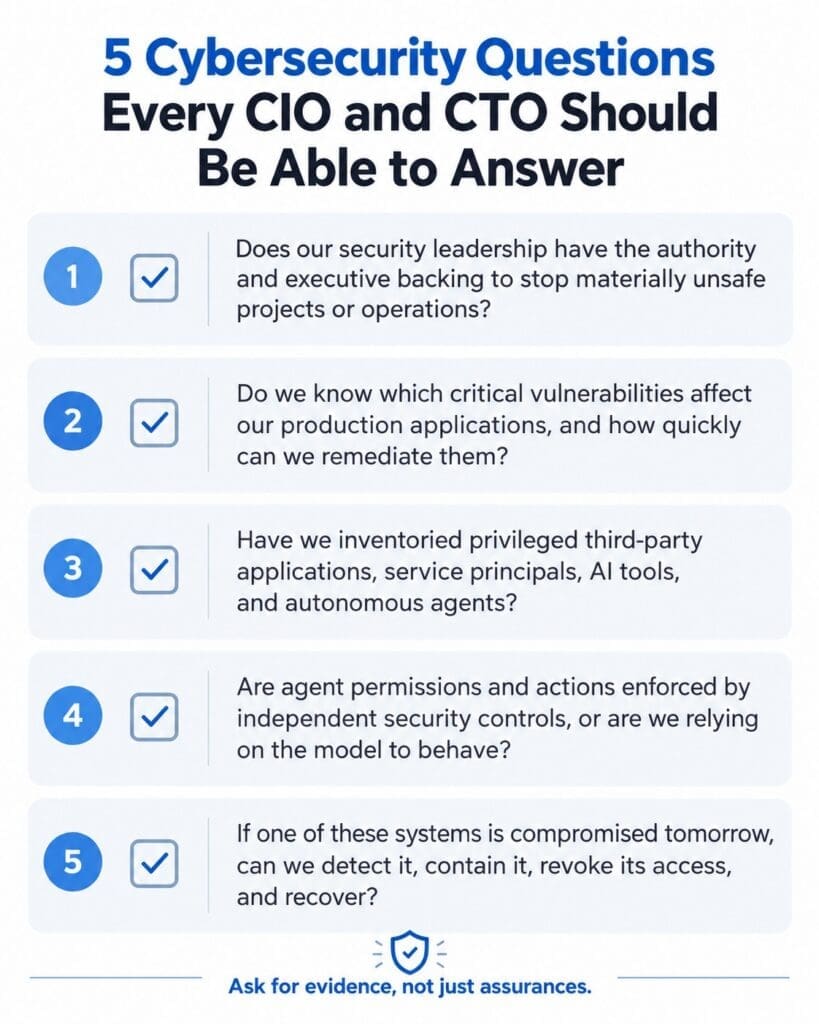
And I’d encourage every CIO, CTO, and business executive to start with five questions.
These aren’t questions that should require weeks of investigation to answer.
They’re questions enterprise technology leadership should be able to discuss confidently, supported by actual evidence.
1. Does Our Security Leadership Have the Authority to Stop Materially Unsafe Projects or Operations?
Cybersecurity teams may identify serious vulnerabilities, dangerous configurations, or unacceptable security risks.
But what happens when they tell project leadership that an application isn’t ready for production?
Can they actually stop the deployment?
Or can they only make recommendations and hope management listens?
Security professionals should not be expected to accept responsibility for risks they have no authority to control.
What a good answer looks like:
The organization has documented, executive-supported security policies defining when security leadership can suspend deployments or operations.
Risk thresholds, escalation procedures, remediation responsibilities, and conditions for resuming activity are clearly established.
Routine development continues through mature DevSecOps processes. Serious security exposures receive immediate attention.
Security has meaningful intervention authority, while business executives remain accountable for enterprise risk decisions.
Responsibility without authority isn’t governance. It’s a setup for failure.
2. Do We Know Which Critical Vulnerabilities Affect Our Production Applications—and How Quickly We Can Remediate Them?
An application that passed every security check yesterday may be vulnerable today.
Nothing necessarily changed in the application’s source code.
A vulnerability may have been discovered in its framework, runtime, operating environment, or software dependencies.
The October 2026 PHP vulnerabilities demonstrated this problem.
Organizations needed to determine which applications used affected PHP versions and deploy corrected runtimes.
But how quickly can your organization answer those questions?
What a good answer looks like:
The enterprise maintains accurate inventories of production applications, software components, runtimes, and responsible owners.
Automated security tools continuously reassess dependencies and deployed software against updated vulnerability intelligence.
Critical exposures are prioritized according to actual business risk, exploitability, and potential impact.
Emergency remediation procedures allow engineering teams to respond rapidly when necessary.
The organization can demonstrate how quickly it identifies affected systems, applies fixes, and verifies that the exposure has been addressed.
Secure software delivery is a continuous operational process, not a one-time certification.
3. Have We Inventoried Privileged Third-Party Applications, Service Principals, AI Tools, and Autonomous Agents?
Most enterprises depend on numerous external applications and services.
Those integrations often require credentials, API access, and permissions to perform legitimate business operations.
But how much access have we granted them?
The October 2026 ConnectWise compromise demonstrated how attackers can abuse trusted application identities to reach Microsoft 365 environments.
The LiteLLM supply-chain compromise illustrated how exposed credentials and weaknesses in privileged development infrastructure can cascade into a major security incident.
What a good answer looks like:
The organization maintains an inventory of privileged applications, service principals, vendors, AI services, and autonomous agents.
Each has an accountable owner, documented business purpose, defined permissions, and appropriate credential management.
Security teams can identify unexpected access, revoke compromised credentials, and disable integrations when necessary.
Permissions are reviewed regularly and limited to what the application actually requires.
A trusted application should not automatically become a trusted administrator.
4. Are AI Agent Permissions and Actions Enforced by Independent Security Controls—or Are We Relying on the Model to Behave?
Autonomous AI agents introduce additional security challenges.
They can interpret instructions, select tools, access information, and initiate business operations.
Their behavior may change depending on the information and instructions they encounter.
A well-written system prompt does not establish a reliable security boundary.
And passing conventional software security scans does not guarantee an agent will only perform appropriate actions.
What a good answer looks like:
Production agents operate within a defined security envelope.
Agents have distinct identities, restricted tools, scoped permissions, and explicit operational limits.
Consequential actions are authorized by trusted business applications and security services—not by the AI model itself.
Sensitive transactions require human approval when appropriate.
Every important operation is independently validated and auditable.
The model provides intelligence. The enterprise defines authority. The architecture enforces it.
5. If One of These Systems Is Compromised Tomorrow, Can We Detect It, Contain It, Revoke Its Access, and Recover?
No security architecture can guarantee that every attack or failure will be prevented.
That’s why incident detection, containment, and recovery are essential.
Imagine discovering that an autonomous AI agent has modified thousands of customer records incorrectly.
Or that a compromised third-party application has obtained privileged access to your environment.
Can you immediately stop further activity?
Can you identify what happened?
Can you restore affected systems and business data?
What a good answer looks like:
The organization has tested procedures for detecting suspicious activity, disabling compromised identities, revoking credentials, isolating affected systems, and recovering business operations.
Security and operational telemetry provide sufficient evidence to reconstruct consequential actions.
Recovery processes are documented, assigned to accountable owners, and periodically exercised.
The organization doesn’t merely have an incident-response plan.
It has evidence that the plan works.
Security isn’t just preventing something bad from happening. It’s also limiting the damage when prevention fails.
Cybersecurity Is Everyone’s Business
These five questions aren’t intended to turn CIOs and CTOs into cybersecurity specialists.
They’re intended to help enterprise leadership understand whether the organization has established the authority, architecture, engineering practices, and operational capabilities necessary to manage cybersecurity risk.
And the responsibility extends well beyond technology executives.
Department heads need to understand that their applications and vendor decisions introduce enterprise risk.
Project managers need to incorporate security reviews and remediation into delivery planning.
Developers need to implement secure architectures and maintain software throughout its operational life.
Executives need to give cybersecurity professionals appropriate resources, authority, and support.
And everyone needs to stop treating cybersecurity, Quality Assurance, and production-readiness controls as obstacles to delivering business value.
They’re the lifeguards.
The objective isn’t to stop projects unnecessarily.
It’s to prevent avoidable security failures while continuing to deliver valuable technology.
Final Recommendation: Put These Five Questions on Your Next Executive Agenda
We’ve spent decades trying to protect enterprise applications from human attackers.
Now attackers have increasingly capable AI tools, while organizations are introducing autonomous AI systems into those same environments.
I believe this combination deserves serious executive attention.
At your next technology leadership meeting, put these five questions on the agenda.
Ask your CIO, CTO, CISO, engineering leaders, and relevant business stakeholders to discuss the answers.
Ask for evidence, not just assurances.
If the organization cannot confidently answer these questions, you’ve identified where the cybersecurity conversation needs to begin.
The answer isn’t to stop using AI.
It’s to ensure our security capabilities keep pace with the technologies we’re deploying.
We cannot afford to deploy AI capabilities faster than we can secure them.
Continue Exploring Enterprise AI Security
This executive checklist concludes AInDotNet’s Enterprise AI Security Special Series. For a deeper examination of the organizational, engineering, and architectural issues, explore the three companion articles:
Your Cybersecurity Team Isn’t the Enemy. They’re the Lifeguards.
Why cybersecurity is an enterprise-wide business responsibility and why security leadership needs appropriate authority and organizational support.
Your Application Was Secure Yesterday. Is It Secure Today?
Why continuous vulnerability management, secure DevSecOps pipelines, and software supply-chain controls matter long after deployment.
Don’t Deploy Another AI Agent Without a Security Envelope.
How to constrain agent authority through independent authorization, scoped business capabilities, monitoring, and containment.
Explore AInDotNet’s foundational guidance:
- Enterprise AI Governance, Risk and Security
- AI Engineering Discipline and Delivery Lifecycle
- Enterprise AI Architecture — Agents
AInDotNet — Practical Enterprise AI Architecture, Engineering, and Governance.
