
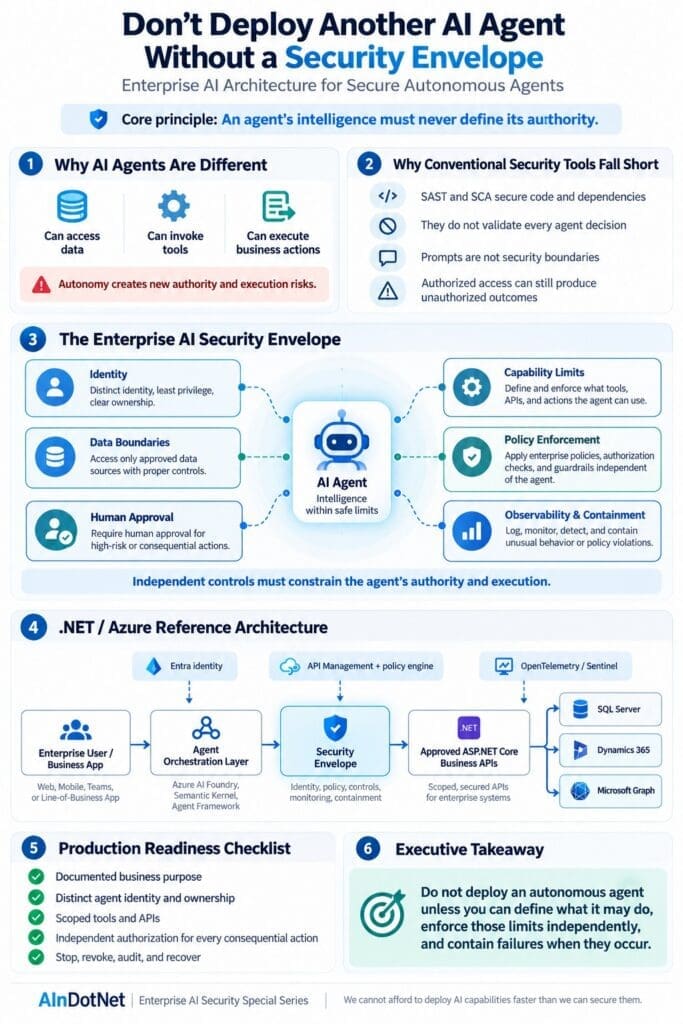
An AI agent’s intelligence must never define its authority. Enterprise security architecture must establish what the agent is allowed to do—and enforce those boundaries independently of the model.
Everyone seems to want an AI agent.
Wouldn’t it be great if an agent could manage customer accounts? Approve invoices? Update financial records? Coordinate employee onboarding? Make decisions and execute business processes without human intervention?
The demonstrations can be impressive.
But there’s something I think enterprise technology leaders need to understand before deploying these systems.
An AI agent isn’t a cute little avatar.
With the right credentials, tools, and permissions, it can become a powerful software system capable of performing consequential business operations.
It may access sensitive information, modify customer records, initiate transactions, communicate with external services, or execute administrative commands.
And unlike conventional deterministic software, its decisions and actions may vary depending on the instructions, data, and context it encounters.
I’m not a cybersecurity specialist. I’ve spent decades developing and architecting enterprise business applications, primarily using Microsoft technologies.
From that perspective, I believe organizations need to approach autonomous AI agents with considerably more engineering discipline than we’re seeing in many demonstrations.
The answer isn’t to stop using agents.
It’s to establish a security architecture that limits what agents can access, what actions they can execute, and how much damage they can cause when something goes wrong.
I call this the Enterprise AI Security Envelope.
And I believe it should be a fundamental requirement for production AI agents.
1. The Fundamental Problem: Intelligence Is Not Authority
Traditional business applications generally follow explicitly implemented workflows.
A customer submits an order. Application code validates the transaction. Business rules determine whether it can proceed. Authorization controls determine who can execute the operation.
The application may contain defects, but its intended execution paths are largely defined by developers.
Autonomous AI agents introduce another dimension.
An agent can interpret instructions, formulate plans, select tools, evaluate intermediate results, and decide what to do next.
That flexibility creates useful capabilities.
It also creates additional uncertainty.
Imagine an enterprise agent responsible for processing customer refunds.
The agent receives a customer complaint, examines transaction history, determines whether a refund is appropriate, and invokes a payment API.
So far, everything appears reasonable.
But what happens when the complaint contains malicious instructions?
What happens when the agent misunderstands company policy?
What if it attempts to issue a refund larger than the authorized amount?
Or invokes a different tool that happens to be available?
The fact that an agent can perform an operation does not establish that it has the authority to perform that operation.
This distinction is fundamental to secure enterprise AI architecture.
The model can recommend an action.
But the model should not independently determine whether that action is permitted.
2. Why Conventional Application Security Isn’t Enough
Enterprise development teams already have established security practices.
Source-code analysis, dependency scanning, secret detection, penetration testing, identity management, and secure CI/CD pipelines are essential components of modern DevSecOps.
Tools such as SonarQube, Snyk, and GitHub security features can identify many categories of software vulnerabilities.
These practices remain essential for AI applications.
But consider another example.
An AI agent has legitimate access to an enterprise SQL Server database through an approved application API.
The agent reads a document containing malicious instructions directing it to retrieve sensitive customer information and send that information to an external destination.
The application code might be perfectly implemented.
Every static security scan could pass.
The API might authenticate the agent correctly.
Yet the agent could still attempt an unauthorized business operation using legitimate software capabilities.
The weakness isn’t necessarily in the C# code.
It’s in the relationship between untrusted information, model behavior, delegated authority, and available tools.
The OWASP Top 10 for Agentic Applications identifies risks including agent goal hijacking, tool misuse, and identity or privilege abuse.
Traditional security testing cannot fully establish whether an agent will behave appropriately across every possible combination of instructions, retrieved information, tool responses, and environmental conditions.
We need to secure not just the software implementation, but the actions the software is authorized to perform.
3. What Is an Enterprise AI Security Envelope?
An AI security envelope is a collection of independently enforced controls that constrain an agent’s authority and execution.
The concept builds on established security principles, including Zero Trust, least privilege, defense in depth, and policy-based authorization.
The difference is how consistently these principles must be applied to autonomous systems.
An enterprise AI security envelope should establish several boundaries.
Identity boundary
Every production agent should have an identifiable, governed identity.
The organization must know which agent is operating, who owns it, what business purpose it serves, and whose authority it is exercising.
Capability boundary
An agent should only have access to the business capabilities necessary for its approved responsibilities.
An agent responsible for answering inventory questions shouldn’t automatically receive access to pricing administration, customer refunds, or employee records.
Data boundary
Data access must be restricted by classification, business ownership, tenant, user permissions, and approved purpose.
This includes controlling where sensitive information can be transmitted.
Read-only access doesn’t eliminate the risk of data disclosure.
Execution boundary
Every consequential operation must pass independently enforced authorization checks.
Business APIs should validate identities, permissions, resource ownership, parameters, and applicable business policies before executing an action.
Autonomy boundary
Agents should operate within defined limits on transactions, execution steps, duration, resource consumption, and financial exposure.
Higher-risk operations may require human approval.
Containment boundary
The organization must be able to suspend an agent, revoke its authority, isolate its runtime, investigate its actions, and recover from unintended changes.
These are not simply instructions written into a system prompt.
They are controls implemented and enforced by trusted software and infrastructure outside the model’s control.
An agent should not be able to talk its way around its own security envelope.
4. Microsoft Is Moving Toward Adaptive Agent Authorization
Microsoft’s October 19, 2026, security announcement provides important evidence of how enterprise agent security architecture is evolving.
In Agents Are Your Newest Insiders. Security Must Move at Their Speed, Microsoft describes agents as software participants that require independent identities, constrained permissions, continuous risk assessment, and coordinated containment.
This is an important architectural shift.
Traditional role-based access control commonly establishes what an identity is authorized to access.
But an AI agent’s operational risk can change during execution.
An agent may begin with a legitimate task, encounter malicious content, select an unexpected tool, or attempt an operation outside its intended scope.
Its identity hasn’t changed.
Its original permissions may not have changed.
But the risk associated with its behavior has changed.
Microsoft’s proposed architecture addresses this through several concepts:
Microsoft Entra Agent ID: Distinct identities, ownership, lifecycle management, and governance for agents.
Dynamic Permissions: Task-scoped, time-bound permissions within organizational limits.
Dynamic Agent Risk: Ongoing assessment using signals from identity, data, endpoints, network, cloud infrastructure, runtime behavior, and agent activity.
Dynamic Conditional Access: Security responses that can reduce permissions, block writes, restrict resources, require human approval, or stop execution as risk increases.
Project Perception: Agent-assisted security investigation, supervision, and containment.
These capabilities represent an important architectural direction, but enterprises should distinguish product announcements from generally available functionality.
As of October 2026, Project Perception remains in Limited Public Preview, available to a small invitation-only group. The effectiveness and availability of particular adaptive controls must be assessed individually.
The key lesson doesn’t depend on any single Microsoft product.
Security enforcement must remain independent of the AI model, even when security decisions incorporate AI-derived risk signals.
5. A Practical .NET and Azure Security Architecture
Let’s translate these principles into an implementable enterprise architecture.
For Microsoft-centric organizations, I would build the system around .NET business APIs, Microsoft Entra identity, Azure security services, and an independent policy-enforcement layer.
The underlying architectural pattern is portable and doesn’t require committing business logic to one model provider or orchestration framework.
Reference architecture
Enterprise User / Business Application
                 |
                 v
        Agent Orchestration Layer
      Planning | Reasoning | Tools
                 |
                 v
       SECURITY ENVELOPE
  +--------------------------------+
  | Authenticated Agent Identity   |
  | Tool and Capability Allowlist  |
  | Policy Decision & Enforcement  |
  | Data and Transaction Limits    |
  | Human Approval Workflow        |
  | Monitoring and Containment     |
  +--------------------------------+
                 |
                 v
       Approved Business APIs
            ASP.NET Core
                 |
       +---------+---------+
       |         |         |
       v         v         v
   SQL Server  Dynamics   Microsoft
                365        Graph
This is a conceptual architecture, not a turnkey Azure product configuration.
Its defining characteristic is the separation between the agent’s decision-making process and the trusted services that authorize and execute operations.
Layer 1: Agent orchestration
The agent runtime manages conversations, task state, planning, model inference, and tool selection.
It might use Microsoft Agent Framework, Semantic Kernel, or another supported orchestration implementation.
This layer can decide which business capability to request.
It should not possess unrestricted access to underlying databases or enterprise infrastructure.
Layer 2: Enterprise identity
Use Microsoft Entra Agent ID where supported and appropriate for the agent workload.
Microsoft distinguishes governed agent identities from conventional application registrations and service principals. Ordinary managed identities remain useful for deterministic backend services and infrastructure access.
The design must preserve attribution between the agent, the sponsoring organization or user, and the business operation.
Never treat an agent’s identity as sufficient proof that every requested operation is authorized.
Layer 3: API gateway and policy enforcement
Azure API Management can validate tokens, restrict API exposure, and enforce certain traffic policies.
But gateway-level authentication alone isn’t sufficient.
An independently controlled policy service and the business API must verify whether the caller is authorized to perform the requested action on the particular resource.
For example, authorization should consider the agent identity, approved task, customer account, operation type, transaction amount, and required approval.
This is where the security envelope becomes enforceable.
Layer 4: Scoped business capabilities
Expose explicit enterprise operations through ASP.NET Core APIs.
For example:
GetCustomerBalanceGetInvoiceDetailsPrepareRefundExecuteApprovedRefundCreateSupportTicket
These are far safer architectural boundaries than giving an agent unrestricted database queries or general-purpose administrative tools.
The APIs own business rules, validation, transactions, and data access.
The agent consumes those capabilities.
Layer 5: Observability and containment
Use OpenTelemetry with Azure Monitor/Application Insights for distributed tracing and operational monitoring.
Security-relevant events can feed appropriate monitoring and incident-response systems, including Microsoft Sentinel.
Record the identity, action, resource, authorization decision, approval reference, outcome, and correlation identifier.
Sensitive payloads should be minimized or protected in telemetry.
Operational controls must also support disabling agents, revoking authorization, restricting network access, and investigating potentially affected business records.
6. The Security Envelope Must Authorize Every Consequential Action
Here’s a critical implementation detail.
Security checks should not happen only when an agent starts.
Authorization must also be evaluated when the agent attempts to execute an operation.
Consider a customer-service agent.
At the beginning of its session, the agent is authorized to retrieve customer information and prepare refund recommendations.
Later, it receives a request to issue a $5,000 refund.
The agent shouldn’t be allowed to execute that operation simply because it authenticated successfully thirty minutes earlier.
The business API should evaluate the proposed transaction against current policy.
For example:
Agent: Customer Service Agent 17
Requested capability: Execute Refund
Customer: Account 4821
Amount: $5,000
Policy: Agent may prepare refunds, but execution above $250 requires authorized human approval.
Decision: Denied pending approval.
The security service does not need to understand the agent’s reasoning to enforce this policy.
It evaluates structured facts against established rules.
If a human approves the transaction, that approval must be bound to the exact operation, resource, amount, and applicable expiration period.
The system must revalidate authorization at execution time, preventing an approval for one transaction from being reused for another.
The agent can propose the refund. The enterprise application decides whether the refund is permitted.
That’s the separation we want.
7. Implementing Deterministic Authorization in ASP.NET Core
ASP.NET Core already provides a policy-based authorization model.
Developers can define authorization requirements, register policies, and implement handlers that evaluate whether an authenticated principal satisfies those requirements.
For agent-controlled operations, I would extend this approach with business-specific authorization.
Rather than relying exclusively on general roles such as Agent or Administrator, evaluate the requested action against the actual resource and business context.
For example:
An agent may have the capability to prepare refunds but not execute them.
Another agent may execute refunds below an approved threshold.
A higher-risk transaction may require explicit authorization from a designated business approver.
These decisions should be enforced within the trusted application layer.
The agent should never be allowed to supply its own trusted authorization status, invent approval evidence, or bypass policy enforcement through an alternate API.
For stronger isolation, the policy-decision service can operate separately from the agent runtime, while the executing business API remains the final enforcement point.
Use short-lived credentials, restrict accessible APIs, validate token audiences and claims, and enforce resource-level permissions.
For consequential writes, consider transaction-level safeguards such as idempotency keys, concurrency checks, durable audit records, and compensating actions where rollback is impossible.
A security envelope is only effective when its enforcement points cannot be bypassed.
8. Human Approval Is a Control, Not a Checkbox
Human-in-the-loop approval is frequently proposed as the solution to agent autonomy risks.
It can be valuable, but approval workflows must be meaningful.
Imagine asking an employee:
“Approve this AI action?”
Without explaining which records will change, what the transaction will cost, or what information will be transmitted, the approval offers limited protection.
A proper approval should identify the action, affected resources, business consequences, and relevant security concerns.
The approving employee must possess the necessary authority.
And approval must be validated independently when the operation executes.
Enterprises should also protect against approval fatigue.
If employees are required to approve hundreds of routine agent actions every day, they may stop reviewing them carefully.
That’s another reason to use progressive autonomy.
Allow low-risk operations to proceed within predetermined limits.
Require stronger evidence and approvals as potential business impact increases.
Reserve human intervention for situations where human judgment or accountability genuinely matters.
9. Secure AI Agents Need More Than Read-Only Permissions
One misconception deserves particular attention.
Read-only access is generally less dangerous than broad write permissions.
But it doesn’t make an agent harmless.
An agent with read access to customer information, financial records, or confidential documents may still disclose that information through an unauthorized output channel.
That channel might be an email, a tool call, an external API, or a response delivered to someone without appropriate access.
The security envelope must therefore consider both sides of data access:
What information can the agent retrieve, and where can that information go?
This requires controls around data classification, output destinations, tool permissions, information flow, and user authorization.
An agent that cannot modify a database can still create serious security problems if it can disclose its contents.
10. Test Agent Behavior, Not Just Application Code
Traditional application testing remains necessary.
Unit tests, integration tests, security scanning, dependency analysis, and deployment validation should continue.
But agentic systems require additional evaluation.
I would test scenarios such as:
- Malicious instructions embedded in retrieved documents.
- Attempts to invoke tools outside the approved capability list.
- Requests for unauthorized data or cross-customer access.
- Transactions exceeding permitted limits.
- Incorrect or missing human approvals.
- Excessive execution loops or repeated transactions.
- Compromised, unavailable, or misleading tool responses.
- Attempts to disclose information through unauthorized destinations.
- Revocation of agent authority while a task is running.
The test suite should verify the behavior of the entire system, including the security enforcement layer.
For example, a prompt-injection test shouldn’t merely check whether the model refuses malicious instructions.
It should also verify that unauthorized tool requests are rejected even if the model attempts them.
That’s a stronger security guarantee.
We don’t need the model to behave perfectly. We need the system to remain within its enforced security boundaries when the model behaves imperfectly.
11. Containment and Recovery Must Be Designed Before Deployment
Prevention matters, but so does limiting damage.
Before deploying a production agent, enterprise architects should answer several operational questions.
Can we immediately disable the agent?
Can we revoke its permissions and prevent additional API execution?
Can we identify every record the agent accessed or modified?
Can we distinguish legitimate operations from unauthorized ones?
Can we recover affected business data without losing subsequent legitimate changes?
Can we determine whether sensitive information was transmitted externally?
These questions become especially important when agents operate continuously or execute multiple transactions without human supervision.
Disabling the agent may stop additional activity.
It doesn’t reverse the actions already completed.
Therefore, security architecture must include auditability, containment, transaction recovery, and incident-response procedures.
That is normal enterprise engineering discipline applied to a new class of execution system.
12. When Should an Enterprise Actually Deploy an Autonomous Agent?
I would make one additional architectural recommendation.
Don’t begin with the assumption that every AI application needs an agent.
Start with the business work.
Identify the decisions, inputs, outputs, rules, exceptions, and necessary capabilities.
Then determine the simplest implementation that can accomplish the work reliably.
Some operations belong in deterministic C# services.
Others may use predictive models, AI services, or LLM-assisted reasoning.
A conversational assistant may provide all the interaction users need without autonomous execution.
Only introduce an agent when adaptive planning or orchestration provides enough business value to justify the additional complexity and risk.
This is consistent with AInDotNet’s Enterprise AI Architecture methodology: strategy, work definition, capabilities, services, interfaces, and then agents.
Agents should be introduced after the underlying capabilities and boundaries are established.
Autonomy should be an architectural decision, not a product demonstration.
13. What CIOs and CTOs Should Require Before Production
For enterprise technology leadership, I would establish a formal agent production-readiness review.
At minimum, every consequential production agent should demonstrate:
- Documented business purpose: Why autonomous execution is necessary.
- Accountable ownership: Who owns the agent, its permissions, and business outcomes.
- Distinct identity: How the agent is authenticated and attributed.
- Scoped capabilities: Which tools, APIs, data sources, and operations are permitted.
- Independent authorization: Where security and business policies are enforced.
- Human oversight: Which actions require approval and how approval is verified.
- Execution limits: How transactions, costs, loops, duration, and data movement are constrained.
- Adversarial testing: Evidence that the system rejects unauthorized actions under malicious or unexpected inputs.
- Observability: Auditable records of actions, decisions, approvals, and outcomes.
- Containment and recovery: Tested procedures to stop the agent and investigate or reverse its effects.
The required assurance should be proportionate to risk.
An agent that summarizes public information does not need the same controls as one that initiates financial transactions or modifies production infrastructure.
And established security teams should have the authority to reject or suspend deployments that fail mandatory production-readiness requirements.
The goal isn’t to stop innovation.
It’s to ensure the enterprise understands and controls the authority being delegated.
Conclusion: Intelligence Must Never Define Authority
Autonomous AI agents offer substantial opportunities for enterprise productivity and business process improvement.
But the ability to reason, plan, and execute operations introduces responsibilities that extend beyond conventional application development.
Organizations must know who or what is acting, what authority has been delegated, which resources are accessible, and how unsafe actions will be prevented.
They also need the ability to observe, constrain, stop, and recover from agent activity.
These controls should not depend on an LLM following instructions correctly.
They should be enforced through trusted identity systems, business APIs, authorization policies, infrastructure boundaries, and operational safeguards.
The model provides intelligence.
The enterprise defines authority.
And the application architecture enforces it.
An AI agent’s intelligence must never define its authority.
That’s the foundation of a secure enterprise AI agent.
And it reinforces the larger message of this AInDotNet security series:
We cannot afford to deploy AI capabilities faster than we can secure them.
Continue Exploring Enterprise AI Architecture
This article is part of AInDotNet’s Enterprise AI Security Special Series, examining the architectural, engineering, and organizational responsibilities involved in enterprise AI adoption.
Explore the related AInDotNet frameworks:
- Enterprise AI Architecture — Agents, Pillar 6 — Bounded autonomy, tool selection, agent readiness, and controlled orchestration.
- Enterprise AI Governance, Risk and Security — Security accountability, authorization, oversight, risk management, and intervention authority.
- Capability Realization for Enterprise AI — Contract-defined business capabilities, deterministic execution, and controlled AI routing.
- AI Engineering Discipline and Delivery Lifecycle — Production readiness, testing, observability, deployment, and operational controls.
AInDotNet — Practical Enterprise AI Architecture, Engineering, and Governance.
Technical references
These primary references substantiate the major architectural claims and provide useful follow-up reading for technical audiences:
- Microsoft Security — Agents Are Your Newest Insiders — Microsoft’s October 2026 direction for identity, dynamic permissions, risk assessment, and containment.
Microsoft Security Blog
- Microsoft Learn — Plan Agent Identity Architecture — Agent identities, blueprints, autonomous and interactive execution, and identity isolation.
Microsoft Learn
- Microsoft Learn — AI Agent Shared Responsibility — Per-action authorization, tool security, memory, orchestration, and operational responsibility.
- Microsoft Learn — Project Perception — Product scope and Limited Public Preview status.
- Microsoft Learn — ASP.NET Core Policy-Based Authorization — Authorization requirements, handlers, and independently enforced application policies.
- Microsoft Learn — Azure API Management Token Validation — Gateway-level authentication enforcement.
- OWASP — Top 10 for Agentic Applications — Agent goal hijacking, tool misuse, identity abuse, and other agent-specific risks.
OWASP Gen AI Security Project
Frequently Asked Questions About Enterprise AI Agent Security
What is an AI agent security envelope?
An AI agent security envelope is a set of independently enforced controls that define and restrict an agent’s identity, permissions, accessible capabilities, data access, operational limits, and execution authority. It also includes monitoring, containment, and recovery mechanisms to limit the consequences of incorrect or unauthorized actions.
Why aren’t system prompts sufficient to secure AI agents?
System prompts influence model behavior but are not reliable security enforcement mechanisms. Models may misinterpret instructions or respond to malicious content. Authorization must be implemented through trusted software, identity systems, and policy enforcement outside the model’s control.
How does Microsoft Entra help secure enterprise AI agents?
Microsoft Entra provides identity and access-management capabilities for AI workloads. Microsoft Entra Agent ID extends governance to distinct agent identities, while related access controls support authentication, permission management, and lifecycle oversight. Business applications must still enforce their own resource-level authorization and business policies.
Do AI agents need human approval for every action?
No. Human approval should be proportionate to risk. Low-risk operations can execute within predefined boundaries, while sensitive, irreversible, or high-impact actions may require authorized human approval. Approvals must be independently validated and associated with the exact operation being executed.
Can conventional DevSecOps tools secure autonomous AI agents?
Conventional DevSecOps tools remain essential for securing application code, dependencies, infrastructure, and deployment pipelines. However, they cannot fully evaluate every agent decision or execution path. Autonomous systems also require behavioral testing, tool-level authorization, data-flow controls, runtime monitoring, and containment mechanisms.
